Acoustic room threatment instead of room correction? The opposite possibilitie

Sake

Active member
Joined
Feb 2, 2025
Messages
103
Location
The Netherlands
Hi!

I have been playing with room correction for a while, but IF set correct, the results sounds dull, lifeless to me.

Anyone have experience with the opposite of room correction, i e. Acoustic threatment?

Btw,
I love to use the in-app Equilizer for the Wiim Ultra. Little more bass, little less treble 😃
 
Hi!

I have been playing with room correction for a while, but IF set correct, the results sounds dull, lifeless to me.

Anyone have experience with the opposite of room correction, i e. Acoustic threatment?

Btw,
I love to use the in-app Equilizer for the Wiim Ultra. Little more bass, little less treble 😃
I present you the opposite opinion: if room correction is set incorrectly, then it sounds dull, lifeless.

That being said, why not both?

1) Choose the correct speakers and subwoofer for your room
2) Optimize speaker and sub placement
3) Optimize speaker and sub placement
4) Optimize speaker and sub placement
5) Optimize speaker and sub placement

6) Treat the room
7) Apply room correction

-Ed

EDIT: PS: I write this as a person who got step 1 wrong and proceeded to keep doing steps 2-7 over and over ad nauseum to no avail for almost 2 years before finally giving up on the wrong speakers and sub, then correcting that problem before having only to do steps 2 and 7 just one more time and achieving perfection with almost no effort (about a month of tuning once the speakers and sub were replaced). The frustration trying to get the sound right with the wrong speakers and sub became absolutely tragically comical upon seeing how easy it was to get the sound right after replacing them with the right gear.

EDIT 2: And to be completely clear, I messed up by trying to do the impossible in my room with a pair of KEF LS50 Metas, which simply were not up to the task in my 13'x22'x8' room with huge, permanent openings on two sides. The MoFi SourcePoint 8s fixed everything in one fell swoop. Lesson learned: Buy Once, Cry Once (I paid $800 for the LS50 Metas thinking I got a deal, but it was not worth it; the $1,700 I paid instead for the MoFi SourcePoint 8s was definitely worth the difference and more).
 
Last edited:
Too much digital room correction will destroy the sound profile of the speakers. You probably bought the speakers because you liked the specific sound they had. You change that with room correction. The only advantage of room correction is that you can reduce peaks in bass region (don't try to increase the dips in the bass).
 
Too much digital room correction will destroy the sound profile of the speakers. You probably bought the speakers because you liked the specific sound they had. You change that with room correction. The only advantage of room correction is that you can reduce peaks in bass region (don't try to increase the dips in the bass).
@Sake this is essentially what I meant with the very first line of my original response as well. For your reference, I currently only utilize correction from 14.5-350Hz (my subwoofer plays completely flat down to only 14Hz in-room), and even that is pushing it. In the past I ran it only up to 250Hz.

-Ed
 
Hi!

I have been playing with room correction for a while, but IF set correct, the results sounds dull, lifeless to me.

Anyone have experience with the opposite of room correction, i e. Acoustic threatment?

Btw,
I love to use the in-app Equilizer for the Wiim Ultra. Little more bass, little less treble 😃
Room correction and acoustic treatment don't address all of the same issues so they are complementary most of the time.

I've tried to summarize how both (and more) can be useful in this post; here's the takeaway:
In summary
Room correction EQ is a very effective way to address resonances/peaks in the response below the room transition frequency, but is NOT the right tool to solve:
  • nulls in the response (you need to optimize listener/speaker/sub placement and sub crossover for this)
  • to optimize low bass response for a very wide listening area (you need multiple subs for this)
  • to optimize upper bass response (>80Hz) for a very wide listening area (you need physical room treatment or something like Dirac ART for this)
  • for acoustical issues higher up in the spectrum (you need physical room treatment for this)
  • or to fix loudspeaker responses full-range (you need to EQ based on anechoic data for this, or just get better speakers :) )
Note also that it is very difficult and expensive to implement physical acoustic treatment that is effective at low frequencies (e.g. <100Hz).
EQ is a much more effective (and cheaper) way to get a controlled bass response.
 
Last edited:
Hi!

I have been playing with room correction for a while, but IF set correct, the results sounds dull, lifeless to me.

Anyone have experience with the opposite of room correction, i e. Acoustic threatment?

Btw,
I love to use the in-app Equilizer for the Wiim Ultra. Little more bass, little less treble 😃
What are your settings? I use REW for my main listening room, but I get good results with Wiim RC below 500hz in my bedroom. I flatten out the peaks to the Harman Curve in both cases, and eliminated wide nulls by speaker, sub and main listening positioning.
 
Hi, Thanks all for your comments!

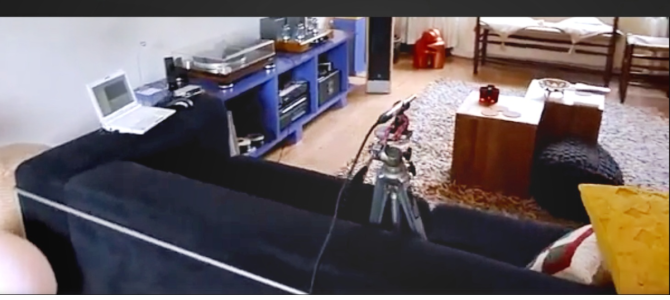
I have been measuring with a fairly cheap but OK measuring microphone from Behringer, and also the build in microphone of my Google Pixel 8 ( Android ). The results are more of less the same.

The benefit of room correctection for me, so far, is that i can play around with EQ avoiding the room's own resonance frequentie. Leave this frequenties as recommended bij measuring.
Its not perfect, but probably i prefer natural sound as is comes from my equipment.

Nice to play with these options , as s hobby. Indeed room correctection will be the more easy and affordable option.

Thrue.. i should have bought the better hifi stuff later on.. Meanwhile listening a lot with headphones. That helps a lot 😃

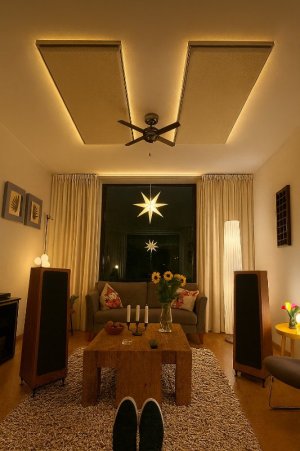
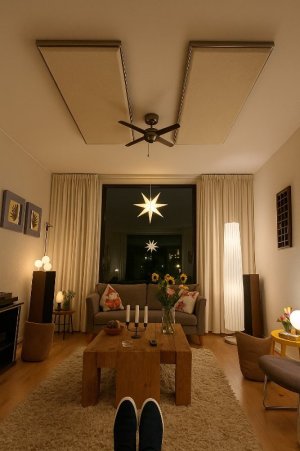
Have been thinking making a few bafflers by my own, so i asked chatTGP to render them.
Hey! It looks serieus high end.. but wil i hear any difference?

Stuff to consider, any suggestions welcome or post some of your own solutions?

Regards Sake
 

Attachments

  • Screenshot_20251205-220758 (1).png
    Screenshot_20251205-220758 (1).png
    975.9 KB · Views: 11
  • Bafflers verlichting.jpg
    Bafflers verlichting.jpg
    87.3 KB · Views: 11
  • Bafflers.jpg
    Bafflers.jpg
    73.2 KB · Views: 11
What's "natural" about room resonances that are not present in the recording? ;)
 
Hi, Thanks all for your comments!

I have been measuring with a fairly cheap but OK measuring microphone from Behringer, and also the build in microphone of my Google Pixel 8 ( Android ). The results are more of less the same.

The benefit of room correctection for me, so far, is that i can play around with EQ avoiding the room's own resonance frequentie. Leave this frequenties as recommended bij measuring.
Its not perfect, but probably i prefer natural sound as is comes from my equipment.

Nice to play with these options , as s hobby. Indeed room correctection will be the more easy and affordable option.

Thrue.. i should have bought the better hifi stuff later on.. Meanwhile listening a lot with headphones. That helps a lot 😃

Have been thinking making a few bafflers by my own, so i asked chatTGP to render them.
Hey! It looks serieus high end.. but wil i hear any difference?

Stuff to consider, any suggestions welcome or post some of your own solutions?

Regards Sake
Note that room correction EQ like RoomFit works best once loudspeaker/subwoofer placement and listening position are optimal.
EQ can't effectively fix cancellations caused by suboptimal placement.

Also, keep in mind that room correction shouldn't normally be applied above about 200-300Hz, because in-room response measurements above that range no longer accurately represent what we hear.

The most common acoustic treatments remove some higher frequency reflections added by your room, which you might or might not like. It would definitely change the presentation, however.
 
Back
Top