RoomFit confusion

ginger_ninja

Member
Joined
Jun 22, 2024
Messages
67
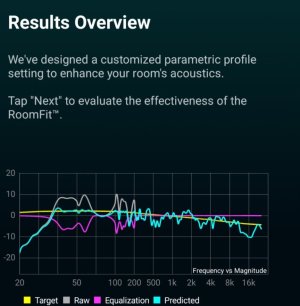
I've been reading about room correction for some time but really struggle with results, how to interpret, what is good/bad etc. I understand the theory behind it but get lost so easily! I've just run a stereo measurement using an IMM-6. 30-500hz range, max gain 6., min 12, max q 10.

My system is 2.0, Dali Oberon 5s. Here are the readings. Any insights guys? Despite hours of looking at Reddit/forums, I am still none the wiser what it means!

1000026622.jpg
 
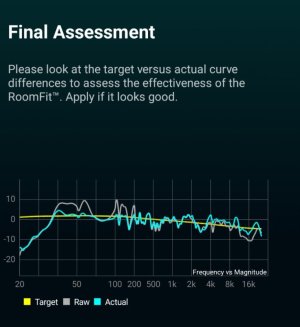
Ps I've applied the changes based on this reading. It sounds...not much different to without. The bass is a tad less boomy, I think
 
I've been reading about room correction for some time but really struggle with results, how to interpret, what is good/bad etc. I understand the theory behind it but get lost so easily! I've just run a stereo measurement using an IMM-6. 30-500hz range, max gain 6., min 12, max q 10.

My system is 2.0, Dali Oberon 5s. Here are the readings. Any insights guys? Despite hours of looking at Reddit/forums, I am still none the wiser what it means!

View attachment 33326
If you can run the "Individual Channel" variant of RoomFit we'd have a better idea of what is happening in your environment.

But generally speaking, the first step to ensure a good result is to optimize loudspeaker placement.

For a 2.0 full-range system (i.e. no sub) I'd generally advise to push the speakers almost entirely to the wall behind them (but leave about 5cm clearance to allow the back port to work properly), and ideally secure over 2m distance to sidewalls. This ensures that the notches created by acoustic interference (SBIR) with the sidewalls end up out of the usable spectrum that the speaker is able to reproduce.

Once that is done, I'd advise to use RoomFit settings recommended in this article: A Practical Guide to RoomFit™Room Correction for Enhanced Sound Quality.

Ps I've applied the changes based on this reading. It sounds...not much different to without. The bass is a tad less boomy, I think
Controlling the bass response (i.e. removing resonances to make it less boomy) is the main purpose of RoomFit, and it seems you were able to achieve that to some extent already.
Lack of bass ("bass suckout") at certain frequencies needs to be fixed by improving physical loudspeaker placement, while other acoustical issues need to be solved in other ways. Have a look at this article for an overview.

Good luck and enjoy! :)
 
Ps I've applied the changes based on this reading. It sounds...not much different to without. The bass is a tad less boomy, I think
a tad less boomy is the whole point of basic low end room correction. the less boom or "mud" in the lower and upper bass the more likely you are to hear the mids more clearly making the whole sound a bit more intelligible. with 20 presets and a whole load of options its fun to mess around, the more you play, the more you learn. And try with non-boost mode turned off, and try with some higher frequencies.
As

Dominikz above says, play with speaker placement. keep everything on the same position except one speaker several inches and you will see the frequency response change quite clearly in the low end. doing that will tech you quite a lot. one of the lessons is that its not a precise science and that sometimes a weird looking response graph and correction may sound surprisingly good.

 
Thanks folks, my room is small so am not able to movey speakers hardly at all. They are currently around 20cm from the back wall. I'll read up about what you've posted and also run the L/R measurements and post up
 
Thanks folks, my room is small so am not able to movey speakers hardly at all. They are currently around 20cm from the back wall. I'll read up about what you've posted and also run the L/R measurements and post up
I'm pretty confident you will get a result in the end thats better than no correction. good luck, and its all learning ))
 
They are currently around 20cm from the back wall.
Let me illustrate how accurately we can predict impact of placement on frequency response.

You say your speakers are 20cm from the wall behind them, and the Oberon 5 should be 28cm deep according to official specs.
That means that the woofers on the front side are approx. 48cm from the wall behind the speaker (i.e. front wall), which puts the front wall SBIR null at 179Hz.
EDIT: The calculation to get the first SBIR null frequency: (343m/s) / (4x0.48m) = 179Hz
In other words: First SBIR null = (speed of sound) / (4 x distance from wall to woofer)

Now lets check again the response you pasted in post #1:
1770130141740.png

Thanks folks, my room is small so am not able to movey speakers hardly at all.
Sure, we all have some limitations. We can just try to make the best of it, and live with what we can't change. :)
The most important thing to understand here is that RoomFit can't cheat physics - some acoustical issues simply can't be effectively solved by it, while others it can fix wonderfully.
 
Last edited:
I have heard the phrase SBIR,, but that's about it, I don't understand anything beyond that. So according to Wiim, put my Dalis close to the wall before running RoomFit? That goes against everything I've every read about speakers like this!
 
So according to Wiim, put my Dalis close to the wall before running RoomFit? That goes against everything I've every read about speakers like this!
There's unfortunately still a lot of misinformation and misinterpretation circulated by traditional HiFi manufacturers, reviewers and audiophiles - on this topic and many others. :confused:

In the past close-to-wall placement was often avoided because of the bass boost it naturally results in - this is somewhat understandable in that context. But now that we have EQ (like with RoomFit), this bass boost can actually be quite beneficial because if gives us more headroom, while EQ takes care of the excess boominess.

Further, what most people are not aware of is that putting full-range speakers less than about 2m from a wall will create a very severe bass suckout due to SBIR. Putting speakers very close to the front wall, on the other hand, pushes this SBIR null to a much higher frequency where it is less of an audible issue. Ideally the speaker is actually put inside the wall, with its face is flush with the wall - which is exactly what high-end studios do (just look up "soffit mounted monitors").

So there's really good reason to favour close-to-wall placement of speakers, especially when room correction is available. Some very competent audio manufacturers are well aware of this - e.g. have a look at placement recommendation by Genelec (link) and Neumann (link).

In case you're interested to learn more about why this recommendation makes sense, perhaps this post may help.
 
I know that Room Perfect on the 'I'll sell a kidney one day for it' Lyndorf recommends speakers against the wall before callibration, I just didn't know until today that is preferred for Room Fit. Don't remember this being the case for the previous Wiim version. I'll give it a go! Thanks!
 
Last edited:
I know that Room Perfect on the 'I'll sell a kidney one day for it's Lyndorf recommends speakers against the wall before callibration, I just didn't know until today that is preferred for Room Fit. Don't remember this being the case for the previous Wiim version. I'll give it a go! Thanks!
No problem, glad to help!

Just one more note that I'd give the exact same placement recommendation regardless which kind of room correction you end up using (RoomFit, REW, Dirac Live, Audyssey, GLM....). The placement recommendation is dictated by physics/room acoustics and system layout (bass-managed or full-range), not by the tool used to apply EQ.

Good luck and have fun! :)
 
No problem, glad to help!

Just one more note that I'd give the exact same placement recommendation regardless which kind of room correction you end up using (RoomFit, REW, Dirac Live, Audyssey, GLM....). The placement recommendation is dictated by physics/room acoustics and system layout (bass-managed or full-range), not by the tool used to apply EQ.

Good luck and have fun! :)
Personally, and we discussed about this before, there is for some of us also a 2. story to this, which is in contradiction to your recommendations.
I do understand and support your view and hear it with my own ears, however, if I put my ProAc Loadspeakers to close to the wall, I am loosing my wide and deep soundscape, which I love. I played around with it and for me the best of both worlds is around 55cm from the wall.
 
Personally, and we discussed about this before, there is for some of us also a 2. story to this, which is in contradiction to your recommendations.
I do understand and support your view and hear it with my own ears, however, if I put my ProAc Loadspeakers to close to the wall, I am loosing my wide and deep soundscape, which I love. I played around with it and for me the best of both worlds is around 55cm from the wall.
Isn’t that a product of your room? It has worked for me. Mine are, however, front ported — Revel F206.
 
Back
Top