"""Let's talk about the jitter over digital outputs. I will use the Holo Audio Spring 3 DAC which is a true NOS DAC and has an unique ability to turn off its PLL. This way I can compare a raw performance of the outputs in j-test."""
Thread of onlyoneme
This is not done in the Armim measures with his AP and by some who want to reproduce this approach with RME machines that do not allow the input " PLLs" ( strong steadyclock fs) to be turned off... etc.
We can't observe anything this way...and explains that all the digital sources tested in this way seem to have remarkable j-test results
Etc
Excuse me... I'm fed up and I'm stopping here...
Thanks for explaining your position!
IMHO this could be a constructive discussion, so I'm really sorry to see it agitated you. While it can be difficult to get our statements challenged and having to defend our positions, it is also an opportunity to sharpen our argumentation and deepen our understanding, or to learn something new and consequently change our minds (if the other side provides convincing enough arguments). My opinion is that either way we can benefit in the end, if we're open to the process.
To the topic at hand: while I have some sympathy for your position (i.e. that jitter suppression in the receiving device can hide some of the imperfections in the digital stream of the sending device), I don't agree that this automatically means there is no value in the digital output tests in ASR reviews.
From the practical example of the two streamers measured on ASR (which I posted about a few posts previously -
link to post), one shows a much better result than the other in the same test, on the same equipment, done by the same person.
So even if one dislikes the test protocol itself, IMHO the test still has value in a comparative sense - since it measures two devices under the same conditions.
However, given that we can't know how well jitter suppression will work in any random DAC we may use, jitter tests without it (such as those performed by
@onlyoneme) are interesting as well. In this sense I do agree with you.
One question though: are you certain AP digital input performs jitter suppression on the incoming digital stream of the DUT? Is this documented or discussed somewhere I could read about it?
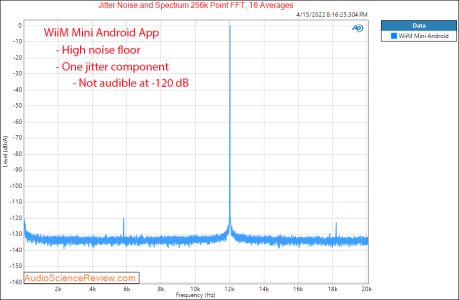
At this point I should probably add that I'm under the impression that jitter suppression is pretty common in commercial DACs (but I have no numbers to support this), and that even in tests without jitter suppression WiiM Mini seems to have inaudible levels of jitter on its digital output. If I'm reading
@onlyoneme's results correctly, WiiM Mini digital output seems to have less than 1ns of jitter, which is much less than what jitter audibility studies I've seen suggest is audible.
For those interested in the topic of jitter audibility, Archimago also has
an interesting article, complete with example audio files with different amounts of jitter added.
All that being said, many of the audio measurements compared (and discussed at length) are under what we consider to be human audibility thresholds - so you are IMO right to point out that there's no reason to treat jitter differently.




 and the actual speaker design for the M and X version is quite complex - with the extra downfiring woofer. Reminds me a bit of Buchardt and Ascilab. Paired with a powerful DSP, I'm sure they'll sound pretty neat!
