

You are using an out of date browser. It may not display this or other websites correctly.
You should upgrade or use an alternative browser.
You should upgrade or use an alternative browser.
What's your setup/configuration look like?
- Thread starter WiiM Team
- Start date


EddNog
Senior Contributor
The noise only occurs if I use my DAC as a preamp. If I use a separate preamp, there is no noise issue whatsoever from my main listening position (have not bothered testing with my ear up against the speaker--what's the point when I listen from 2 meters away?).@EddNog Your D90-III has balanced outputs, huh? I have the D90LE and noticed that in my set up it sounds better, quieter and with more gain... Used as a preamp I didn't hear the noise. No noise at all when used set to unity gain as a source into a preamp.
Really odd the number of people (not just in this forum) who question the use of a separate, analog preamp. Properly designed analog preamps are transparent and provide all the benefits of full signal attenuation (so not just the sound, but also the noise floor) not to mention the prevention of an accidental full-power signal being sent when something electronic decides to reset itself upstream.
-Ed
The noise only occurs if I use my DAC as a preamp. If I use a separate preamp, there is no noise issue whatsoever from my main listening position (have not bothered testing with my ear up against the speaker--what's the point when I listen from 2 meters away?).
Really odd the number of people (not just in this forum) who question the use of a separate, analog preamp. Properly designed analog preamps are transparent and provide all the benefits of full signal attenuation (so not just the sound, but also the noise floor) not to mention the prevention of an accidental full-power signal being sent when something electronic decides to reset itself upstream.
-Ed
I'm not questioning the use of a preamp. Indeed, I have several. Very good ones too. In the systems where I run more than one source, they are imperative. However, in the very few cases where your source has a very good analog output source with variable analog gain, then you might not need the switching preamp.
I use analog preamps because they provide a good analog drive section that is beyond what is available in the vast majority of DACs. And of course, it allows me to use the DAC as its maximum level, with no bit loss, while the preamp uses a good old high quality analog potentiometer. Plus the ability to switch sources and ancillary functionality that comes very handy.
Indeed, two of my pre amps take both SE and balanced inputs and convert all of that into SE and balanced... Meaning it will take an SE signal and generate a balanced signal... the magic of FETs and expensive transformers! They are indeed the most transparent things you'll never hear. Just switching and lots of current at a magic 2V output.
Plus, naturally, the ability to change the L/R balance -using one pot per side... just throwing money at it but it works.
Alps, Vishay, Nichikon, Edcor.... ring a bell? No remote! (*)
I have tried other setups bypassing the analog preamp as gain buffer, like the D90, the Ultra... but that's just for kicks to give them a try. They work, but not as well, they do need proper volume adjustment to drive the amps. Lower noise, some gain, isolation, etc... DACs with digital gain all have the need to be buffered from the amps.
However, there's a couple of DACs in my collection that are interesting: the Nitsch DACs provides a very good analog output with a very high quality analog pot, and in that system, right now, I'm only running the DAC as source, so a stand alone preamp just gets in the way.
Then, the Burson DAC has the Burson opamps and also a very good analog pot, but since that system has three sources, I kept an analog preamp in the system.
Oh, I lied, I got more than two... the Nuforce DACs all have analog sections with analog pots.
In general, I believe that DACs that incorporate a good headphone amp with an analog gain stage do not need an analog preamp in the chain.
There is also the issue of the tubes... two of my preamps have tubes with the teflon caps, Vishay resistor ladders, etc... they add a sound that I like... but sometimes, I don't want it...
So there. In my experience, if your DAC has a strong analog output section with an analog gain stage (pot or resistor ladder) AND your system has a single input, then you can go from DAC to amp directly. It does sound very good... and it saves you bucks and shelf space.
Oh, one more thing... the Nitsch has an analog input as well as USB... so it actually serves as a very basic preamp. Hmm... come to think about it, I might plug the FM tuner into it.
(*) I do have the parts to add a very high quality remote... one of these days I might go that route.
Last edited:
EddNog
Senior Contributor
I've personally always preferred resistor ladders over potentiometers. I do a LOT of low level listening, basically every night.I'm not questioning the use of a preamp. Indeed, I have several. Very good ones too. In the systems where I run more than one source, they are imperative.
Normally, I use them because they provide a good analog drive section that is beyond what is available in the vast majority of DACs. And of course, it allows me to use the DAC as its maximum level, with no bit loss, while the preamp uses a good old high quality analog potentiometer.
Alps anyone?
I have tried other setups, like the D90, the Ultra... but that's just for kicks to give them a try.
However,the Nitsch DACs provides a very good analog output with a very high quality pot, and in that system, right now, I'm only running the DAC as source, so a preamp just gets in the way.
-Ed
I edited the post while you were posting. Added the resistor ladder.
Yes, I got resistor ladders in two or my preamps. Vishay. Don't ask. One was the SE version option.. the other, in the DYI preamp, was something I wanted.
Simply put, the best volume controls you will NEVER hear.
Oh more... both of my current DIY phono preamps also use Vishay resistor ladders. Absolutely NO NOISE.
Yes, I got resistor ladders in two or my preamps. Vishay. Don't ask. One was the SE version option.. the other, in the DYI preamp, was something I wanted.
Simply put, the best volume controls you will NEVER hear.
Oh more... both of my current DIY phono preamps also use Vishay resistor ladders. Absolutely NO NOISE.
EddNog
Senior Contributor
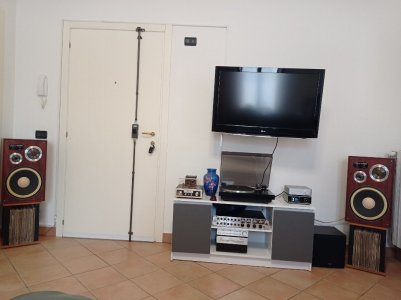
Lovely setup
They are really beautiful aren’t they?! And sound very good to my ears. Very pleased!Love those Leaks!!
-Eric
My favorite speakers. Also the cats favorite.
Hello
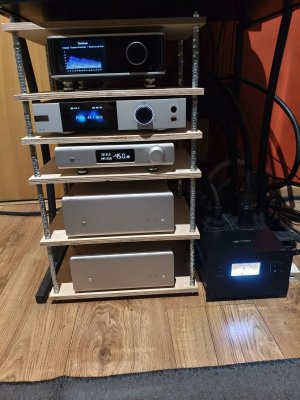
Here's my set.
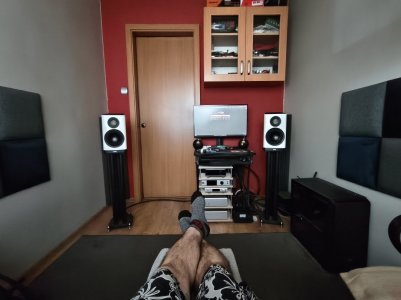
Have you thought of putting a rug between you and the speakers?
It will help control the reflections off the floor and make for a better soundstage
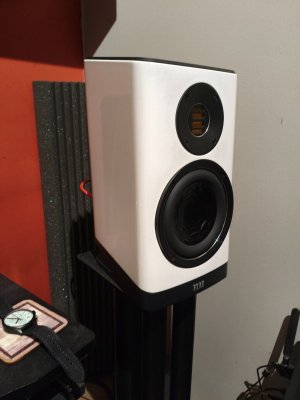
Hi, there's carpet. In the photo with the speaker, you can even see the foam bass trap behind it. I have some knowledge of acoustic treatment. Best regards.Have you thought of putting a rug between you and the speakers?
It will help control the reflections off the floor and make for a better soundstage
Hi, there's carpet. In the photo with the speaker, you can even see the foam bass trap behind it. I have some knowledge of acoustic treatment. Best regards.
OK, I see... your picture wasn't quite clear. However, with the foam behind the speakers... remember the old LEDE (Live End, Dead End) layout? I've always kept the wall behind the speakers live and then placed a couch and some stuff on the back wall. It doesn't have to absorb, it can also just diffuse... In fact, we put a 6'x4' curved curio cabinet on the far wall.
I also have bass traps for the front corners... used to, I ended up modifying the furniture to break up the corners and act as diffusors.
What I've found over the years, is that diffusion is better as it makes the room more efficient while controling the reflections that affect the soundstage.
The carpet and a couch and some absorption along the side walls also work very good.
Since you're damping the wall behind the speakers, how does the other side of the room look like?
Nice speakers.... I've been meaning to get a set of those. Carinas, huh?

Very nice!
I also like that ‘stack-rack’ - sort of a nutty industrial sheik.
dangermouse
Valued Contributor
- Joined
- Jul 25, 2023
- Messages
- 395

D
Deleted member 34890
Guest
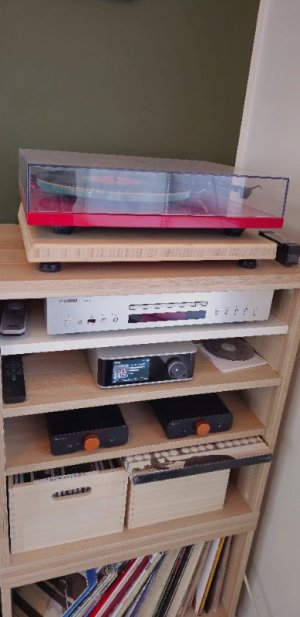
Aptitlig!Rega p3 Yamaha cd s303 wiim and 2 fosi ZA3 in mono mode with Dali Oberon 3 speakers
Last edited by a moderator:
Sarebbe fantastico vedere qualche foto della tua configurazione con il prodotto WiiM e l'esatta configurazione audio per dare ad altri idee e consigli :Freddo:.
Attachments
D
Deleted member 28380
Guest
 .
.
D
Deleted member 34890
Guest
No! This IKEA part under the turntable is "Aptitlig". That is simply the name of this part. No need to be corrected by a moderator, this part is quite famous in high fidelity circles.Appetizing!

- Joined
- Mar 2, 2024
- Messages
- 4,198
Fair enough. You could have mentioned that it was an IKEA product name.No! This IKEA part under the turntable is "Aptitlig". That is simply the name of this part. No need to be corrected by a moderator, this part is quite famous in high fidelity circles.
Similar threads

- Question
- Replies
- 36
- Views
- 2K


- Replies
- 5
- Views
- 726
- Replies
- 8
- Views
- 1K