Wiim mini jitter

"I just want an efficient basic streamer without any tinkering."
I imagine a person wanting a basic streamer and not wanting to to do any "tinkering" also wouldn't want an external DAC or "bit-perfect".
Because the easiest way to use a streamer is to use its own functions: like its DAC and volume control.
So the people you describe do want to "tinker", just in very specific ways. 😁
(And I'm practically certain that the people actively asking questions, etc., on such a forum are not representative ( ;-) ) of the majority of Wiim product buyers/users...except for those waiting for the beautiful screen with a McIntosh-style VU meter or a dancing FFT Villis :-) )
To be honest, I imagine the typical consumer buying a WiiM streamer would just use the basic functions it provides - including the built-in DAC and its own volume control. This is actually the simplest way to use it.
Which also means that as a bonus they'd avoid the pitfalls of "bit-perfect" and inter-sample overloads. Sometimes simple is actually what's best. :)
 
They just want to define an analog or digital output and that's it (and maybe not even enough volume to observe my friends around me... ) . and take advantage of the efficiency and tracking of Wiim in terms of streaming function and connection to their "box".

And I just know that this concerns far more people than just people like you, so expert and "invested".
;-)))
(But I know, as you do, the value of approaches using PEQ correction, see FIR, etc., below 300Hz... for "everyone"! (See above 1kHz for headphones if they are "minefields" in their frequency response).)
 
Last edited:
And I just know that this concerns far more people than just people like you, so expert and "invested".
;-)))
It is impossible to say for sure how many people are affected by any specific issue, because we can only guess about how people use their devices. We simply have no statistics on this, just personal experience which is anecdotal and not necessary reflective of the general population.

That being said, for any issue we discussed there are definitely people who are affected, and it makes sense to see how best to help them. After all, people are free to use their devices in any way they see fit. But it is good to be aware that some usage scenarios end up being more complicated than others (even if it may not seem so at first), and that they require some kind of configuration for optimal results.

As always, it is a fine line to walk between simplicity and advanced functionality. WiiM try to cater to both kind of consumers to some extent, which I applaud - there's not many manufacturers like that on the market. But the downside is that there is some learning curve for everyone. Such is (HiFi) life. 😁
Luckily we have this nice community where many questions can be answered by our friendly fellow members. :)

But let's perhaps not digress too much from the topic of this specific thread - in post #1 @Promso asked about a very specific issue, and setting the "Volume Limit" to a value lower than 100% seems to fully resolve that issue. So the solution is pretty simple in this case.
 
(But I know, as you do, the value of approaches using PEQ correction, see FIR, etc., below 300Hz... for "everyone"! (See above 1kHz for headphones if they are "minefields" in their frequency response).)
Indeed. It is a true challenge to make this topic more understandable and more accessible to everyone. There are improvements already, but there's still a significant way to go, IMHO!
 
But let's perhaps not digress too much from the topic of this specific thread - in post #1 @Promso asked about a very specific issue, and setting the "Volume Limit" to a value lower than 100% seems to fully resolve that issue. So the solution is pretty simple in this case.
The solution, certainly... but that doesn't mean we shouldn't try to understand what's going on here...? ;-)
Peq with positifs gains?
 
Hi Folks,
I see my question brought philosophical discussions😂

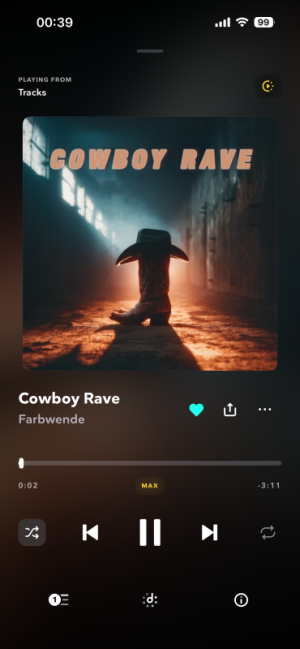
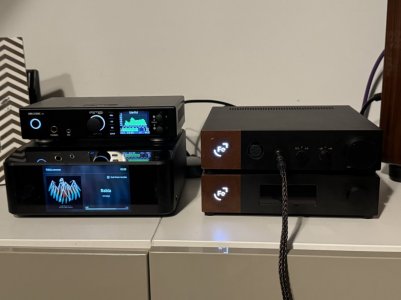
Just heads up, connected RME on my Bluesound node icon via Audioquest USB cable just to check what I have best, seems these red dots appearing as well on same songs, if you want to check go to for example this one on Tidal:
IMG_4486.png
And I hear same problems. So just wrote RME to explain what it means these dots, attached video.

But… i feel it is still sounding better than Wiim mini via optical after some AB testing with Wiim returned on fixed 100% volume. Im not that technical and cannot explain why, so asked AI:
Jitter Reduction: USB allows the RME to act as the "Master Clock" (Asynchronous mode), whereas Optical (Toslink) relies on the source's clock, which is prone to higher jitter.

No idea if this true, but probably conclusion is do not expect 10x cheaper product will give you max possible quality. I mean I love wiim mini and still will use it when icon is busy with other tasks, its my second mini, using it in office connected to active speakers, had Ultra earlier which is real bargain, but if you spent on your headphone setup like “few” k euro, be realistic and buy some streamer which has at least USB out😜

P.s. Will let you know what rme will answer.
IMG_4489.jpeg
 

Attachments

Last edited:
Hi Folks,
I see my question brought philosophical discussions😂

Just heads up, connected RME on my Bluesound node icon via Audioquest USB cable just to check what I have best, seems these red dots appearing as well on same songs, if you want to check go to for example this one on Tidal:
View attachment 33146
And I hear same problems. So just wrote RME to explain what it means these dots, attached video.

But… i feel it is still sounding better than Wiim mini via optical after some AB testing with Wiim returned on fixed 100% volume. Im not that technical and cannot explain why, so asked AI:
Jitter Reduction: USB allows the RME to act as the "Master Clock" (Asynchronous mode), whereas Optical (Toslink) relies on the source's clock, which is prone to higher jitter.

No idea if this true, but probably conclusion is do not expect 10x cheaper product will give you max possible quality. I mean I love wiim mini and still will use it when icon is busy with other tasks, its my second mini, using it in office connected to active speakers, had Ultra earlier which is real bargain, but if you spent on your headphone setup like “few” k euro, be realistic and buy some streamer which has at least USB out😜

P.s. Will let you know what rme will answer.
View attachment 33147
You could have asked AI what the red dots mean. It would have said digital clipping.
 
Jitter Reduction: USB allows the RME to act as the "Master Clock" (Asynchronous mode), whereas Optical (Toslink) relies on the source's clock, which is prone to higher jitter.

You have read the rme manual, right?
It has exceptional jitter control on spdif inputs.

"RME's SteadyClock FS guarantees exceptional performance in all clock modes. Thanks to a highly efficient jitter suppression, the DA-conversion always operates on highest sonic level, being completely independent from the quality of the incoming clock signal."

"Effective clock jitter influence on DA conversion: near zero. PLL ensures zero dropout, even at more than 100 ns jitter."

iirc, to pretty much eradicate intersample overs needs a touch over 3db headroom, so 95% volume limit is suitable.
 
Hi Folks,
I see my question brought philosophical discussions😂

Just heads up, connected RME on my Bluesound node icon via Audioquest USB cable just to check what I have best, seems these red dots appearing as well on same songs, if you want to check go to for example this one on Tidal:
View attachment 33146
And I hear same problems. So just wrote RME to explain what it means these dots, attached video.

But… i feel it is still sounding better than Wiim mini via optical after some AB testing with Wiim returned on fixed 100% volume. Im not that technical and cannot explain why, so asked AI:
Jitter Reduction: USB allows the RME to act as the "Master Clock" (Asynchronous mode), whereas Optical (Toslink) relies on the source's clock, which is prone to higher jitter.

No idea if this true, but probably conclusion is do not expect 10x cheaper product will give you max possible quality. I mean I love wiim mini and still will use it when icon is busy with other tasks, its my second mini, using it in office connected to active speakers, had Ultra earlier which is real bargain, but if you spent on your headphone setup like “few” k euro, be realistic and buy some streamer which has at least USB out😜

P.s. Will let you know what rme will answer.
View attachment 33147
@Promso The video you attached definitely looks like clipping to me. Best solution is to decrease volume until there's no clipping anymore.

As @canard asked already, do you perhaps have any EQ with positive gains configured in the WiiM Mini or the RME ADI-2 DAC?

If you do, that explains why the clipping happens. Whenever you add EQ with total gain >0dB you need to decrease the level by the same amount to avoid clipping.
This is exactly why many EQ presets found online (like e.g. from oratory1990 or AutoEQ) have a "pregain", "preamp" or "preamp gain" section telling you by how much to reduce the level to avoid clipping.
 
@Promso The video you attached definitely looks like clipping to me. Best solution is to decrease volume until there's no clipping anymore.

As @canard asked already, do you perhaps have any EQ with positive gains configured in the WiiM Mini or the RME ADI-2 DAC?

If you do, that explains why the clipping happens. Whenever you add EQ with total gain >0dB you need to decrease the level by the same amount to avoid clipping.
This is exactly why many EQ presets found online (like e.g. from oratory1990 or AutoEQ) have a "pregain", "preamp" or "preamp gain" section telling you by how much to reduce the level to avoid clipping.
Can NOS filter on RME be the reason that I need to reduce the volume? Others turned off looks like, but will check everything again this evening.
 
Can NOS filter on RME be the reason that I need to reduce the volume? Others turned off looks like, but will check everything again this evening.
PEQ or not upstream... (?)

there are also tracks, types of music mastered without any care... just "stuffed to zero dB", without even a true peak observation... and with very, very strong dynamic compression... even the margin imposed by RME won't be enough...
So a minimum of "95%" would be very welcome.
Your clip stuck at zero dB has a serious problem... if it's not due to a "headphone correction"...is not a hardware problem too..
 
Last edited:
Can NOS filter on RME be the reason that I need to reduce the volume? Others turned off looks like, but will check everything again this evening.
If you have all DSP functions disabled in both WiiM and RME (RoomFit, PEQ, pre-gain, loudness, crossfeed, bass/treble...), then the most likely reason for clipping is the inter-sample overload that results from too loud (poorly mastered) recordings, as @canard also suggested.

Again the best solution is to just reduce the volume a bit until you don't see the red dots anymore. There's no real practical drawback to it, only potential benefits.

On a side note - NOS filter is IMHO not the best choice if you want the highest signal fidelity. NOS might give the nicest-looking impulse response (less important), but you sacrifice frequency response (more important) and it allows any out-of-band garbage to pass through.
My choice for music/media listening would therefore be the "Sharp" filter, or alternatively the "Short Delay Sharp" (in case you have a very latency-sensitive use-case like e.g. real-time monitoring while playing a music instrument through a SW plugin).
 
If you have all DSP functions disabled in both WiiM and RME (RoomFit, PEQ, pre-gain, loudness, crossfeed, bass/treble...), then the most likely reason for clipping is the inter-sample overload that results from too loud (poorly mastered) recordings, as @canard also suggested.

Again the best solution is to just reduce the volume a bit until you don't see the red dots anymore. There's no real practical drawback to it, only potential benefits.

On a side note - NOS filter is IMHO not the best choice if you want the highest signal fidelity. NOS might give the nicest-looking impulse response (less important), but you sacrifice frequency response (more important) and it allows any out-of-band garbage to pass through.
My choice for music/media listening would therefore be the "Sharp" filter, or alternatively the "Short Delay Sharp" (in case you have a very latency-sensitive use-case like e.g. real-time monitoring while playing a music instrument through a SW plugin).
How long will you continue to assist each other with such patience and skill, when so often those asking questions are asked to spend little more time searching for information themselves?
Often, it only takes a few clicks, etc... tempting them not to even make the effort...
"An expert on hand"
(personalized assistance "roomfit" and co...)

that's really a delicate balance to strike... "help" and here it's all about ....just ...."hi-fi"
;-)

Very friendly and admiringly...

Simplified approaches? "Roomfit" presets for the main scenarios, etc.? This should really be developed by Wiim to handle non-expert approaches......*
A priority now...and not so simple to achieve properly, think about it...

(*I say this mainly in case subwoofer processing becomes successful in the future...because otherwise it's only really conceivable in cases without subwoofers)
 
Last edited:
RME answer:
“As long as it doesn’t say “OVR”, overload, all is good.

But if you would apply a filter with some amplification, the output could overload.

So you always need to keep the balance between the input level and the output level.“

So probably i need new ears😂 thanks everyone!
 
RME answer:
“As long as it doesn’t say “OVR”, overload, all is good.

But if you would apply a filter with some amplification, the output could overload.

So you always need to keep the balance between the input level and the output level.“

So probably i need new ears😂 thanks everyone!
I wonder if RME used AI to answer 🤣. Did they explain what the red dots meant?
 
Back
Top