

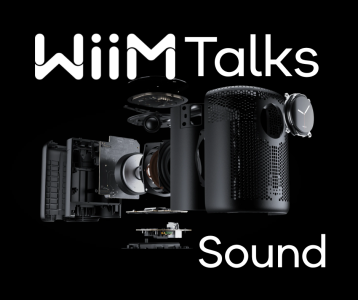
We sat down with our Product Manager to get the inside story on WiiM Sound and WiiM Sound Lite. You asked great questions about design choices, surround sound setups, and where the product line is headed. Here's what we learned.
Thanks again for all your questions. We couldn't get to everything, but we covered the big topics. If there's something we missed, drop it in the comments and we'll see what we can do next time.
Ryan: Before we get too deep, let's start with the basics. We just announced both the WiiM Sound and the WiiM Sound Lite. What's the difference between the two?
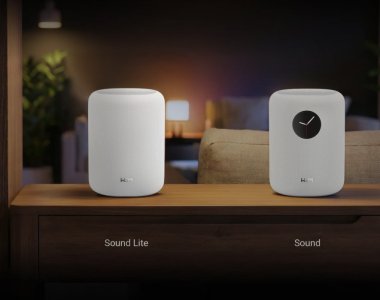
Product Manager: The Sound Lite is essentially the same speaker without the screen and remote. Same drivers, same amplification, same AI RoomFit, same sound quality. We built it for people who don't need on-device control or who already have a preferred way to manage their music. Maybe they're always using their phone anyway, or they've got voice control set up throughout the house. The Lite gives them the same audio performance at a lower price point. The Lite is also a great choice for surround speakers or other applications where the screen isn't necessary. It's also cleaner visually if you want something more minimal. But if you value having a convenient on-device screen to use and having an included remote control, the Sound is a great choice.
Ryan: Let's start with something that's gotten a lot of attention in the community. The dual tweeter setup. What was the thinking behind this approach?
Product Manager: We wanted wide, even dispersion without sacrificing detail. A single tweeter can beam at higher frequencies, which means you lose clarity when you're off-axis. By using two tweeters working together, we spread that sound more evenly across the room. You get consistent imaging whether you're sitting directly in front or off to the side. It also helps with power handling. We can push more volume without compression or distortion.
Ryan: One of our community members asked about the DAC and audio components within the WiiM Sound? And will users be able to adjust the filters?
Product Manager: The Sound uses the TAS5825M digital amplifier; its internal filter settings can't be adjusted. That's different from some of our other products where we have more flexibility. It's a tradeoff we made to hit the size and power requirements we needed for this form factor. That said, there's a lot that can be done with RoomFit to adjust the audio, further adjustable through EQ. We also support dynamic bass adjustment based on listening volume, so bass stays full at low levels and remains controlled as volume increases. You can fine-tune the bass level to match your room and personal preference.
Ryan: The 100-watt rating stands out for a speaker this size. How do you measure that, and what does it actually mean for someone using it at home?
Product Manager: That's peak power. The maximum the amp can deliver in short bursts. It matters for dynamics. When a kick drum hits or an orchestra swells, you need that headroom to reproduce the impact without clipping. In everyday terms, it means the Sound can fill a medium-sized room with authority. You're not going to max it out unless you're throwing a party or really want to feel the bass. Most people listen at a fraction of that, but having the reserve keeps everything clean and effortless.
Ryan: Can you talk about the overall design philosophy behind the Sound?
Product Manager: Starting with the WiiM Ultra, we had a pretty simple idea: what if the speaker could tell you what it's playing without needing your phone? That screen became central to our premium product line-up. When we were designing the WiiM Sound, we knew it needed a screen and from there, we asked how to make it equally useful for someone who just wants to press play and someone who wants to dial in custom EQ curves.
I like to say that the philosophy is "immediate when you need it, deep when you want it." You can tap the screen and play music in seconds, or you can open the app and tune every frequency band. Both paths are valid.
Ryan: With so many features and settings, what were the critical must-haves for launch?
Product Manager: Three things. First, it had to sound good. Not just good, but really good. This is our first all-in-one speaker and it needed to make a statement. So everything started there and we knew we'd be able to rely on AI RoomFit. Since it's compact, we knew people would place this on shelves, counters, corners, wherever it fit. We needed automatic correction so it sounds good no matter where it lands.
Second, the screen had to be genuinely useful, not just decorative. That meant touch controls for playback, source switching, and Quick EQ right on the device.
Third, it needed to expand on the existing WiiM product lineup. We already had streamers and amps. The Sound had to work seamlessly with those products while also standing on its own. That meant full multi-room support, the ability to integrate into surround setups, and maintaining the same open platform philosophy. Google Cast, Spotify Connect, TIDAL Connect, Roon... If you already have WiiM devices, adding a Sound should feel natural. If this is your first WiiM product, it should work perfectly standalone.
Ryan: The industrial design is striking. Walk us through the design process. Any particular inspirations or challenges?
Product Manager: We looked at a lot of midcentury audio gear and modern minimalist furniture. The goal was something that felt substantial but not imposing. The round display was a challenge. Round screens are harder to source and more expensive, but we felt it was worth it. It softens the whole design and makes the speaker feel more like an object you'd want out in your space, not hidden away. The fabric wrap was another deliberate choice. It's tactile, it's warm, and it diffuses the light from the screen in a way that feels natural. We tested dozens of weave patterns before landing on this one.
Ryan: Are there plans for additional colors beyond black and white?
Product Manager: We're watching the response closely, and we put out a poll as well to see what people were most interested in. We will explore some limited edition colors as a possibility. The challenge is inventory and minimum order quantities. Adding a third or fourth color means more SKUs, more logistics, more risk. But if the community really wants something specific, we're open to it. We've considered limited editions before for other devices too.
Ryan: There's been a lot of discussion about AirPlay. Can you share anything about its possible inclusion in future products?
Product Manager: We're going to keep working with Apple to get future WiiM devices certified for AirPlay. We'd love to make the devices as open and flexible as possible. While it wasn't possible with the WiiM Sound, there are still plenty of ways to connect such as Alexa and Google Cast, Spotify Connect, Bluetooth, DLNA, and many more choices.
If you're locked into AirPlay, you have a couple of workarounds. The simplest is Bluetooth pairing directly to your device. Or you can use the Aux Line-In with an AirPlay-capable device. You can also group the Sound with another AirPlay-enabled WiiM device and use that to receive the AirPlay and transmit it using WiiM multiroom. It's not native, but it works.
Ryan: How does the WiiM Sound fit into multi-room and surround setups? Could two Sounds work as front speakers for a WiiM Ultra, for example?
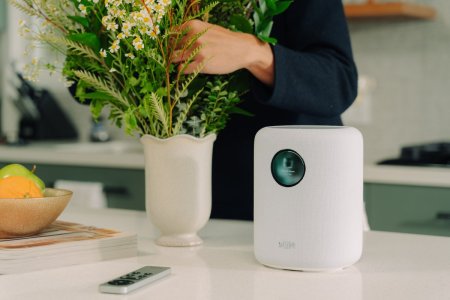
Product Manager: In WiiM configurations you can interchangeably configure WiiM Sound and WiiM Sound Lites. Two Sounds or Sound Lites can pair for true stereo, which opens up the sound stage and gives big improvement over a single speaker. For surround, you can use a pair of Sounds as surrounds or as a center channel in a 5.1 setup with compatible WiiM components. As front speakers for a WiiM Ultra, that's not a supported configuration right now. The Amp Ultra is designed to drive passive speakers, and the Ultra pairs with amplified speakers as a source. The ideal surround setup depends on your space, but it’s probably integrating them as surrounds in a larger system with a WiiM Amp Ultra, Amp Pro, or Ultra handling the fronts. And then adding a WiiM Sound or other WiiM device as the center channel.
Ryan: Is the WiiM Sound the start of a speaker family? Are other bookshelf or floor-standing variants in the works?
Product Manager: We're definitely thinking about expansion. The Sound proved there's an appetite for powered speakers with smart features and serious sound quality. Different form factors make sense. A bookshelf version could appeal to people who want more power or better bass extension. A smaller version could be interesting, as could a battery-powered option. We're not announcing anything yet, but the architecture is scalable. If the response to the Sound and Sound Lite is strong, you'll see more.
Ryan: How do you balance advanced features with simplicity? What guides your decisions about what makes it into the product?
Product Manager: We ask two questions. First, does this make the core experience better for most people? Second, can we hide the complexity until someone needs it? AI RoomFit is a great example. Running it is just a few taps. The app does the rest. But if you're an enthusiast, you can see the correction curve and adjust it manually. Same with EQ. Quick EQ on the screen gives you bass, treble, and a few presets. The app gives you a full parametric EQ to play with.
We don't force everyone to become an audio engineer, but the tools are there if you want them. We're going to keep improving the experience and making things easier, but backed by real science and not marketing hype. We also have a major roadmap for automatic acoustic tuning in home theater systems. These enhancements will be delivered through future firmware and app updates, bringing smarter calibration and more consistent sound performance over time.
Ryan: What's your vision for the music library interface? Are you considering more customization or better ways to browse?
Product Manager: The library experience needs work. We know that. Right now it's functional, but it's not delightful. We want to make it easier to explore your collection, create smart filters, view by decade or mood, that kind of thing. Album art should be bigger and more prominent. Navigation should feel effortless. We'll keep working to find ways to improve the interface without overcomplicating things.
Ryan: Looking ahead, what excites you most about where the WiiM Sound and the broader product line are heading?
Product Manager: Honestly, it's seeing people use these products in ways we didn't fully anticipate. The flexibility is the point. We're building tools, not appliances. The Sound and Sound Lite are just the beginning and we’ll add more devices and refine the software in the future so the whole system gets smarter. That's what keeps me excited. We're not done. Not even close.
Ryan: Thanks for taking the time to sit down with us and answer questions from the community! Lots of exciting things coming down the road in 2026 from what I've seen, can't wait!
Product Manager: You're welcome. And yes, lots coming down the line! We'll get some of our roadmaps updated as well, I know people are asking to get a glimpse and the last ones we shared are a bit old.
Last edited:


 . Been there, forgot to recharge, swearing.....
 .
. Well, if you have that problem - presumably, you'll run the cables in anyway, so that they stay charged.... Or just buy the powered version!

 & I speak as an ex-60 a day man


