Dayton microphone on Wiim amp ultra to improve Roomfit?

Would adding a quality microphone like the Dayton audio iMM-6c to my iPhone, improve the Roomfit measurements?
That depends on how well the generic iPhone mic calibration matches the mic in your specific phone. If it matches well, then there won't be much difference.

A calibrated measurement microphone like the iMM-6c would however give you more confidence that the response you measure is reliable. IMHO that alone is worth the investment.

Will it equate to better sound?
Not necessarily.
It might be almost identical if your iPhone mic matches the generic calibration well.
Otherwise there could be some tonality difference between the calibrations made with and without the external mic, which you may or may not prefer.
 
I am using an iPhone 16 Pro Max to do the calibration. I wonder what the quality of the microphones of my phone is like, if it is close enough.
 
I am using an iPhone 16 Pro Max to do the calibration. I wonder what the quality of the microphones of my phone is like, if it is close enough.
It is possible that is is pretty close - but it is unfortunately impossible to know for sure without comparing how it does against an individually calibrated microphone.
 
I guess there must be members with iphones AND external microphones that can at least give some hints? If I remember well, iphone owners have not much to complain. I myself did all the measurements only with my iphone16 and I am pretty happy! I only correct up to 300Hz and there mainly because of room modes. It is much better with roomfit and with these measurements. If it would be even better, maybe. But I have to say, probably not much…
 
I guess there must be members with iphones AND external microphones that can at least give some hints? If I remember well, iphone owners have not much to complain. I myself did all the measurements only with my iphone16 and I am pretty happy! I only correct up to 300Hz and there mainly because of room modes. It is much better with roomfit and with these measurements. If it would be even better, maybe. But I have to say, probably not much…
If the iPhone mic deviates from the stock calibration that likely just results in slightly different overall bass level (some examples of the effect here).
But bass level is anyway subject to preference, and should therefore be tuned to taste (here's instruction for that).
So I don't really see it as a question of better vs worse. Instead an individually calibrated mic gives us a known point of reference - I personally find value in that.
 
Last edited:
You have no way of knowing what the pickup pattern is like in a phone, or the frequency response. They might even use multiple mics to get some specific directional response to maximize call quality. They might also roll off low and high frequency response to minimize wind noise. That alone is reason to use a calibrated mic because the calibration will be for a specific orientation of the microphone. The UMIK-1 mic, for example, has two calibrations- one for pointing the mic at the source and the other for pointing it straight up. When they start supplying that sort of thing for a phone, a phone's mic will be good. Don't hold your breath.
 
I used to use the iPhone 14 pro for calibration, but now I use the iMM-6C. This improved the quality of the low-frequency correction, which is even noticeable by ear. Although I thought that WiiM takes into account the decrease in frequency response of phone microphones at low frequencies.
 
I used to use the iPhone 14 pro for calibration, but now I use the iMM-6C. This improved the quality of the low-frequency correction, which is even noticeable by ear. Although I thought that WiiM takes into account the decrease in frequency response of phone microphones at low frequencies.
Frequency response of which phone? Held in what specific orientation relative to the sound source?
Speakers have specific radiation patterns, meaning the frequency response varies depending on the angle at which you sample it. Microphones have similar directional patterns in their frequency response.
 
Frequency response of which phone? Held in what specific orientation relative to the sound source?
Speakers have specific radiation patterns, meaning the frequency response varies depending on the angle at which you sample it. Microphones have similar directional patterns in their frequency response.
No. Here, a omnidirectional microphone (are used at a point considered for listening....roomcorrection)
 
@mrehorst I used the upward direction for both the iPhone and the external microphone with the calibration file. However, the iPhone found fewer bass frequencies in my room, which caused them to increase unnecessarily when using RoomFit. Of course, if desired, this could be fixed using EQ.
 
@mrehorst I used the upward direction for both the iPhone and the external microphone with the calibration file. However, the iPhone found fewer bass frequencies in my room, which caused them to increase unnecessarily when using RoomFit. Of course, if desired, this could be fixed using EQ.
Perhaps it is worth adding that either vertical or horizontal mic orientation can produce very similar steady-state in-room magnitude frequency responses, as long as the appropriate calibration file is used (0° cal file for horizontal mic orientation, 90° cal file for vertical mic orientation).

Some explanation, links and examples can be found in this post.
 
as long as the appropriate calibration file is used (0° cal file for horizontal mic orientation, 90° cal file for vertical mic orientation).
Hmm, for my iMM-6C, the manufacturer's website states that it is omnidirectional and I can only get one calibration file using SN. The calibration file and when downloading it do not specify which angle the file should be used for.
 
Hmm, for my iMM-6C, the manufacturer's website states that it is omnidirectional and I can only get one calibration file using SN. The calibration file and when downloading it do not specify which angle the file should be used for.
If it is not specified then it is typically a 0° cal file, meaning that the microphone is intended to be used horizontally.

But as @canard already explained, the influence of mic orientation is not significant at low frequencies, which is where we perform room correction.
The impact of mic orientation will be visible at high frequencies, which would be attenuated if you used vertical mic orientation with a 0° calibration file.
This is actually visible in your measurements here (the drop above 6kHz).
 
In low-frequency use, there will be no impact " for cal "between 0 and 90 degrees...rest assured.
You can use cal at 0 in 90degres if <300hz ;-)
This is my experience also with the iphone mic. It did not matter much if I held it in direct listening position or let‘s say in 45degree angle of it… (for bass response)
 
If it is not specified then it is typically a 0° cal file, meaning that the microphone is intended to be used horizontally.

But as @canard already explained, the influence of mic orientation is not significant at low frequencies, which is where we perform room correction.
The impact of mic orientation will be visible at high frequencies, which would be attenuated if you used vertical mic orientation with a 0° calibration file.
This is actually visible in your measurements here (the drop above 6kHz).
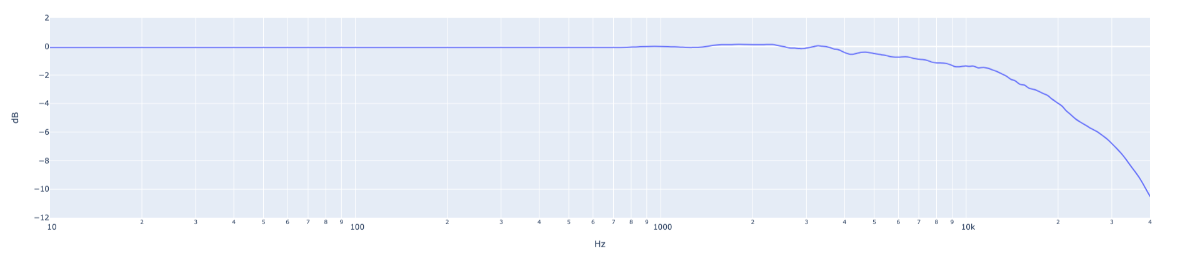
example:
Here's a typical 90-degree response from a high-performance omni measurement microphone, normally very linear up to 30 kHz... just indicative...
;-)
(But I think I've already posted it here...)
Responses above 1 kHz are not relevant to our corrections... not a topic

But Umik offers 0 and 90 degrees, if that's any reassurance.
;-)
 

Attachments

  • 90_Degree__Typical_Response.PNG
    90_Degree__Typical_Response.PNG
    26.1 KB · Views: 14
Last edited:
I've use the Dayton Audio mic with Android and a quick test with an audio analyzer outside of the Wiim app showed me the internal microphone basically cut off both the low- as well as the top end. IIRC anything above 16 kHz was not picked up. And that made a noticeable difference for Roomfit.
 
Small ps:
It's very easy to view -observe your cal files in REW.
;-)
 
Back
Top