Important subject...about dac level etc etc

The -3dB -4dB default setting, as some do, is a wise precaution... but forget about bitperfect, etc., and it allows for even more precise measurements of the precautions to be taken with positive-gain PEQs, etc.

(I'm hardly concerned because I mainly listen to "auto-leveled" radio stations or acoustic music on these streamers ;-) )


We need to see how this is handled by streaming providers...the key point...


The enormous irony is that these issues are mainly present with music in very narrow dynamic ranges... it's crazy... (Analog and its clipping management made much more sense in this case...)

(If these aspects are not taken care of...we can imagine that it is not necessarily completely upstream in the production chain in certain cases...)

(I invite you to go see the current discussion on asr on this subject quite essential...)
 
Last edited:
The -3dB -4dB default setting, as some do, is a wise precaution... but forget about bitperfect, etc., and it allows for even more precise measurements of the precautions to be taken with positive-gain PEQs, etc.

(I'm hardly concerned because I mainly listen to "auto-leveled" radio stations or acoustic music on these streamers ;-) )


We need to see how this is handled by streaming providers...the key point...


The enormous irony is that these issues are mainly present with music in very narrow dynamic ranges... it's crazy... (Analog and its clipping management made much more sense in this case...)

(If these aspects are not taken care of...we can imagine that it is not necessarily completely upstream in the production chain in certain cases...)

(I invite you to go see the current discussion on asr on this subject quite essential...)
Replaygain should probably help in these cases but interesting to see the Tracy Chapman track mentioned in the article actually has a positive Replaygain value making the situation worse.
 
Replaygain should probably help in these cases but interesting to see the Tracy Chapman track mentioned in the article actually has a positive Replaygain value making the situation worse.
Even though I shouldn't be concerned... I'm at 94%... as a minimum precaution ;-)
 
Output levels in my WiiM devices rarely (if ever) go above 50%, so I don't really concern myself with digital overload at all. :)

It can be a legitimate problem to those who keep the output at 100% and control their system volume elsewhere, however!
 
The -3dB -4dB default setting, as some do, is a wise precaution... but forget about bitperfect, etc., ...
It's impossible by definition to take measures against the ISO present in a digital recording and to keep it bit perfect at the same time. Audiophiles should be aware of this. They can't have it all at the same time. :)
 
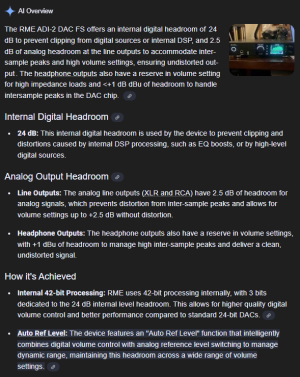
There are (external) DACs that have this headroom built in. For example, the RME ADI-2 DAC FS.

View attachment 27866

-Ed
even 2.5db seems insufficient in many cases ;-)
With the 32 bits of the Wiim, considering a +-4.5db (92-93%) doesn't seem stupid for those who listen to a lot of rock, pop, etc.
;-)
 
even 2.5db seems insufficient in many cases ;-)
With the 32 bits of the Wiim, considering a +-4.5db (92-93%) doesn't seem stupid for those who listen to a lot of rock, pop, etc.
;-)
I wonder how/if this even manifests in a system like mine (zero DAC; Marantz M1 amplifier is straight PCM to PWM, pure digital input, with global feedback).

-Ed
 
even 2.5db seems insufficient in many cases ;-)
With the 32 bits of the Wiim, considering a +-4.5db (92-93%) doesn't seem stupid for those who listen to a lot of rock, pop, etc.
;-)
and here I forget the complexity induced by the positive corrections, and positive pregain etc... (hence the interest of the true peak overload of "my current blabla" in gentle monitoring)
 
even 2.5db seems insufficient in many cases ;-)
With the 32 bits of the Wiim, considering a +-4.5db (92-93%) doesn't seem stupid for those who listen to a lot of rock, pop, etc.
;-)
2.5dB? The post you quoted stated 24dB for digital sources.
 
I wonder how/if this even manifests in a system like mine (zero DAC; Marantz M1 amplifier is straight PCM to PWM, pure digital input, with global feedback).

-Ed
If volume control is digital it shouldn't manifest at all, unless you crank the volume to maximum. :)
even 2.5db seems insufficient in many cases ;-)
With the 32 bits of the Wiim, considering a +-4.5db (92-93%) doesn't seem stupid for those who listen to a lot of rock, pop, etc.
;-)
IMHO it is a bit overstated to say that +2,5dB inter-sample peak (ISP) headroom is "insufficient in many cases".
In Archimago's article we can see that in most genres +2,5dB ISP headroom handles >99% of tracks in his library without any overload at all.
For the few ISP-heavy genres +2,5dB was still plenty for the vast majority of tracks specifically:
  • Electronica: ~94% of tracks with ISP below +2,5dB
  • Rap / Hip-Hop: ~97% of tracks with ISP below +2,5dB
  • Pop: ~98% of tracks with ISP below +2,5dB
So again we see that a very small proportion of all tracks require more than +2,5dB headroom for ISP.
If we're being honest, even 0,5-1dB of ISP headroom would cover most of the tracks. +4,5dB would certainly be a very safe margin, but also a bit of overkill. Most well-recorded and well-produced music will not have a lot of ISP.

Note also that whichever value for ISP headroom you select, you will probably find some track that needs more. The question is only where we should draw the line.

But again, ISP headroom in general is only important if the user sets the digital volume to 100%. E.g. people who buy-into the "bit-perfect" story may override digital volume controls and use an analog volume control downstream instead. These people may indeed suffer from inter-sample peak overload distortion and so may want higher ISP headroom in their DAC; but one may argue that the simpler solution would be to just use the digital volume control instead. The impact to SNR by using a digital volume control is irrelevant in practice, and you avoid the issue altogether. But anyway, that's just my two cents. 🤷‍♂️

and here I forget the complexity induced by the positive corrections, and positive pregain etc... (hence the interest of the true peak overload of "my current blabla" in gentle monitoring)
Any boosts have to be compensated by pregain and/or volume if one wishes to be certain to avoid any chance of overload, indeed.
But I don't see that DAC ISP headroom changes that consideration significantly. If you take this approach you just need to add a few dB on top to cater for any potential ISP.
 
If volume control is digital it shouldn't manifest at all, unless you crank the volume to maximum. :)...
This thing has a ton of, "gain;" I have the maximum volume capped at 50% and there's literally only like 4 tracks in my entire collection that I ever listen to at 100% in order to hit 90dB peaks at my main listening position 8 feet away from the speakers/sub. I never have to worry about clipping despite using DIRAC Live.

-Ed
 
This thing has a ton of, "gain;" I have the maximum volume capped at 50% and there's literally only like 4 tracks in my entire collection that I ever listen to at 100% in order to hit 90dB peaks at my main listening position 8 feet away from the speakers/sub. I never have to worry about clipping despite using DIRAC Live.

-Ed
Just a note that gain and power are not the same thing. I.e. an amp with a lot of gain may actually clip more easily than an amp with low gain - since it will be easier to push a high-gain amp into maximum power.
Whether or not you hit clipping depends (at least) on DL/PEQ boosts, digital volume level, amplifier gain, amplifier power and speaker sensitivity.
But with level limited to 50% you are most probably safe on all points. :)
And for the few tracks that require more level, those are probably such quiet recordings that again there's no need to worry.
 
If volume control is digital it shouldn't manifest at all, unless you crank the volume to maximum. :)

IMHO it is a bit overstated to say that +2,5dB inter-sample peak (ISP) headroom is "insufficient in many cases".
In Archimago's article we can see that in most genres +2,5dB ISP headroom handles >99% of tracks in his library without any overload at all.
For the few ISP-heavy genres +2,5dB was still plenty for the vast majority of tracks specifically:
  • Electronica: ~94% of tracks with ISP below +2,5dB
  • Rap / Hip-Hop: ~97% of tracks with ISP below +2,5dB
  • Pop: ~98% of tracks with ISP below +2,5dB
So again we see that a very small proportion of all tracks require more than +2,5dB headroom for ISP.
If we're being honest, even 0,5-1dB of ISP headroom would cover most of the tracks. +4,5dB would certainly be a very safe margin, but also a bit of overkill. Most well-recorded and well-produced music will not have a lot of ISP.

Note also that whichever value for ISP headroom you select, you will probably find some track that needs more. The question is only where we should draw the line.

But again, ISP headroom in general is only important if the user sets the digital volume to 100%. E.g. people who buy-into the "bit-perfect" story may override digital volume controls and use an analog volume control downstream instead. These people may indeed suffer from inter-sample peak overload distortion and so may want higher ISP headroom in their DAC; but one may argue that the simpler solution would be to just use the digital volume control instead. The impact to SNR by using a digital volume control is irrelevant in practice, and you avoid the issue altogether. But anyway, that's just my two cents. 🤷‍♂️

The irony is that the bitperfect quality sought after in the name of "HQ" quality, etc., in the case of the music concerned, actually induces distortion... which doesn't seem to bother much...
the impact of the loudness war being the thing to prefer...
Funny...

Any boosts have to be compensated by pregain and/or volume if one wishes to be certain to avoid any chance of overload, indeed.
But I don't see that DAC ISP headroom changes that consideration significantly. If you take this approach you just need to add a few dB on top to cater for any potential ISP.
just the sum of the two...our DSP side tinkering if in positive gain....and original ISP....
Justbecome more difficult to grasp..
that's just my point
;-)
 
The irony is that the bitperfect quality sought after in the name of "HQ" quality, etc., in the case of the music concerned, actually induces distortion... which doesn't seem to bother much...
the impact of the loudness war being the thing to prefer...
Funny...


just the sum of the two...our DSP side tinkering if in positive gain....and original ISP....
Justbecome more difficult to grasp..
that's just my point
;-)
I agree on both points. :)

EDIT: We all sometimes tend to overcomplicate so it is not strange that it happens often in the audio hobby as well. But to be fair, it is sometimes far from trivial to understand which complications are necessary and which aren't, sometimes even years of study and experimentation... But we could also say that's half the fun. :)
 
Last edited:
Just a note that gain and power are not the same thing. I.e. an amp with a lot of gain may actually clip more easily than an amp with low gain - since it will be easier to push a high-gain amp into maximum power.
Whether or not you hit clipping depends (at least) on DL/PEQ boosts, digital volume level, amplifier gain, amplifier power and speaker sensitivity.
But with level limited to 50% you are most probably safe on all points. :)
And for the few tracks that require more level, those are probably such quiet recordings that again there's no need to worry.
I've said this myself, so that note is only useful to other readers.

My choice of the M1 was partially due to this specific issue. I was simply not happy with the lack of gain on the Topping monoblocs I was previously using. Sticking in an analog preamp between my DAC and monoblocs was just extra complication for silly reasons. With reasonably efficient speakers as I have, it was kind of ridiculous having a gain problem, but there lies the issue when applying DIRAC Live or other forms of room correction. Just a major consumption of headroom as the cost of getting the sound right in a non-ideal room (and not all of us can just pick and choose/build a dedicated listening space, we have lives outside of music listening).

I rolled the dice when I decided to audition the M1 because I had read that it utilizes direct to digital amplification (PWM to PCM, no analog input at all) with global feedback (a concept similar to the PFFB circuit on WiiM Amp Pro/Amp Ultra/Vibelink that ensures no load dependency on frequency response) while integrating DIRAC Live correction and support for Qobuz Connect and UPnP all in one convenient box. If it sounded good enough/transparent, and had sufficient gain and power, then I was in.

It took only one listen to know I'd found I wanted.

Then it took another week to realize that the hardware is amazing but the software is shit.

So here I am feeding the M1 with the Eversolo T8 set to fixed maximum volume and zero filters/processing enabled. Let the T8 handle purely getting the music and the M1 purely putting the sound out. And it's working great so far (at last).

-Ed
 
I agree on both points. :)

EDIT: We all sometimes tend to overcomplicate so it is not strange that it happens often in the audio hobby as well. But to be fair, it is sometimes far from trivial to understand which complications are necessary and which aren't, sometimes even years of study and experimentation... But we could also say that's half the fun. :)
And wait, with all that... you're forgetting the additional layer that Wiim adds to all this...
The impact of DRC...!
Not so trivial because all this clearly shows that, contrary to what seems to be assumed, there are solid reasons to be very involved... What behaviors should we adopt when faced with ISP...? ISP + pregain?
ISP + pregain and positive DSP? Etc...!

How can we approach the levels to avoid all this!?
Doesn't it lead to a real lack of ability to observe overload levels in a relevant way?

In any case, and I don't have the time to devote to this right now... but there's a serious reason to look into its impacts...

Intelligent autogain/peq is a minimum requirement for our PEQ-related tinkering to be fairly transparent...
Pregain and ISP would generally be quite understandable if done alone...
But DRC, precisely because of its operation, is a real pain that can make everything confusing.

The remaining need is to be able to disengage this DRC by choice, and probably in a "basic" way so that Truepeak overload is available for all WiIMs...
(unless you do as I do at the most basic level, internal of plus... without PEQ with positive gains, nor positive pregain, etc., running it as a precaution at 93%, for example...)

The impact of this DRC, given the possibility of DSP and ISP manipulations, would require serious observation...
I know some people here capable of tackling it ;-)

Sorry for my writing...
(Hoping that at least the general idea is understood... ;-) )

a very simplified, non-expert mode, ensuring disengagement of the DSP and pregain functions etc, basic input/output side, and a -3db type would perhaps be a good thing for many... ( + sub for ultra)
I'm not sure that the passionate actors in our discussions " dsp etc etc" here are so representative of the majority of Wiim buyers
;-)
The box of good ideas each has its limits, and even more so if Wiim struggles to bring certain difficult ones to fruition...

 
Last edited:
And wait, with all that... you're forgetting the additional layer that Wiim adds to all this...
The impact of DRC...!
Not so trivial because all this clearly shows that, contrary to what seems to be assumed, there are solid reasons to be very involved... What behaviors should we adopt when faced with ISP...? ISP + pregain?
ISP + pregain and positive DSP? Etc...!

How can we approach the levels to avoid all this!?
Doesn't it lead to a real lack of ability to observe overload levels in a relevant way?

In any case, and I don't have the time to devote to this right now... but there's a serious reason to look into its impacts...

Intelligent autogain/peq is a minimum requirement for our PEQ-related tinkering to be fairly transparent...
Pregain and ISP would generally be quite understandable if done alone...
But DRC, precisely because of its operation, is a real pain that can make everything confusing.

The remaining need is to be able to disengage this DRC by choice, and probably in a "basic" way so that Truepeak overload is available for all WiIMs...
(unless you do as I do at the most basic level, internal of plus... without PEQ with positive gains, nor positive pregain, etc., running it as a precaution at 93%, for example...)

The impact of this DRC, given the possibility of DSP and ISP manipulations, would require serious observation...
I know some people here capable of tackling it ;-)

Sorry for my writing...
(Hoping that at least the general idea is understood... ;-) )

a very simplified, non-expert mode, ensuring disengagement of the DSP and pregain functions etc, basic input/output side, and a -3db type would perhaps be a good thing for many... ( + sub for ultra)
I'm not sure that the passionate actors in our discussions " dsp etc etc" here are so representative of the majority of Wiim buyers
;-)
The box of good ideas each has its limits, and even more so if Wiim struggles to bring certain difficult ones to fruition...
As I stated before in several discussions we had on this topic, I disagree with you that DRC makes anything worse or more complicated.
On the contrary, my opinion is that it is a very helpful safeguard, especially for users that aren't deeply technical.

Regarding how to handle this complexity in general, the answer seems fairly obvious to me:
  • Prefer single-box solutions over chaining multiple audio devices (wherever possible).
  • Use the WiiM digital volume control for overall system level control.
  • Calibrate your system so you never need more than about 70% volume in WiiM, even when listening loud.
  • Use the "No-Boost Mode" in RoomFit.
  • Avoid using positive gain values in input pre-gain.
With the above you can even add significant boosts in EQ without running into level limitting.

But I know this approach goes against the typical audiphile advice so I'm sure some people will argue against it. 🤷‍♂️

Lastly, as I said before I do agree with you that overload indication in WiiM Home app would be helpful, and I also wouldn't mind having the option of autogain, or to be able to disable and enable the DRC/limiter.
Though I'd personally prefer to see some other features first.
 
As I stated before in several discussions we had on this topic, I disagree with you that DRC makes anything worse or more complicated.
On the contrary, my opinion is that it is a very helpful safeguard, especially for users that aren't deeply technical.

Regarding how to handle this complexity in general, the answer seems fairly obvious to me:
  • Prefer single-box solutions over chaining multiple audio devices (wherever possible).
  • Use the WiiM digital volume control for overall system level control.
  • Calibrate your system so you never need more than about 70% volume in WiiM, even when listening loud.
  • Use the "No-Boost Mode" in RoomFit.
  • Avoid using positive gain values in input pre-gain.
With the above you can even add significant boosts in EQ without running into level limitting.

But I know this approach goes against the typical audiphile advice so I'm sure some people will argue against it. 🤷‍♂️

Lastly, as I said before I do agree with you that overload indication in WiiM Home app would be helpful, and I also wouldn't mind having the option of autogain, or to be able to disable and enable the DRC/limiter.
Though I'd personally prefer to see some other features first.
Have you observed what happens at say 0.5db 1.5db 3db 6db 9db overload?
The comportement in level etc ;-)
 
Last edited:
Back
Top