Using a WiiM Mini or WiiM Ultra over optical into a Vibelink Amp

Burnside

Major Contributor
Community Curator
Joined
Jul 27, 2024
Messages
7,093
Location
Scotland
After seeing a query elsewhere and watching the video linked below, I asked AI whether you’d experience any difference feeding a Mini or Ultra over optical into a Vibelink amp. Here’s the response:


“Based on the principles of modern DAC design highlighted in the video above, the VibeLink Amp as a modern competently designed DAC should yield identical results regardless of whether the source is a WiiM Mini or a WiiM Ultra.

Why the Clock Doesn't Matter

The ESS ES9039Q2M DAC inside the VibeLink is an asynchronous system. It does not "slave" its conversion timing to the incoming S/PDIF clock from the Mini. Instead:
  • The Buffer: It pulls the data into a FIFO (First-In, First-Out) buffer.
  • The Reclocking: It uses its own high-precision internal oscillator to "clock out" that data for conversion.
  • Jitter Rejection: The ESS Time Domain Jitter Eliminator identifies the timing inconsistencies (jitter) of the Mini and strips them away before the audio reaches the analogue stage.
The "Competent Design" Verdict

Because the digital data (the 1s and 0s) sent by a Mini and an Ultra are identical—and both are bit-perfect—the VibeLink’s hardware buffer ensures that any "wobble" in the Mini's cheaper clock never reaches your speakers. In this scenario, the VibeLink acts as the "master" of timing, rendering the source's clock quality irrelevant.

The only real-world exception would be if the Mini's clock was so unstable that it caused the VibeLink's buffer to underflow or overflow (leading to a total dropout), but for standard music playback, this is virtually non-existent in modern gear.”

Discuss (20 marks), maybe after watching the video from around 16 minutes in…
 
Ah, so it's me she's talking about... It seems to me there's nothing "eminent" about it.

PS: That's a non-issue...
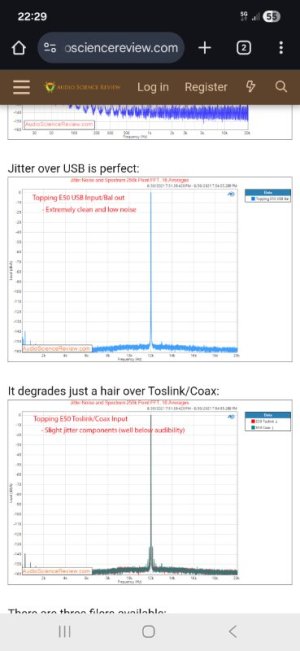
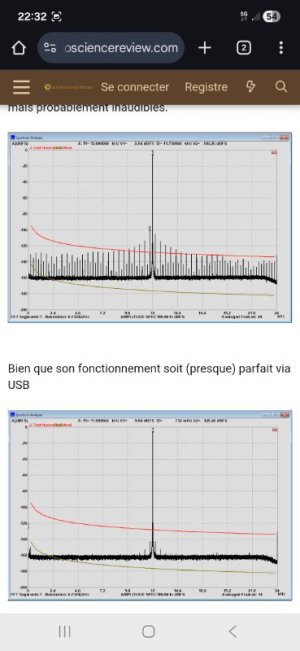
Example: If the reasoning were correct on a modern DAC... how would you explain this?
Dozens of cases if you closely examine sites like ASR...
From what you've written, there shouldn't be, couldn't be, any difference... But there is...
(Why is another matter...)
Factual
Etc
Etc
Etc...
 

Attachments

  • Screenshot_20260202_222920_Chrome.jpg
    Screenshot_20260202_222920_Chrome.jpg
    46 KB · Views: 15
  • Screenshot_20260202_223252_Chrome.jpg
    Screenshot_20260202_223252_Chrome.jpg
    46.4 KB · Views: 15
ask AI how would you turn the Vibelink back on once it goes into "deep sleep" , when using a Mini as a source -
using the button on its back? or maybe the app, though it sometimes disappears from there
 
ask AI how would you turn the Vibelink back on once it goes into "deep sleep" , when using a Mini as a source -
using the button on its back? or maybe the app, though it sometimes disappears from there
Irrelevant to the question being asked.
 
Irrelevant to the question being asked.
the topic of this is thread is "Using a WiiM Mini or WiiM Ultra with a Vibelink Amp". using a Mini with the Vibelink means the requirement for physical accessibility to the amp in order to turn it on . this should be clearly noted before any recommendation on this "combo"
 
the topic of this is thread is "Using a WiiM Mini or WiiM Ultra with a Vibelink Amp". using a Mini with the Vibelink means the requirement for physical accessibility to the amp in order to turn it on . this should be clearly noted before any recommendation on this "combo"
Dorsn‘t the Vibelink have auto-sensing for its optical in?
And how would it wake up when connected to an Ultra?
Ah, I see. It has a trigger in.
 
Last edited:
the topic of this is thread is "Using a WiiM Mini or WiiM Ultra with a Vibelink Amp". using a Mini with the Vibelink means the requirement for physical accessibility to the amp in order to turn it on . this should be clearly noted before any recommendation on this "combo"
I've edited the subject line to reflect the topic described in the post itself to better focus responses
 
Last edited:
I've edited the subject line to better reflect the topic described in the post itself to better focus responses
As much as I‘m in your boat, but what do you want to hear?

Personally I‘d have no problem with connecting even a badly measuring streamer to a DAC or amp/DAC combo that I trust.
My former Squeezebox Touch would most probably not stand a chance on ASR today. Would I still use it? Yes I would. Via coax out into my Lyngdorf SDA-2400. Would I notice a difference vs. my current Ultra? No, I wouldn‘t.

But I‘m one of those dinosaurs that also doesn‘t care for high-res. 48/24 is top-of-the-line for me. I had 192/24 and 96/24 downloads. I resampled them to 48/24. No frills and KISS is my mantra. This saves me a lot of trouble and pondering over technical BS that only costs money but has no practical effect. I prefer to focus on features (or those which I don‘t need) these days.
 
Last edited:
I couldn't quite grasp what this video was saying, so I had Gemini watch it and verify it for me.

Response.
"To get straight to the point, the content presented in this video is an extremely accurate and logically sound explanation within the context of modern digital audio technology."


Btw, I also had them verify this Amp Ultra review from What Hi-Fi.


Response.
"To conclude, the What Hi-Fi? review exhibits **strong subjective impression manipulation, with numerous instances of statements contradicting scientific facts (measurement values) or lacking factual basis.**"


Sorry 😂


Full text here..

Specifically, their abstract criticisms—such as "lack of dynamics" and "failing to evoke emotion"—directly contradict the actual measurement data indicating **extremely high fidelity (transparency).**

1. Verification of Scientific Validity (Errors and Points of Criticism)

① Evaluation: "Dynamic expression is suppressed"

Review Content: "It struggles to convey subtle changes in volume (dynamics), resulting in a lack of emotional impact in music."

Scientific Error: * Fact: Third-party measurements (SINAD over 100dB, SNR over 120dB) confirm this amplifier achieves exceptionally low noise and distortion far exceeding the audible range.

Point: The perception of "lacking dynamics" likely stems from the ears misinterpreting the "natural sound" – where no specific frequency band is emphasized due to extremely low noise and distortion – as "insufficient." Scientifically, this represents the most faithful reproduction of the input signal; no physical behavior indicating the amplifier "suppresses" dynamics is observed.


② Evaluation: "The sound is thin and lacks body"

Review Content: "Overall balance is good, but the sound is slightly thin in an absolute sense and lacks a sense of presence."

Scientific Misconception:

Fact: Frequency response measurement data is perfectly flat within ±0.1dB to ±0.5dB across the 20Hz to 20kHz range.

Point: There is no factual reduction in specific bands (like mid-low frequencies). This is merely describing the absence of "additional noise from specific distortions (like even-order harmonics)" as "thin." Scientifically, this is "accurate reproduction," and there is no physical basis for the claim that the sound is thin.


③ Evaluation that "RoomFit robs the system of agility"

Review Content: "Using RoomFit increases the weight in the low frequencies, but it robs the presentation of agility."

Scientific validity and errors:

Partially valid: Applying room correction (DSP) introduces phase shifts and filter processing, so a change in perceived "crispness" is physically possible.

Point: However, RoomFit is designed to suppress room standing waves (booming). When correctly configured, it should eliminate "unclear low frequencies," actually enhancing agility. Perceiving this as "deterioration" may stem from mistaking the "excessive energy from room resonance" present before correction for "agility."


2. "Unscientific" Points in the Review

As part of What Hi-Fi?'s traditional tendencies, the following "unscientific biases" are present:

"Price-appropriate" bias: They tend to write reviews under the assumption that "it can't be perfect at this low price." While the TPA3255 chip and PFFB (Post-Filter Feedback) technology used in the WiiM Amp Ultra deliver measurement results comparable to high-end amplifiers, acknowledging this would undermine the position of premium units costing thousands of dollars. Therefore, they deliberately use abstract language to emphasize a perceived "class" difference.

Lack of Blind Testing: Evaluations like "doesn't resonate emotionally" are influenced by visual bias from knowing the product's design and price. If a scientific double-blind test were conducted, it's highly likely this amp would be indistinguishable from others in the same price range or higher.


Conclusion: While the What Hi-Fi? review is an interesting read, it lacks technical accuracy. Based on measurement data, the WiiM Amp Ultra is a "high-performance amplifier at a price-disrupting level." The flaws they point out are actually the flip side of its "lack of distortion."


Sorry 😂
 
As much as I‘m in your boat, but what do you want to hear?

Personally I‘d have no problem with connecting even a badly measuring streamer to a DAC or amp/DAC combo that I trust.
My former Squeezebox Touch would most probably not stand a chance on ASR these days. Would I still use it? Yes I would. Via coax out into my Lyngdorf SDA-2400. Would I notice a difference vs. my current Ultra? No, I wouldn‘t.
Basically what people thought of the assertion that "the VibeLink Amp as a modern competently designed DAC should yield identical results regardless of whether the source is a WiiM Mini or a WiiM Ultra" when using an optical connection.

In part the question came from a query elsewhere where someone had been gifted a Vibelink Amp and hadn't realised that it didn't have a streamer component. Leaving aside the obvious connectivity and feature set differences, the Mini was coming in for criticism as not being as good a source as a WiiM device further up the range. As I believe this forum is the pre-eminent source of expertise for WiiM advice, I was interested in the views of fellow members here particularly in light of the statements made in the video.
 
I couldn't quite grasp what this video was saying, so I had Gemini watch it and verify it for me.

My helicopter view or takeaway from the video was that a modern competently designed DAC (like the Vibelink's DAC) thru its use of PLL and buffers practically eliminates any source timing or jitter errors, even over SPDIF, no matter how poor the source's clock is. With that in mind, even the humble Mini could feed a Vibelink over optical and there'd be no benefit - for that use case - using any of its better specced streamer siblings.
 
Last edited:
I said here a long time ago that I feel this is one of the fundamental questions related to modern hifi, but one which much of the hifi press seem to go to great lengths to try and avoid answering. Namely, purely from a sound quality perspective, is there any advantage to having a DAC fed by a more expensive bit-perfect digital source? So would, say, music from a modern DAC fed by optical from a WiiM Mini sound any different to being fed by a Cyrus 40 ST at roughly 25 times the price? I cannot recall reading that sort of comparison before. Indeed, most reviews of expensive streamers concentrate solely on their line output, which is after their internal DAC.

But if streamers’ bit-perfect digital outputs are all able sound basically the same then it has serious implications for the hifi buying public. Again, from purely a sound quality point of view, why then pay large sums for an individual streamer or CD player component rather than buy products like WiiM’s and spend the money saved on a really good DAC, whether that be stand alone or in an amplifier?

It would be good to have an unbiased answer.
 
I said here a long time ago that I feel this is one of the fundamental questions related to modern hifi, but one which much of the hifi press seem to go to great lengths to try and avoid answering. Namely, purely from a sound quality perspective, is there any advantage to having a DAC fed by a more expensive bit-perfect digital source? So would, say, music from a modern DAC fed by optical from a WiiM Mini sound any different to being fed by a Cyrus 40 ST at roughly 25 times the price? I cannot recall reading that sort of comparison before. Indeed, most reviews of expensive streamers concentrate solely on their line output, which is after their internal DAC.

But if streamers’ bit-perfect digital outputs are all able sound basically the same then it has serious implications for the hifi buying public. Again, from purely a sound quality point of view, why then pay large sums for an individual streamer or CD player component rather than buy products like WiiM’s and spend the money saved on a really good DAC, whether that be stand alone or in an amplifier?

It would be good to have an unbiased answer.
Watch the video above and see what you think. I found it presented quite a compelling case and would be interested whether some of our more experienced and knowledgeable members would support or refute its assertions, particularly when an spdif connection is being used.
 
I'm pretty sure I've posted this before, but it's relevant here.


Also, any "Smart" TV these days can perfectly reproduce the much more demanding HD video from a streaming service like Amazon, from hundreds of miles away, with likely tons of jitter, perfectly. Jitter is a solved problem.
 
I couldn't quite grasp what this video was saying, so I had Gemini watch it and verify it for me.

Response.
"To get straight to the point, the content presented in this video is an extremely accurate and logically sound explanation within the context of modern digital audio technology."


Btw, I also had them verify this Amp Ultra review from What Hi-Fi.


Response.
"To conclude, the What Hi-Fi? review exhibits **strong subjective impression manipulation, with numerous instances of statements contradicting scientific facts (measurement values) or lacking factual basis.**"


Sorry 😂


Full text here..

Specifically, their abstract criticisms—such as "lack of dynamics" and "failing to evoke emotion"—directly contradict the actual measurement data indicating **extremely high fidelity (transparency).**

1. Verification of Scientific Validity (Errors and Points of Criticism)

① Evaluation: "Dynamic expression is suppressed"

Review Content: "It struggles to convey subtle changes in volume (dynamics), resulting in a lack of emotional impact in music."

Scientific Error: * Fact: Third-party measurements (SINAD over 100dB, SNR over 120dB) confirm this amplifier achieves exceptionally low noise and distortion far exceeding the audible range.

Point: The perception of "lacking dynamics" likely stems from the ears misinterpreting the "natural sound" – where no specific frequency band is emphasized due to extremely low noise and distortion – as "insufficient." Scientifically, this represents the most faithful reproduction of the input signal; no physical behavior indicating the amplifier "suppresses" dynamics is observed.


② Evaluation: "The sound is thin and lacks body"

Review Content: "Overall balance is good, but the sound is slightly thin in an absolute sense and lacks a sense of presence."

Scientific Misconception:

Fact: Frequency response measurement data is perfectly flat within ±0.1dB to ±0.5dB across the 20Hz to 20kHz range.

Point: There is no factual reduction in specific bands (like mid-low frequencies). This is merely describing the absence of "additional noise from specific distortions (like even-order harmonics)" as "thin." Scientifically, this is "accurate reproduction," and there is no physical basis for the claim that the sound is thin.


③ Evaluation that "RoomFit robs the system of agility"

Review Content: "Using RoomFit increases the weight in the low frequencies, but it robs the presentation of agility."

Scientific validity and errors:

Partially valid: Applying room correction (DSP) introduces phase shifts and filter processing, so a change in perceived "crispness" is physically possible.

Point: However, RoomFit is designed to suppress room standing waves (booming). When correctly configured, it should eliminate "unclear low frequencies," actually enhancing agility. Perceiving this as "deterioration" may stem from mistaking the "excessive energy from room resonance" present before correction for "agility."


2. "Unscientific" Points in the Review

As part of What Hi-Fi?'s traditional tendencies, the following "unscientific biases" are present:

"Price-appropriate" bias: They tend to write reviews under the assumption that "it can't be perfect at this low price." While the TPA3255 chip and PFFB (Post-Filter Feedback) technology used in the WiiM Amp Ultra deliver measurement results comparable to high-end amplifiers, acknowledging this would undermine the position of premium units costing thousands of dollars. Therefore, they deliberately use abstract language to emphasize a perceived "class" difference.

Lack of Blind Testing: Evaluations like "doesn't resonate emotionally" are influenced by visual bias from knowing the product's design and price. If a scientific double-blind test were conducted, it's highly likely this amp would be indistinguishable from others in the same price range or higher.


Conclusion: While the What Hi-Fi? review is an interesting read, it lacks technical accuracy. Based on measurement data, the WiiM Amp Ultra is a "high-performance amplifier at a price-disrupting level." The flaws they point out are actually the flip side of its "lack of distortion."


Sorry 😂
What were your prompts to Gemini, what did you ask precisely? Did you feed it a copy of the text (what-hifi article) or just dumped the link in it or otherwise? I'm really impressed by its explanations/conclusions.
 
What were your prompts to Gemini, what did you ask precisely? Did you feed it a copy of the text (what-hifi article) or just dumped the link in it or otherwise? I'm really impressed by its explanations/conclusions.
I don’t necessarily trust simple AI searches, but can find that a conversation with ChatGPT or similar, particularly when you question, challenge or even correct some of its responses can sometimes lead to good summations. Or maybe I keep going till it gives me an answer I like ;)
 
I don’t necessarily trust simple AI searches, but can find that a conversation with ChatGPT or similar, particularly when you question, challenge or even correct some of its responses can sometimes lead to good summations. Or maybe I keep going till it gives me an answer I like ;)
Same. I keep pushing for a straight answer. I tell it to not assume, guess or make thing up in advance and even then it sometimes goes completely off the rails. I ask for its sources often also. What I hate with a passion is that the current AI's are not AI in the literal sense. They will not learn or remember anything from corrections and information from its users. Your corrected info will not benefit others. It just goes to waste.
 
Back
Top