
Do your Mains really fall off the cliff at 4kHz??

You are using an out of date browser. It may not display this or other websites correctly.
You should upgrade or use an alternative browser.
You should upgrade or use an alternative browser.
What's your setup/configuration look like?
- Thread starter WiiM Team
- Start date
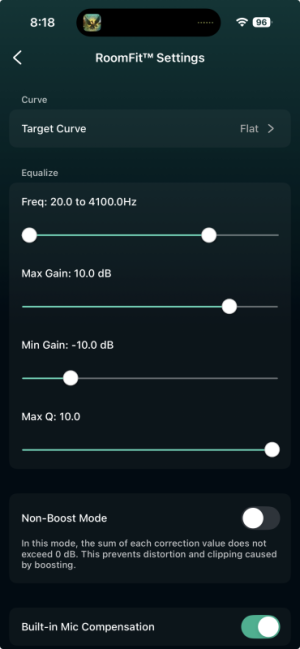
[Edit] A little research and I gather it's most likely the iPhone 14 Pro mic I'm using. I also read that I should probably drop that RoomFit EQ range down to 500Hz or so. Thoughts?Do your Mains really fall off the cliff at 4kHz??
No... Isn't that what most see at the end of a RoomFit measurement? I figured that 'cliff' is because RoomFit is only acting on / measuring frequencies up to ~4kHz (in my case - I think that's the default):
Last edited:

HansD-NL
Valued Contributor
I did not start anything and certainly not as you call it a class warfare, how you came to that conclusion is beyond me. I made a general comment on how it makes me sad the charlatans and their believers are pressuring people into buying stuff they don't need (and often can't really afford)Dude! YOU STARTED this.
You're the one that started the class warfare statement. If you disagree with me you have several options:
(1) Ignore me
(2) Reply in kind - trust me, you won't insult me. I'll actually enjoy a good discussion.
(3) Go the Miss Manners route - figures... I'll send you some smelling salts.
(4) Misconstrue the meaning and nature of my comments and start an ad hominem attack - well... see (1) above.
Get over it.
Is it possible that English is not your first language and you completely misunderstand and misrepresent the idioms and mannerisms of American English? It is a fairly direct way of expression...
( In the US, we call that statement a way to give you a graceful exit from the argument ).
Mind you, American English is my 4th language, but somehow I cultivated it since I live here.
In the meantime... I'm thinking of swapping the amp... I have this Nuforce STA-200 that I bought years ago, store demo, 400 bucks! It has no right to sound sooo good for that price. It was a steal actually.
You "Dude" are a narcissist judging by your latest comments (and heavily edited afterwards) directed at me while setting some kind of boundaries for me to react to you and the Me Me Me attitude you display in (all) your posts.
Last edited:

Ignored.
Bye.
I think I'll spend some time comparing my Pass Sony VFET amps. Two N-channels and one P-channel with different front end cards. And, funny thing is. you can't buy them. They were strictly DIY affairs.
Driving them with the WiiM and the Nitsch, which are not expensive at all... although the Nitsch is a fairly boutique brand that takes months to get one - and are semi custom.
The High End is not necessarily expensive at all, it just requires know how... and people who are addicted to consumer products will never understand that. They confuse ego, ignorance and expense with technical knowledge.
Meanwhile, I'm enjoying the Ultras and the Sound quite a lot.
Bye.
I think I'll spend some time comparing my Pass Sony VFET amps. Two N-channels and one P-channel with different front end cards. And, funny thing is. you can't buy them. They were strictly DIY affairs.
Driving them with the WiiM and the Nitsch, which are not expensive at all... although the Nitsch is a fairly boutique brand that takes months to get one - and are semi custom.
The High End is not necessarily expensive at all, it just requires know how... and people who are addicted to consumer products will never understand that. They confuse ego, ignorance and expense with technical knowledge.
Meanwhile, I'm enjoying the Ultras and the Sound quite a lot.
Last edited:
Wiim products are an phenomenal for the money - there's no question about it. I honestly feel they occupy a space now largely without any meaningful competition when you factor in overall performance, interoperability, flexibility, ease of use, and overall app functionality. My comment wasn't an attack on Wiim, just a musing about my own usage matrix vs what it tries to offer.Wiim products are a steal considering what they can do. Most people use the bells and whistles just fine. The sidelining is what you chose to do, so you made yourself sad i guess?

dominikz
Senior Contributor
- Joined
- Dec 31, 2024
- Messages
- 1,032
It is either due to the phone mic, or due to phone orientation vs speakers. For more accurate response measurement you should remove the phone protective case (if any) before measuring, and orient the bottom phone mic towards the speakers. But really the only way to get an accurate measurement is to use a calibrated measurement mic (like e.g. miniDSP UMIK-1 or Dayton iMM-6c). However that might not necessarily give you a better result after correction (that depends on how close your phone mic response is to the calibrated mic at low frequencies - this is unfortunately impossible to tell, it varies from phone to phone)![Edit] A little research and I gather it's most likely the iPhone 14 Pro mic I'm using.
RoomFit measures all frequencies regardless of settings - the "Freq" range only specifies where it applies the *correction*.No... Isn't that what most see at the end of a RoomFit measurement?
I figured that 'cliff' is because RoomFit is only acting on / measuring frequencies up to ~4kHz (in my case - I think that's the default):

Default settings in RoomFit are unfortunately far from ideal. In your case IMO there isn't much reason for correction above about 100Hz, so I'd advise to set the upper limit for correction to 300Hz (setting it lower is ignored by RoomFit - see the discussion here).The WiiM Ultra's subwoofer config/support,what I bought it for, seems to work well. I like using RoomFit targeting a Flat curve with Variable smoothing... At a 100Hz crossover for the SB100Pro and CS5-M2 mains, things seem to measure pretty well:


It is perhaps worth mentioning that the "flat" target is intended for listening in relative nearfield (e.g. desktop systems) in well-damped rooms.
If your room is a typical residential room the "B&K" target is the better choice.
Also, note that using "stereo" variant of RoomFit will give you about 3dB less bass compared to "individual channel" RoomFit even if both are run with the exact same target. This has been discussed e.g. here, with a more complete explanation here.
So a combination of "flat" target together "stereo" RoomFit might result in relative bass deficiency. However, that might just be your personal preference, and si perfectly OK! The amount of bass is anyway largely a matter of personal preference (see the large gray area in this figure which illustrates the spread of personal preference range found in research).
Lastly, have a look at this FAQ article for some practical recommendations of RoomFit settings.
(I'd just recommend "variable" over "1/12" smoothing - the FAQ article was written before "variable" became available.)
Hope this helps!
Thank you for your detailed response!It is either due to the phone mic, or due to phone orientation vs speakers. For more accurate response measurement you should remove the phone protective case (if any) before measuring, and orient the bottom phone mic towards the speakers. But really the only way to get an accurate measurement is to use a calibrated measurement mic (like e.g. miniDSP UMIK-1 or Dayton iMM-6c). However that might not necessarily give you a better result after correction (that depends on how close your phone mic response is to the calibrated mic at low frequencies - this is unfortunately impossible to tell, it varies from phone to phone)!
RoomFit measures all frequencies regardless of settings - the "Freq" range only specifies where it applies the *correction*.
I had assumed the old flagship iPhone's mic was up to the task... As you suggest, it might not be impacting the results too badly (and it's certainly more objective than my human ears ;-). I had also assumed the case removal was a good idea, but I'm afraid I got lazy about removing the thick leather case with each RoomFit iteration (I guess I'll just use the phone naked 'til I'm past this
 ). After voicing my RoomFit frequency-of-interest speculation, I realized it wouldn't drop off with such a curve across ignored frequncies.
I'm glad you mentioned this - my Flat curve choice is driven by my desire to get things as close to 'studio-neutral' as possible with RoomFit, then adjust preference with EQ. Because my Ultra-connected SVS subwoofer on the ground floor is also supporting two (WiiM Pro-connected) stereo speakers aimed at my Loft listening area directly above it, I accept that would be applying a PEQ to boost the bass to a compromise between the two floors... which segues to your next point:Default settings in RoomFit are unfortunately far from ideal. In your case IMO there isn't much reason for correction above about 100Hz, so I'd advise to set the upper limit for correction to 300Hz (setting it lower is ignored by RoomFit - see the discussion here).
It is perhaps worth mentioning that the "flat" target is intended for listening in relative nearfield (e.g. desktop systems) in well-damped rooms.
If your room is a typical residential room the "B&K" target is the better choice.
Interesting about the bass reduction in stereo RoomFit vs mono... ironically my recent challenge had been controlling the bass room gain in this space... it's a smooth but unfinished concrete floor with 20" of painted concrete at the base of the walls. I initially used a Fosi SW10 subwoofer (bottom firing; rear-ported) that had its gain/volume dialed down and RoomFit still worked to control the bass. I replaced the floor-standing Fosi with an SVS SB-1000 Pro, which I placed off of the concrete floor on my 'shelf of sound'Also, note that using "stereo" variant of RoomFit will give you about 3dB less bass compared to "individual channel" RoomFit even if both are run with the exact same target. This has been discussed e.g. here, with a more complete explanation here.
So a combination of "flat" target together "stereo" RoomFit might result in relative bass deficiency. However, that might just be your personal preference, and si perfectly OK! The amount of bass is anyway largely a matter of personal preference (see the large gray area in this figure which illustrates the spread of personal preference range found in research).
 . NOTE: the SVS has a "Room Gain Compensation" switch that I turned on at 25Hz - this made life easier for RoomFit.
Anyway, I'll be reading your links and revisiting the following now that I have started running RoomFit 'mono & mono', but here's what I've been applying on my downstairs Ultra [post-Flat & Variable-RoomFit] in order to restore the weaker bass mix that I had noticed while helping the upstairs speakers in the Speaker Group cope with my unfinished Juniper wood decking between listeners and the subwoofer:
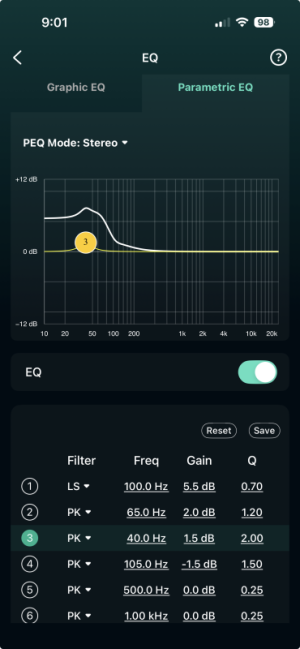
I saved this as "PostRoomFitBassBump". Also, the 2 speakers in the loft get a steep HPF at 100z and a few other tweaks in a PEQ table applied at the WiiM Pro. I've heard vague references to a 'multi-RoomFit' for speaker groups with 'overlapping zones' like mine. In fact, I've noticed that the WiiM Pro's speakers in my active Speaker Group actually do participate in the Ultra's "Subwoofer and Speakers Sync" process. IOW, I can sit in my loft listening area and do the SubSpeakerSync in the active Speaker Group, and measured a 2ms subwoofer delay there (less than most of the downstairs).
I certainly will look at the FAQ, and your reply has helped! Thanks againLastly, have a look at this FAQ article for some practical recommendations of RoomFit settings.
(I'd just recommend "variable" over "1/12" smoothing - the FAQ article was written before "variable" became available.)
Hope this helps!

I gather the Q Concerto Meta has an easier division of labor for the Uni-Q coaxial drivers... The LS50 apparently has a somewhat beefed up Uni-Q driver as it does heavier bass extension duty down to ~90Hz or so by design, whereas the Concerto's woofer's crossover with the Uni-Q is at ~450Hz. I suspect the Concerto's Uni-Q barely moves in comparison to the LS50's. Any idea why the LS50 Meta is currently the more expensive choice?Q Concerto Meta is a nice, solid buy at open-box pricing. Doesn't give up a ton to R3 Metas, and would pair up really nicely to SB-1000 Pro. The imaging ability of KEF Uni-Q is straight-up legendary--you will LOVE it if you do it! Doesn't have the headroom/bass limits of LS50 Meta, yet doesn't particularly give up a ton in terms of accuracy or detail extraction versus LS50 Meta; having owned LS50 Meta in the past, I'd take Q Concerto Meta over it any time, day, or place.
Last edited:
@BMeek I've wondered about the location of your woofer up on the wall.
Most subwoofers -in a box- are designed to be on the floor, along the back wall, so they "see" a quarter of the room. Your location is such that the woofer sees half the room. This might make the bass frequency response a little lumpier as now you have to deal with bass reflections from the floor...
Have you played with locating the new woofer on the floor?
Most subwoofers -in a box- are designed to be on the floor, along the back wall, so they "see" a quarter of the room. Your location is such that the woofer sees half the room. This might make the bass frequency response a little lumpier as now you have to deal with bass reflections from the floor...
Have you played with locating the new woofer on the floor?

EddNog
Senior Contributor
Maybe not so much now, but in the past, the LS50 Meta were in the same class/grouping as the Blades 1 and 2 Meta on their web site. The cabinet construction as well as grade of Uni-Q driver on the LS50 Meta are more in line with the Blades Meta than with the Q series. If you open up the LS50 Metas, the quality of build and materials (crossovers, enclosures, etc.) is closer to R Meta series than to Q Meta series. Basically you're paying for better quality components, materials, and build.I gather the Q Concerto Meta has an easier division of labor for the Uni-Q coaxial drivers... The LS50 apparently has a somewhat beefed up Uni-Q driver as it does heavier bass extension duty down to ~90Hz or so by design, whereas the Concerto's woofer's crossover with the Uni-Q is at ~450Hz. I suspect the Concerto's Uni-Q barely moves in comparison to the LS50's. Any idea why the LS50 Meta is currently the more expensive choice?
-Ed
Since we seem to constantly bring up KEF.... the only ones that interest me are the KEF LS60 Wireless. but I don't know you can stream Tidal Connect to them.. .and I don't see how to get my turntable, FM tuner and NAS into them.
Indeed, how can you connect analog sources into any of the wireless speakers from KEF?
Indeed, how can you connect analog sources into any of the wireless speakers from KEF?
Last edited:
Most subwoofers are too damn big to sit on a shelf@BMeek I've wondered about the location of your woofer up on the wall.
Most subwoofers -in a box- are designed to be on the floor, along the back wall, so they "see" a quarter of the room. Your location is such that the woofer sees half the room. This might make the bass frequency response a little lumpier as now you have to deal with bass reflections from the floor...
Have you played with locating the new woofer on the floor?
. I have a 2" thick; 16" deep; 8' wide shelf mounted to 6 studs.Actually, my concrete floor and basewall is really super-gain-inducing. By getting the subwoofer up to speaker level, there's certainly been a change in the boundary gain - from 2-3 boundaries (floor+wall+ sidewall [if in the corner]) to only the back wall and shelf on either side of the subwoofer. This likely reduces the total room gain by approximately 3-6db in the lowest octaves, so it seems this leaner room response allows the sub's driver to articulate more detail vs. just pressurizing the room.
Also, the subwoofer placement is proving to be a great benefit to the loft listening area... Here's a somewhat wide-angle view of what I'm dealing with:
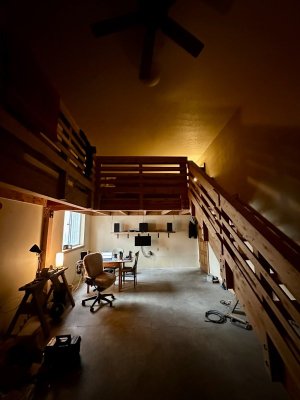
Anyway, having the subwoofer centrally placed seems to be working real well. Things sound great. I'm just tweaking settings and considering speaker upgrades because... you know
 .
.
EddNog
Senior Contributor
One of these?Since we seem to constantly bring up KEF.... the only ones that interest me are the KEF LS60 Wireless. but I don't know you can stream Tidal Connect to them.. .and I don't see how to get my turntable, FM tuner and NAS into them.
Indeed, how can you connect analog sources into any of the wireless speakers from KEF?

MINIDSP Adept ADC & Phono Preamp Review
This is a review and detailed measurements of the MINIDSP Adept analog to digital converter and phono equalization/capture. It was sent to me by the company and costs US $299. The device is rather attractive for its class. User interface though, is unusual. You push the rotary encoder in and...
www.audiosciencereview.com
So with the Concerto, I may be replacing the LS50 Uni-Q's sweet spot between 100-500Hz with the aluminum woofer's output on the Concertos. I had been leaning toward the LS50's lower Uni-Q driver height, and depending on their wider directivity, given that they'll be elevated at standing/barstool ear-level, when I also spend a fair amount of time listening at a lower off-axis seating position.Maybe not so much now, but in the past, the LS50 Meta were in the same class/grouping as the Blades 1 and 2 Meta on their web site. The cabinet construction as well as grade of Uni-Q driver on the LS50 Meta are more in line with the Blades Meta than with the Q series. If you open up the LS50 Metas, the quality of build and materials (crossovers, enclosures, etc.) is closer to R Meta series than to Q Meta series. Basically you're paying for better quality components, materials, and build.
-Ed
One of these?
MINIDSP Adept ADC & Phono Preamp Review
This is a review and detailed measurements of the MINIDSP Adept analog to digital converter and phono equalization/capture. It was sent to me by the company and costs US $299. The device is rather attractive for its class. User interface though, is unusual. You push the rotary encoder in and...
Sort of defeats the whole purpose of having a turntable and analog signals... I guess analog and wireless just don't play together. The WiiM Ultra model works because you put move the "control" side of the wireless equation away.. while the sources, processing and speakers all stay together.
Maybe, if WiiM could produce an Ultra Sound Speaker pair....
Last edited:
EddNog
Senior Contributor
The wider range of directivity makes off-axis listening less sensitive anyway. This is the case for any coaxials. One of a multitude of reasons why I prefer coaxial speakers.So with the Concerto, I may be replacing the LS50 Uni-Q's sweet spot between 100-500Hz with the aluminum woofer's output on the Concertos. I had been leaning toward the LS50's lower Uni-Q driver height, and depending on their wider directivity, given that they'll be elevated at standing/barstool ear-level, when I also spend a fair amount of time listening at a lower off-axis seating position.
-Ed
@EddNog Coax speakers are indeed great for imaging... we have the Elac Unifi 2 and they are pinpoint. However, once you move away, say 10 feet, it doesn't make so much of a difference. Mini monitors with a tweeter placed right next to the small "woofer" image just as well as the coax designs. My AE1s belong in that genre -although a 4" woofer is sort of pushing the concept... ;-)
 www.madisoundspeakerstore.com
You ought to hear these.... ugly as sin and my wife will never let me have them in the living room... but the imaging, resolution and the voice (midrange) is fantastic...
 www.tannoy.com
BUT, the best are simply full range with no crossover. Sure they have limitations, but within those, they are simply superb. Check out the Fostex and MarkAudio speakers.
Here's a very interesting write up by Bruno Putzeys about speakers, crossovers, etc... I think you will all enjoy what he says.

 pmamagazine.org
pmamagazine.org
pmamagazine.org
Coaxial Speaker Kits | Point Source Audio | Madisound
Coaxial driver speaker kits. Time-aligned designs, KEF & SEAS-based projects. Ships worldwide. Call (608) 831-3433 for free advice.
www.madisoundspeakerstore.com
You ought to hear these.... ugly as sin and my wife will never let me have them in the living room... but the imaging, resolution and the voice (midrange) is fantastic...
Tannoy | Product | STIRLING GR-OW
BUT, the best are simply full range with no crossover. Sure they have limitations, but within those, they are simply superb. Check out the Fostex and MarkAudio speakers.
Here's a very interesting write up by Bruno Putzeys about speakers, crossovers, etc... I think you will all enjoy what he says.
Active Speakers—The Second Wave, by Bruno Putzeys, Part 1 of 2 (Unabridged)
What can active speakers do that passive ones can’t? Impulse response, impulse response, impulse response, says Bruno Putzeys. That, and their sheer practicality, makes them the wave of the future.
pmamagazine.org
Active Speakers—The Second Wave, by Bruno Putzeys, Part 2 of 2
Bruno Putzeys concludes his two-part series that explains why active speakers are inherently better than passive ones.
pmamagazine.org
Last edited:
EddNog
Senior Contributor
Those Tannoys aren’t all that different from my own speakers. MoFi SourcePoint 8, themselves just a, “miniaturized,” SourcePoint 10. Masterpiece design by Andrew Jones; I’ve endgamed with these.@EddNog Coax speakers are indeed great for imaging... we have the Elac Unifi 2 and they are pinpoint. However, once you move away, say 10 feet, it doesn't make so much of a difference. Mini monitors with a tweeter placed right next to the small "woofer" image just as well as the coax designs. My AE1s belong in that genre -although a 4" woofer is sort of pushing the concept... ;-)
Coaxial Speaker Kits | Point Source Audio | Madisound
Coaxial driver speaker kits. Time-aligned designs, KEF & SEAS-based projects. Ships worldwide. Call (608) 831-3433 for free advice.
You ought to hear these.... ugly as sin and my wife will never let me have them in the living room... but the imaging, resolution and the voice (midrange) is fantastic...
Tannoy | Product | STIRLING GR-OW
BUT, the best are simply full range with no crossover. Sure they have limitations, but within those, they are simply superb. Check out the Fostex and MarkAudio speakers.
Here's a very interesting write up by Bruno Putzeys about speakers, crossovers, etc... I think you will all enjoy what he says.
Active Speakers—The Second Wave, by Bruno Putzeys, Part 1 of 2 (Unabridged)
What can active speakers do that passive ones can’t? Impulse response, impulse response, impulse response, says Bruno Putzeys. That, and their sheer practicality, makes them the wave of the future.Active Speakers—The Second Wave, by Bruno Putzeys, Part 2 of 2
Bruno Putzeys concludes his two-part series that explains why active speakers are inherently better than passive ones.
-Ed
dominikz
Senior Contributor
- Joined
- Dec 31, 2024
- Messages
- 1,032
What I'll say will be counter-intuitive (and is often misunderstood), but I ask you to bear with meI'm glad you mentioned this - my Flat curve choice is driven by my desire to get things as close to 'studio-neutral' as possible with RoomFit, then adjust preference with EQ.
: the "flat" target won't really produce 'studio-neutral' tuning with most speakers and in most environments.While neutral, well-designed speakers are indeed tuned for flat on-axis anechoic response, due to the increasing directivity with frequency of front-facing box speakers, this flat on-axis response translates into a downward-sloping in-room response in real rooms (which include reflections). The response we measure in a room actually resembles the B&K target in many cases.
And what we measure with RoomFit is of course the in-room response (downward-sloping), not the anechoic on-axis response (flat)!
So using the "B&K" target curve actually comes closer to preserving the flat on-axis response of well-designed speakers, while trying to EQ the in-room response to "flat" can actually tilt the speaker's anechoic on-axis response to become upward-sloping (i.e. bright).
Which brings us to the next point: both "Harman" and "B&K" curves came about as an average result of many in-room responses of well-designed loudspeakers - they were not originally intended as targets for room EQ at all!
Here's a diagram showing this (from the amazing book "Sound Reproduction: The Acoustics and Psychoacoustics of Loudspeakers and Rooms" by dr. Floyd Toole):
That all being said, at very close listening distances (<1m from the speakers), and in acoustically dampened ("dead") rooms the in-room response might be similar to the anechoic on-axis response - i.e measure as "flat".
But this will not happen in most rooms people have in their homes, and at typical listening distances (>2m).
Definitely not in very reflective spaces such as yours.
In such spaces in-room response of "flat" on-axis speakers will be downward-sloping, so B&K or Harman are recommended targets to use to better preserve the "flat" on-axis response of good loudspeakers.
Here's a link to another post tackling this topic.
OK, so you found the response bass-deficient as well - that is not surprising! And I see you compensated for this with PEQ - this approach is valid as well; you can absolutely use any target in RoomFit and then use EQ to tune bass to taste.here's what I've been applying on my downstairs Ultra [post-Flat & Variable-RoomFit] in order to restore the weaker bass mix that I had noticed while helping the upstairs speakers in the Speaker Group cope with my unfinished Juniper wood decking between listeners and the subwoofer:

I saved this as "PostRoomFitBassBump". Also, the 2 speakers in the loft get a steep HPF at 100z and a few other tweaks in a PEQ table applied at the WiiM Pro.
The result will be similar to increasing sub gain and using a downward sloping curve in RoomFit from the start.
My personal preference, however, is to get the frequency balance how I like it initially with RoomFit, and then to use EQ for other purposes (e.g. loudspeaker anechoic response correction based on EQ profiles from spinorama.org).
Honestly, when I have access to room correction (like RoomFit) I usually see room gain as free headroom - so 100% a good thing.ironically my recent challenge had been controlling the bass room gain in this space... it's a smooth but unfinished concrete floor with 20" of painted concrete at the base of the walls. I initially used a Fosi SW10 subwoofer (bottom firing; rear-ported) that had its gain/volume dialed down and RoomFit still worked to control the bass.
It is also why I often recommend that people put subs in room corners. That increases their output capability significantly, and works also to avoid SBIR notches (bass suck-out) in many rooms.
It also exacerbates room resonances (peaks in response) - but those are really easy to knock down by room correction, and actually increase your clean SPL headroom further.
Corner placement of subs can be really bad without room correction, but is actually often the best choice when room correction is available. I wrote about this more in this post.
Though I should add that this is only a good solution if you do most of your listening from only one main listening location.
If you move by only 1m in any direction, the bass response changes significantly, and the RoomFit correction no longer helps as much.
Unfortunately this is not a problem RoomFit can help with in general. I wrote more about this limitation (and a few others) in this post.
So if you often listen from several locations in your space, it does make sense to sacrifice headroom to find a position that gives you more consistent response between listening positions. You'd still probably need to make a dedicated RoomFit calibration for every listening position to get the best results.
But the really ideal solution that can give a consistent bass response over a wider area is to have multiple DSP-controlled subwoofers optimized with specialized SW like MSO (more on this in this presentation by Todd Welti and this user guide by miniDSP).
Glad to hear that! Good luck!your reply has helped! Thanks again
dominikz
Senior Contributor
- Joined
- Dec 31, 2024
- Messages
- 1,032
It is worth mentioning that not everybody agrees about the importance of impulse-response fidelity, e.g.: Zero Phase In Studio MonitorsBUT, the best are simply full range with no crossover. Sure they have limitations, but within those, they are simply superb. Check out the Fostex and MarkAudio speakers.
Here's a very interesting write up by Bruno Putzeys about speakers, crossovers, etc... I think you will all enjoy what he says.
Active Speakers—The Second Wave, by Bruno Putzeys, Part 1 of 2 (Unabridged)
What can active speakers do that passive ones can’t? Impulse response, impulse response, impulse response, says Bruno Putzeys. That, and their sheer practicality, makes them the wave of the future.Active Speakers—The Second Wave, by Bruno Putzeys, Part 2 of 2
Bruno Putzeys concludes his two-part series that explains why active speakers are inherently better than passive ones.
The article contains comments by dr. Floyd Toole, dr. Wolfgang Klippel, Andrew Jones and James Croft, who based on their research all seem to suggest impulse response / phase response accuracy to be much less of a priority in loudspeakers compared to flat on-axis magnitude response and smooth directivity - both of which are not really possible with one-way, full-range designs.
And by the way, even Bruno Putzeys in the article you linked advocates multiway speakers, he just prefers crossovers done in DSP because that way the designer can optimize both magnitude and phase response, as well as directivity and distortion.
Similar threads

- Question
- Replies
- 36
- Views
- 2K


- Replies
- 5
- Views
- 726
- Replies
- 8
- Views
- 1K