RoomFit Moving Mic Measurement (beta) - improvements

dominikz

Major Contributor
Joined
Dec 31, 2024
Messages
732
Today I accidentally noticed several improvements to RoomFit Moving Mic Measurement (MMM) beta feature which seem to have been added silently at some point:
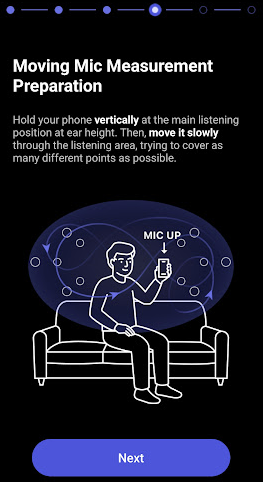
  • There's a screen now explaining how to perform MMM
    1766661824261.png
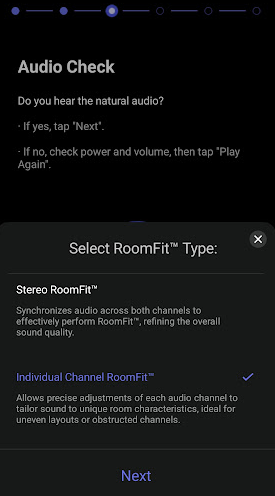
  • It is now possible to use "Individual Channel RoomFit" mode while MMM is enabled:
    1766661874911.png
  • If MMM is enabled only periodic pink noise is used to measure the response, while previously there was first a sweep and then periodic pink noise. This is a major improvement because previously sweep response was given significantly higher weight (link), decreasing the benefits of MMM.
  • If MMM is enabled periodic pink noise and MMM is also used during result evaluation!
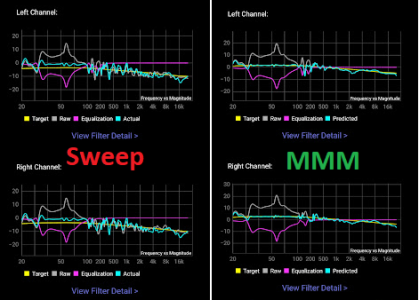
Let me try to illustrate the benefits, here's the same system measured with a single sweep vs MMM (periodic pink noise):
1766662382719.png

Both responses are quite similar below 100Hz (meaning you can use either for bass response correction), but they start to diverge above that - with MMM looking much smoother, while sweep gives an irregular/noisy response at higher freqencies.
This is because the spatial averaging of the MMM filters-out audibly benign room reflections, and gives a response that is closer to anechoic predicted in-room response. This makes MMM responses a slightly better representation of loudspeaker tonality that we actually hear.

There is one potential problem, though - in my tests when MMM was enabled, RoomFit didn't apply any correction below 30Hh, even when lower bound of the correction range was set to 20Hz. Not sure if this is intentional (i.e. due to greater sensitivity of MMM to ambient noise compared to a sweep), or if it is a bug.

All in all great work @WiiM Team @WiiM Support @jiaxin.li (WiiM) @RyanWithWiiM, thanks!
 
Last edited:
Hi @dominikz

I found it when WiiM Home App v3.4.3 arrived, so MMM seems to have been upgraded before that. I really like it.😊

When I turn MMM on before evaluation, I can use pink noise for the evaluate. (I don't remember if this was possible before.)

However, the issue where EQ turns off when evaluate is executed has not yet been fixed. The team seems to have determined that no revisions are necessary.
 
When I turn MMM on before evaluation, I can use pink noise for the evaluate. (I don't remember if this was possible before.)
I think this is new, I seem to recall that originally sweep was always used for evaluation.
However, the issue where EQ turns off when evaluate is executed has not yet been fixed. The team seems to have determined that no revisions are necessary.
That’s too bad, having the ability to evaluate RoomFit and EQ together was really convenient! Did you get some official feedback from WiiM on this?
 
A Roomfit vs rew ( in "variable") ???
(I think it will be interesting in the future to compare them with those who can implement both approaches, mmm )
;-)
 
Last edited:
I think this is new, I seem to recall that originally sweep was always used for evaluation.

That’s too bad, having the ability to evaluate RoomFit and EQ together was really convenient! Did you get some official feedback from WiiM on this?
What type of straightening are you comparing sweep vs mmm? Sure that s the same in both cases in "traitement" ?
Just question ;-)
If the MMM mode becomes truly polished, that's great news because it will probably be the preferred alternative for the vast majority of Wiim users "not expert" ;-)

But the issue of gain/level management, and of signal processing, remains unresolved.
 
Last edited:
Just wanted to express my gratitude to @dominikz and @Wiimer for all the knowledge you've passed on to some of us mere mortals. I greatly appreciate all that you contribute to this forum!
Totally agree! 👍🏻🙏🏻
That’s very kind of you to say! I'm really glad when people find some of these posts interesting!

What type of straightening are you comparing sweep vs mmm? Sure that s the same in both cases in "traitement" ?
Just question ;-)
1/12 smoothing in both cases.

If the MMM mode becomes truly polished, that's great news because it will probably be the preferred alternative for the vast majority of Wiim users "not expert" ;-)
It seems to me RoomFit MMM is pretty good already.

However single point sweep is much quicker, and since it gives very similar results to MMM at bass frequencies, in many cases it may still be a preferred choice.
Remember also that sweep is more resistant to ambient noise compared to MMM.

But I personally prefer MMM as it is easier to get repeatable results between runs, and the response looks closer to how the system sounds.

In any case, RoomFit is becoming a very powerful tool!
 
@dominikz


Do you have any recommendations for measuring MMM?
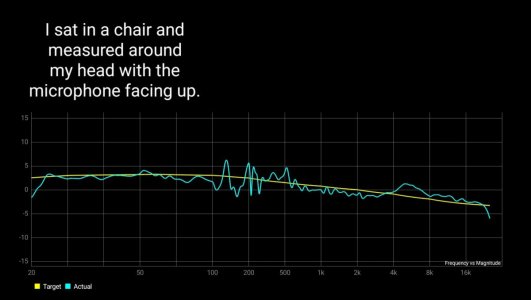
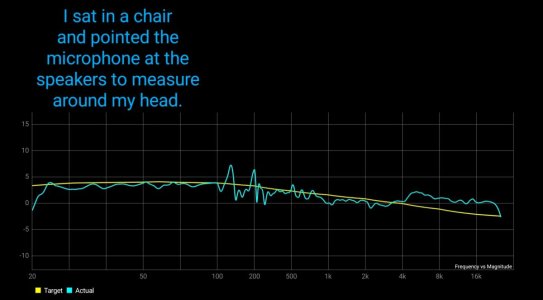
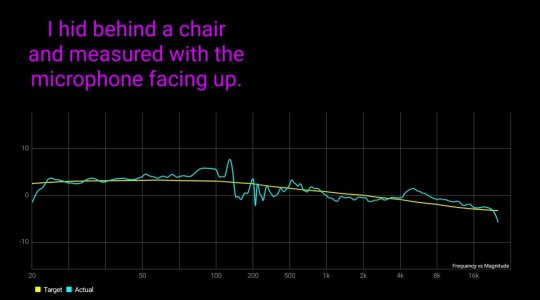
I've tried the following three methods, but each gives different results. (I'm currently using Method A.)


[A] Sit in the listening position on a chair and hold the microphone facing upward. Move the microphone around my head while keeping it upright.
7fae8bd5-c224-4a69-88b3-2e9021fe04a1-1_all_3196.jpg


Sit in the listening position on a chair, hold the microphone sideways (facing speakers), and move it around my head.
7fae8bd5-c224-4a69-88b3-2e9021fe04a1-1_all_3197.jpg


[C] Hide behind the chair and move the microphone around the position where my head is. Keep the microphone facing upward.
7fae8bd5-c224-4a69-88b3-2e9021fe04a1-1_all_3198.jpg


Comparing the 3 responses, the difference is most pronounced between 80Hz and 500Hz.

The WiiM app instructions tell us to sit on the couch and hold the microphone facing upward, so is "A" the correct method?
(I believe it used to say you should walk around the room.)
 
@dominikz

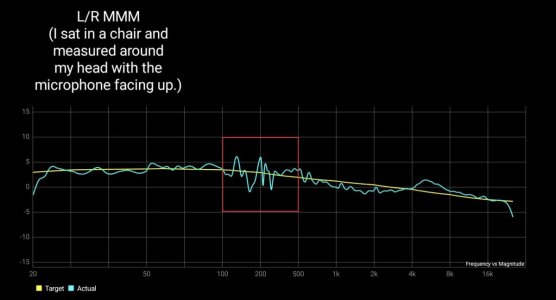
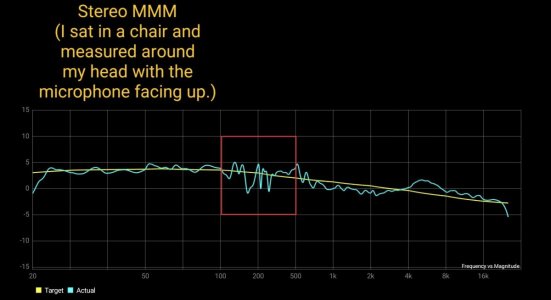
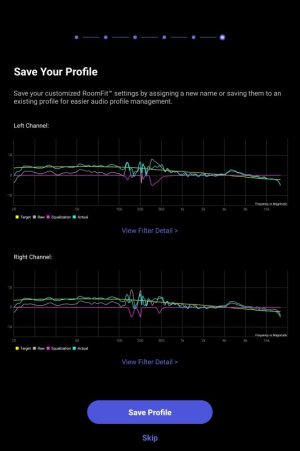
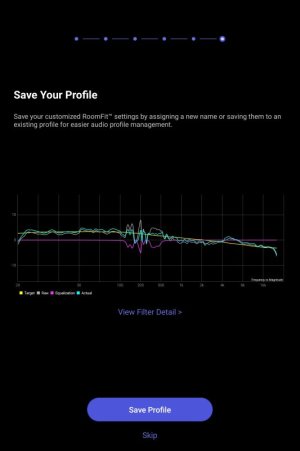
One more thing I'd like to ask: In my case, stereo MMM seems to be more effective at reducing peaks than L/R MMM. Do you know why?

L/R MMM (Correction frequency: 130Hz~500Hz)
699.jpg


Stereo MMM (Correction frequency: 130Hz~500Hz)
698.jpg


This is the correction result of each.

L/R MMM
7fae8bd5-c224-4a69-88b3-2e9021fe04a1-1_all_3228.jpg


Stereo MMM
7fae8bd5-c224-4a69-88b3-2e9021fe04a1-1_all_3194.jpg


Thank you in advance.🙂
 
@dominikz


Do you have any recommendations for measuring MMM?
I've tried the following three methods, but each gives different results. (I'm currently using Method A.)


[A] Sit in the listening position on a chair and hold the microphone facing upward. Move the microphone around my head while keeping it upright.
View attachment 31484


Sit in the listening position on a chair, hold the microphone sideways (facing speakers), and move it around my head.
View attachment 31485


[C] Hide behind the chair and move the microphone around the position where my head is. Keep the microphone facing upward.
View attachment 31486


Comparing the 3 responses, the difference is most pronounced between 80Hz and 500Hz.

The WiiM app instructions tell us to sit on the couch and hold the microphone facing upward, so is "A" the correct method?
(I believe it used to say you should walk around the room.)
These are very insightful questions! :)

I'll do my best to answer, but I'm absolutely open to other viewpoints and a discussion!

Personally I believe we shouldn't sit in the main listening position while measuring, as that will interfere with the soundfield and RoomFit will try to compensate for it.

Now some will say that this interference happens anyway while we listen - and while this is of course true, our hearing is adapted to this kind of sound interference caused by sound reflecting of our own body because we live with it every day, and every sound we hear is subject to it. As such, I don't believe we should try to correct for it.

So ideally we should be as far away from the listening position while measuring to ensure sound at the listening position is accurate when there are no obstructions. One way to achieve this is to mount the microphone to a boompole and hold the mic from a distance, while standing well away from the direct sound path.
A reasonable compromise is just to stand at arms length to the side of the listening position and measure with your arm extended from there. This is what I do usually, being too lazy to dig out my mic stand. :)

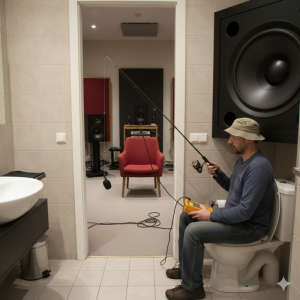
So from the options you tried, it seems to me option C would be closest to this (i.e. it's the one with the least disturbed soundfield at the listening position).

Walking around the room with the mic is IMHO not a good idea. Unless we have multiple subs we can't really optimize the bass response over more than a single seat.

@dominikz

One more thing I'd like to ask: In my case, stereo MMM seems to be more effective at reducing peaks than L/R MMM. Do you know why?

L/R MMM (Correction frequency: 130Hz~500Hz)
View attachment 31487


Stereo MMM (Correction frequency: 130Hz~500Hz)
View attachment 31488


This is the correction result of each.

L/R MMM
View attachment 31489


Stereo MMM
View attachment 31490


Thank you in advance.🙂
Interference between the two channels will create new peaks/dips in the combined (stereo) response - this is expected.
You can either optimize the response for hard-panned content (with individual channel RoomFit) or for center-panned content (with stereo RoomFit), but not for both at the same time. I wrote a little about it recently here:
In that case the dips could be a result of either SBIR (interference of a loudspeaker direct sound with sound reflected of walls) or interference between the two loudspeakers. I'd suggest to first try to optimize individual channel responses - ideally with placement.

Then you can compare the differences in individual channel and summed channel responses (which will always exist to some extent).

Note that if you optimize for a smooth combined channel response by boosting dips that are exclusive to it, you will introduce new peaks/resonances to individual channel responses. In other words optimizing for the combined channel response in some frequency range will favor center-panned (or mono) content, at the expense of hard-panned (stereo) content. The opposite is true as well.

However, given that we're less sensitive to dips than the peaks, I'd personally rather have some dips in the summed response with no peaks in the individual channel responses.

But in the end, if you prefer the sound with this new EQ that is of course perfectly OK!

Hope this is helpful!
 
Is it better to move the microphone "around" the head or laterally, both to the right and to the left?
 
Is it better to move the microphone "around" the head or laterally, both to the right and to the left?
Basically you need to move the mic in random ways, not very fast, in about 50-100cm sphere around the point where your head would be while listening.
Different movement patterns should result in very similar responses in the end.
 
Personally I believe we shouldn't sit in the main listening position while measuring

I asked this question because I usually perform sweep measurements in an unoccupied room. Your advice is always kind, logical, clear, and precise. I find it very convincing.

So from the options you tried, it seems to me option C would be closest to this (i.e. it's the one with the least disturbed soundfield at the listening position).

Next time, I think I'll try doing it like this.😁
1698.png


You can either optimize the response for hard-panned content (with individual channel RoomFit) or for center-panned content (with stereo RoomFit), but not for both at the same time. I wrote a little about it recently here:

This was also very helpful!
Thank you for beautiful advice.🤗🤗🤗
 
Next time, I think I'll try doing it like this.😁
1698.png
:ROFLMAO: That’s exactly what I meant! :D
 
Back
Top