
Strange behavior of RoomFit and settings

aeroshin

Member
Joined
Jan 21, 2026
Messages
5
Hi everyone!
I think my RoomFit is behaving strangely and I could use some help.

My setup
  • WiiM Amp Pro
  • ELAC Debut B6.2 speakers
  • Calibration mic: Dayton iMM-6C (with calibration file)

RoomFit settings
  • Freq: 30.0 to 300 Hz
  • Max Gain: 4.0 dB
  • Min Gain: -12.0 dB
  • Max Q: 10.0
  • Non-Boost Mode: off (I believe this is correct since I don’t listen louder than about 40%)

What happened
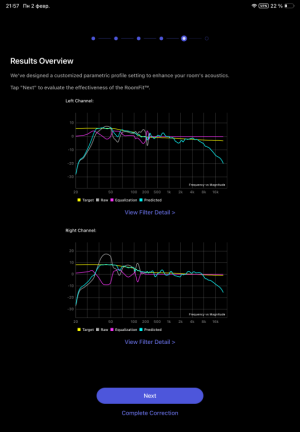
  1. After the measurement, the Predicted curve looked very good.
    1770063397221.png
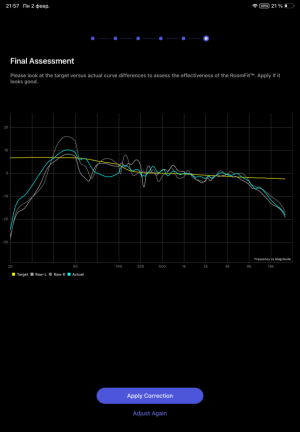
  2. I applied the results and did a re-measurement. Now the Actual response is uneven — in some places the Raw measurement even looks better than Actual.
    1770063438830.png
    1770063458970.png

Questions
  1. How can I fix this? Could I have set RoomFit incorrectly? Which settings should I change (Freq range, Max/Min gain, Q, Non-Boost mode, etc.) to get a smoother Actual response?
  2. On my measured curve there are deep dips (nulls) that I suspect are due to room modes / standing waves. Boosting at the null frequency won’t help. I was thinking you might be able to compensate by reducing the level of surrounding frequencies (so the curve looks flatter overall). Is there a way to do that in RoomFit, or another recommended approach to handle room nulls with these tools?
Any advice on diagnostics, settings to try, or workflow would be appreciated. If you need more data I can attach it.
Thanks in advance!
 
Hi everyone!
I think my RoomFit is behaving strangely and I could use some help.

My setup
  • WiiM Amp Pro
  • ELAC Debut B6.2 speakers
  • Calibration mic: Dayton iMM-6C (with calibration file)

RoomFit settings
  • Freq: 30.0 to 300 Hz
  • Max Gain: 4.0 dB
  • Min Gain: -12.0 dB
  • Max Q: 10.0
  • Non-Boost Mode: off (I believe this is correct since I don’t listen louder than about 40%)

What happened
  1. After the measurement, the Predicted curve looked very good.
    View attachment 33306
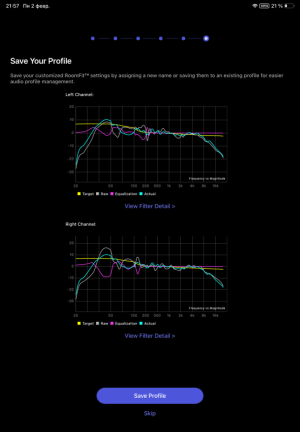
  2. I applied the results and did a re-measurement. Now the Actual response is uneven — in some places the Raw measurement even looks better than Actual.
    View attachment 33307
    View attachment 33308

Questions
  1. How can I fix this? Could I have set RoomFit incorrectly? Which settings should I change (Freq range, Max/Min gain, Q, Non-Boost mode, etc.) to get a smoother Actual response?
  2. On my measured curve there are deep dips (nulls) that I suspect are due to room modes / standing waves. Boosting at the null frequency won’t help. I was thinking you might be able to compensate by reducing the level of surrounding frequencies (so the curve looks flatter overall). Is there a way to do that in RoomFit, or another recommended approach to handle room nulls with these tools?
Any advice on diagnostics, settings to try, or workflow would be appreciated. If you need more data I can attach it.
Thanks in advance!

Hi, welcome.

I'm not an expert, so I can't pinpoint the cause of your problem. However, I experienced a similar issue with the WiiM Sound stereo pair I have in my bedroom.

These are the results from measuring the left and right speakers individually, and the results from measuring the stereo pair.

L ch
2191.jpg

R ch
2190.jpg

Stereo pair
2192.jpg

In the stereo pair, cancellation occurs at 80Hz to 100Hz, resulting in a significant dip.

Moving the speakers to another room for testing did not reproduce this issue. After repeating several tests, I concluded that the 80-inch projector screen in the bedroom was likely the cause.

Subsequently, moving the speakers slightly forward improved the situation somewhat. (I still haven't identified all the causes.)

I'm not sure if the same thing is happening in your room, but it might be worth checking if moving your speakers or listening position slightly could improve things.


Do I need to invert the microphone calibration file? It has negative values at the edges of the range and positive values in the middle of the range.
I don't think so.
 
Moving the speakers to another room for testing did not reproduce this issue. After repeating several tests, I concluded that the 80-inch projector screen in the bedroom was likely the cause.
I made a simple formula for calculating 1/4 of the wavelength in Excel, then substituted RT60 from REW (which usually coincides with the frequency response peaks) and got the depth values of my shelves of cabinets in the room :)
But I do not know how to nulls frequency response failures and do not understand why the result of RoomFit does not match the target value so much.
upd: Now I noticed that I performed individual calibration for the right and left channels (since my speakers are not positioned symmetrically, one is closer to the wall and creates more low frequencies, but I do not have the opportunity to position the speakers symmetrically in the room), and the final measurement is performed in stereo mode. Because of this, the final result is very different and looks worse than planned. When calibrating in stereo mode, the calibration result and the target curve match. Is it possible to solve this problem? I definitely need an individual calibration for my speaker arrangement.
 
Last edited:
On my measured curve there are deep dips (nulls) that I suspect are due to room modes / standing waves. Boosting at the null frequency won’t help. I was thinking you might be able to compensate by reducing the level of surrounding frequencies (so the curve looks flatter overall). Is there a way to do that in RoomFit, or another recommended approach to handle room nulls with these tools?
The dips are not likely caused by room modes / standing waves, a much more likely cause is Speaker Boundary Interference Response (SBIR) or Listener Boundary Interference Response (LBIR). You can use this online calculator to estimate at which frequency SBIR will happen in your room and with your placement.

SBIR/LBIR dips and peaks happen at specific frequencies when a speaker or listener are a corresponding distance from a solid boundary (like a wall, ceiling or floor).
Careful placement of speakers, subwoofer (if any) and listening position can help a lot with (or even completely solve) such dips.
RoomFit and similar room correction tools are really good at knocking down resonances/peaks, but not as good at fixing dips, so dips should be fixed by optimizing placement. I wrote on what RoomFit does and doesn't do well in this post.

Regarding placement, I usually recommend to read this really nice illustrated loudspeaker/subwoofer placement guide by Genelec.

If you don't have a sub, I'd recommend to have your speakers as close as possible to the wall behind them (which will push the front wall SBIR null to ~300Hz and should make the dip shallower), and if possible put the speakers more than 2m from any sidewall (which will push the sidewall SBIR null to <40Hz where the speakers have no output anyway).

Lastly, note that the cyan curve when doing response evaluation (after RoomFit calculated the correction filters) is an L+R summed response, which means it also contains interreference between the two channels (unlike the individual channel measurements you have for the raw speaker response). As @Wiimer suggested, sometime this inter-channel interference can be improved a bit by further tweaking speaker placement.

Hope this helps and good luck!
 
Back
Top