Ay... read what I wrote... we went dual rail in the power supplies... we DOUBLED the voltage from 24VDC to 0 to +/- 24VDC. Double the number of parts.
And in this case, we didn't really increase the rated output into 8 ohms, we just kept doubling it down to 2 ohms ( likely more ). But then, what is rated power anyhow? It's just a measurement of power into a load with some distortion number. To achieve high numbers, specially short peaks that will draw some current, you need.... a more powerful power supply...
In reality, "rated RMS sustained power" is never a situation when the output at the amplifier is near Vcc. Imagine what kind of heat sinks you would need and you would have no overhead. Only Class A amps reach anything even half near like that kind of power draw from their power supplies. Class AB amps seldom draw that much from their supplies during operation... most of the time they put out 1 watt or so to the speakers. Unless you run something like a Magnepan which runs 10 watts ( 83 db/w). But when peaks hit, those numbers may shoot by 6 db or more.. 10 db for example on a closely miked drum kit... that will take your 1 watt to ~10 ( back of the envelope ). If you are playing the music louder, well, that can be a substantial increase in power... but, it's a short burst... so you don't run into heat problems. You might, however, run into clipping... but if it's short term clipping your tweeters will sound nasty but survive.
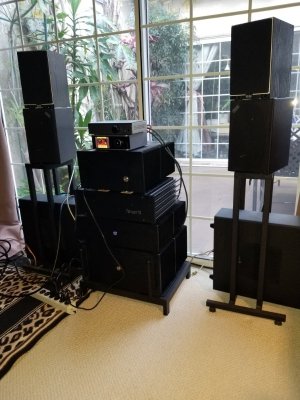
In my case, we spec'd the higher wattage power supplies... each runs 200 watts which is a lot more than the amp will use.. and this is a Class A design. More power, double the voltage than the original single linear power supply.
I specifically wrote that. I even specified the model number. The Meanwell switching power supplies cost $28 each at Mouser. Two of them, in an amp, meant 56 bucks for the BoM. Plus then we had more filtering behind them. How much is the power supply in the BoM for the WiiM Ultra Amp?
Then the output bias was dialed down so the output transistors don't run that hot, yet, they can swing more voltage in peaks and low impedance. The fact that this is a Class A amp with very large 4U heat sinks helps a lot... even so, it idles at 50C.
Do remember that there is nothing in an amp, unless it has some means of power limiting circuitry with some diodes somewhere, to keep it from running more power than rated. And if the output impedance lowers, the main constraints to how much power it can deliver are
(1) The ability of the power supply to keep Vcc steady under load -some amps can drive into 1 ohm.. some into a short.
(2) The ability of the output devices not to burn ( get a bigger heat sink )
(3) The hearing -as the distortion will likely go higher.
I also gave you the specs on the NAD monitor and PE amps. They were able to swing much more in dynamic peaks than their RMS... this was because their power supplies could really swing voltages. Now, I know those were linear power supplies, but the discussion noted the wide dynamic range in music from the RMS background to musical peaks... think drum kit, trumpet...
Those NAD amps of yore used dual voltage power supplies, they could switch for short bursts into the high voltage. Since the power dissipation of such a low burst is not a load into the power supply (think capacitor discharge) it didn't pose an issue with heat.
Do me a huge favor... stop the ad hominem, stop saying that I don't know what I'm "talking" about. I do. You could start by telling me where, in your opinion, I am wrong. Don't call me an "audiophile". Don't say that I got my physical facts incorrect. Tell me which physical facts I got incorrect. Be constructive about it.
If you want more power, start by running a more powerful power supply that can drive the amps into lower loads and can keep the voltage high when power demand increases. Only then, if you want more steady power delivery get bigger heatsinks and larger (or more) output devices.
Now, I realized that you were cagey when you said I know nothing about SMDS power supplies. It is true that I have not designed one, but I have worked with their schematics. So I know enough to be able to design with them.
This whole discussion started because I wrote that "IMHO, it's not the RMS power but the dynamic range added by more power and a heftier power supply." To handle dynamic peaks.
Then I was told that I "didn't understand" SMPS... which, IMHO, is irrelevant. As I noted in the beginning, you just need a more "heftier" power supply. Heftier: strong, solid, substantial, robust, tough. You think that all things being the same, a power supply of 400w with 48VDC is "heftier" than a 200w 24VDC power supply? It will drive low impedance loads better and hit higher peaks. You can still play with the biasing to control the heat, but it will do peaks better ( more operational overhead ).
In any event, I doubt those big Meanwell power supplies will make it into a product that costs under 1500 bucks at MSRP. So, I think we're gone past the idea of the post.
Perhaps installing some NC400 modules might make sense, but then you got a big MSRP. I doubt that WiiM will do Purify modules either as those are pretty expensive.
New WiiM product? multichannel processor.





 . [Side-story} When I was a young tech geek, I worked Tech Support for a silicon valley tape backup system vendor. It was mostly used to backup old NetWare servers across the very slow LANs of the day (mid 80s). I quickly became a network support engineer helping these poor sods trying to backup their company's vital LAN server over randomly bad network implentations and critical software patches. "It ['the network'] works fine for everything else!"


