Optimal Headphone Gain for WiiM Ultra with Sennheiser HD650?

Fralle

Valued Contributor
Joined
Mar 13, 2024
Messages
260
Hey everyone,

Following up on my previous discussion regarding the optimal line-out level for my Audiophonics power amp (thanks for all the great input there!), I’ve now turned my attention to the headphone output.

I primarily use a pair of Sennheiser HD650s.
Currently, I have the output level set to 500 mVrms, mirroring my speaker setup for consistency and safety.

Once again, I’m seeing conflicting advice:
  1. One camp suggests keeping the level low (500 mV - 1 V) to keep the noise floor as low as possible.
  2. The other camp (and my AI collaborator) suggests cranking it to 2 Vrms to give the high-impedance Sennheisers the voltage they need to control the drivers properly, especially when using EQ with negative preamp/auto-gain.
For those of you using high-impedance headphones like the HD600/650 series with the WiiM Ultra:
  • What output level are you running?
  • Have you noticed a difference in "drive" or bass authority when moving from 1V to 2V?
  • Does the higher gain introduce any audible hiss or noise during quiet passages?
I’m curious if the "headroom" logic we discussed for the line-out level applies differently here when the WiiM is acting as the actual headphone amplifier.

Looking forward to your thoughts!
 
Last edited:
I'm running them with a DIY Whammy ( typically 0.5w into 32 ohms)... and a Nitsch that can swing upwards of 4.5w.

I did play them once in the Ultra but just to check it out... no need for that.

With the 650, drive them with as much power as you can get.
 
I haven't seen any way to change the gain on my Ultra's headphones output. Also I haven't used the headphones output, but the analog outputs into a Topping L30. I cannot remember the settings used with my Sennheiser HD580 Precision (very similar to the 650s) but I've ended up using 2V with the L30 on low gain on most music, and lifting it if the recording is dynamic or peaking at -6 dB (som early CDs do) with my 250 ohm Beyerdynamic DT 1770s.
I'd venture that the headphone output on the Ultra is ok, but there's a lot to gain by finding e.g. a Topping DX5 II to drive your cans properly.
 
The Vrms setting is only for the analog RCA outputs on the back. This does not affect the headphone output.
  • What output level are you running?
  • Have you noticed a difference in "drive" or bass authority when moving from 1V to 2V?
  • Does the higher gain introduce any audible hiss or noise during quiet passages?
When changing the volume to the desired listening level, you're already gradually changing the maximum Vrms. This is not going to change the frequency response of the headphones or change any of the output's characteristics or noise level.

Personally I found the Ultra's headphone output to do an adequate job with my HD-490 Pro's, but I don't use headphones that often in my living room. If you feel the need to improve things, an external USB DAC with headphone output is the way to go :)
 
The Vrms setting is only for the analog RCA outputs on the back. This does not affect the headphone output.

When changing the volume to the desired listening level, you're already gradually changing the maximum Vrms. This is not going to change the frequency response of the headphones or change any of the output's characteristics or noise level.

Personally I found the Ultra's headphone output to do an adequate job with my HD-490 Pro's, but I don't use headphones that often in my living room. If you feel the need to improve things, an external USB DAC with headphone output is the way to go :)
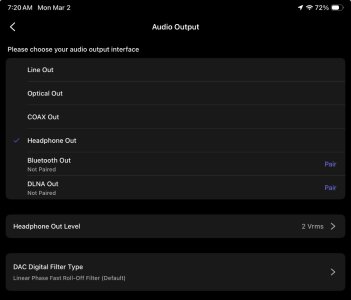
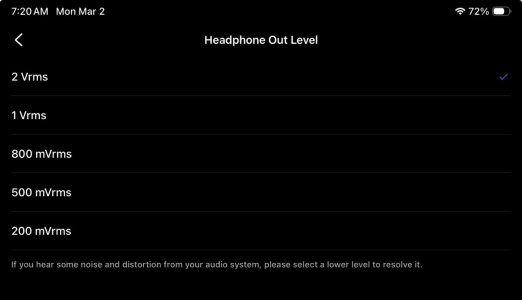
I have this on my Ultra.
 

Attachments

  • IMG_1745.jpeg
    IMG_1745.jpeg
    67.8 KB · Views: 0
  • IMG_1744.jpeg
    IMG_1744.jpeg
    60.2 KB · Views: 0
I have this on my Ultra.
I stand corrected! Guess that goes to show how little I use the headphone output ;)

Still, I'm pretty sure this is just a setting to match the maximum output level to your specific set of headphones - to get the best usable volume range. It won't change any of the characteristics.
 
I stand corrected! Guess that goes to show how little I use the headphone output ;)
It's a recent change, but somewhat misleading I feel as there's no way the headphone out does 2000mW.
Rated at 150mW at 32 ohms, so it seems this is just to align with the rca output screen.
 
At 150mV at 32 ohms, that is about 700 mW.

Which compares with the Whammy's 500mW to 1W range... but pales when compared with something like the Nitsch's 4.5W ( 800 mV ). The latter is an outgrowth and exotic refinement of the Schitt range. It also has a three position gain control up front so you can test it on the fly, no remote needed. For IEMs they suggest the low gain ( they're correct ) for my bigger headphones I prefer the high gain.

The one thing that is deceiving about the numbers from the Whammy and the Ultra is that although they look different, it's all in the rating numbers games. The Whammy has a big power supply and a analog section with plenty of current to hold even low impedances. The WiiM doesn't. My Whammy was built with socketed op amps... which is great!

So, I think for "serious" headphone usage, you would need a separate headphone amp. At that point, might as well also upgrade to a better DAC/headphone amp/preamp and use the WiiM for its source processing not for its analog section. The WiiM headphone amplifier is just not it's forte.

BTW, @EddNog There is a $50 difference between the Multibit DAC with Unison and the newer Mesh DAC with Forkbeard. Perhaps they've cheapened the newer headphone amps with the Mesh DAC?
 
Last edited:
At 150mV at 32 ohms, that is about 700 mW.


So, I think for "serious" headphone usage, you would need a separate headphone amp. At that point, might as well also upgrade to a better DAC/headphone amp/preamp and use the WiiM for its source processing not for its analog section. The WiiM headphone amplifier is just not it's forte.

That’s why despite having Wiim Ultra, I decided to build dedicated headphone “station” with Wiim Pro and Fiio K13 Amp/Dac. Don’t know given budget friendly approach that I can be called “serious” headphone usage though. I use Hifiman H400se and Fidelio X2HR cans.

Btw I tried Ultras headphone amp and consider it pretty good.
 
At 150mV at 32 ohms, that is about 700 mW.

Which compares with the Whammy's 500mW to 1W range... but pales when compared with something like the Nitsch's 4.5W ( 800 mV ). The latter is an outgrowth and exotic refinement of the Schitt range. It also has a three position gain control up front so you can test it on the fly, no remote needed. For IEMs they suggest the low gain ( they're correct ) for my bigger headphones I prefer the high gain.

The one thing that is deceiving about the numbers from the Whammy and the Ultra is that although they look different, it's all in the rating numbers games. The Whammy has a big power supply and a analog section with plenty of current to hold even low impedances. The WiiM doesn't. My Whammy was built with socketed op amps... which is great!

So, I think for "serious" headphone usage, you would need a separate headphone amp. At that point, might as well also upgrade to a better DAC/headphone amp/preamp and use the WiiM for its source processing not for its analog section. The WiiM headphone amplifier is just not it's forte.

BTW, @EddNog There is a $50 difference between the Multibit DAC with Unison and the newer Mesh DAC with Forkbeard. Perhaps they've cheapened the newer headphone amps with the Mesh DAC?
150mV at 32 Ohms is 700uW not 700mW.
 
Wiim support site states 150mW at 32 ohms.
mW, not mV.
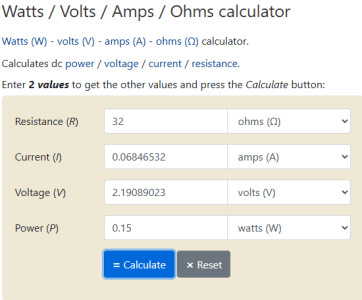
So what does 2V at 32ohms mean in terms of mW, if the headphone output level screen really does indicate volts?
Is it actually 125mW? (That's what a quick google tells me.)
Maybe I need eat my words and the headphone output level screen is consistent after all :)
That's what you get for mixing up V and W...
 
Last edited:
You don't need no stinking calculator ( just need to read your own ).

Ohm's Law

E = IR ( E is EMF, which is reflected by V.. volts... so V = IR ).

From which we derive the rest.

In this case,

P = V^2/R

and

V = SQR( PV)

It's best to use consistent terms, as in volts, ohms, amps, watts... otherwise you'll make the mistake I did upstairs and misread the output.

And, yeah, you don't need no stinking Internet web site to do these calculations. You should be able to do them, al least get into the ballpark, in your head.

So, that's the Physics... but the EE side takes into account the power available from the power supply. If there is not enough power to supply the current into a particular load, then you don't get the "perfect" solution. That's why many amplifiers do not double their power into half loads... as in many will do 100 wpc into 8 ohm, but will not do 200 wpc into 4. Amps that do tend to have significantly powerful power supplies.

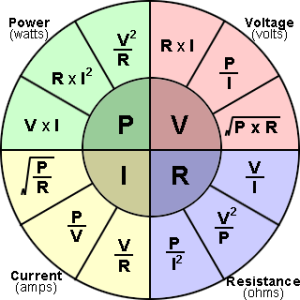
One thing about the drawing below. Strictly from a Physics point a view an "X" indicates vector multiplication. So we never write P=V X I... we write P = IV or P = I dot V. These are scalar terms, not vectors.

OK, enough of Physics 102 ( second semester ).

Here: Ohm's equations.

1772557409472.png
 
Last edited:
Back
Top