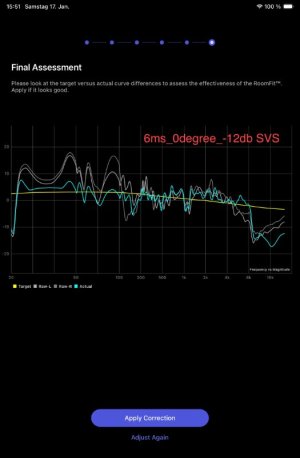
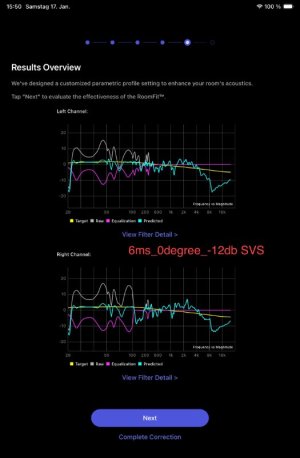
Thanks dominikz, much appreciated.
Unfortunately moving the speakers to the left won´t be possible due to sideboard and TV.
Hence I have to live with it ;-)
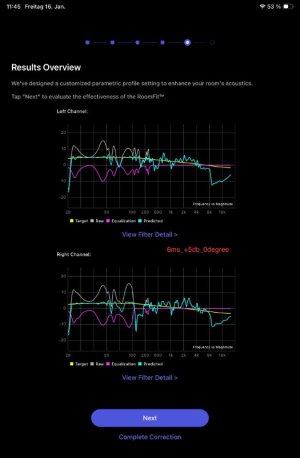
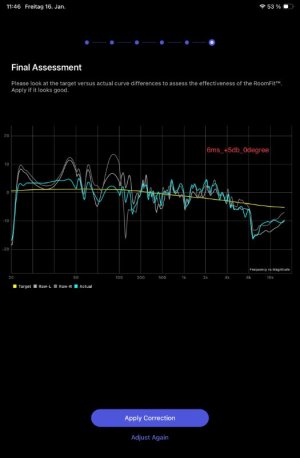
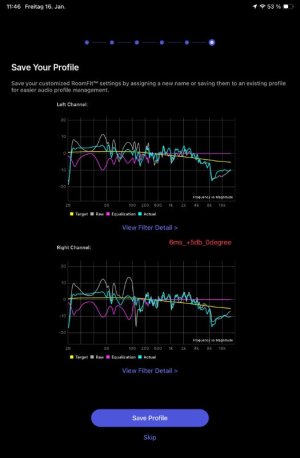
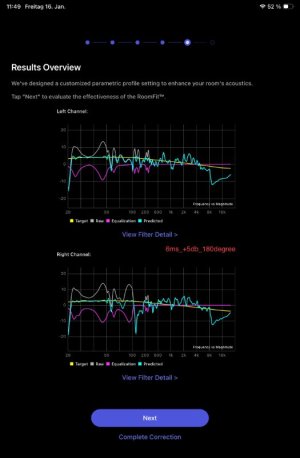
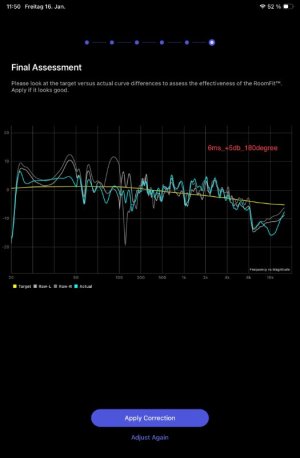
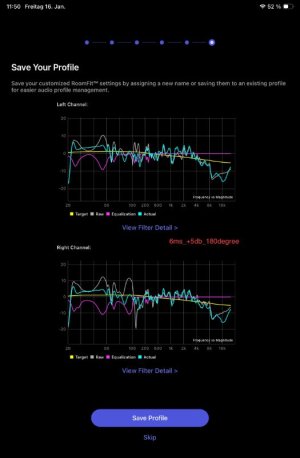
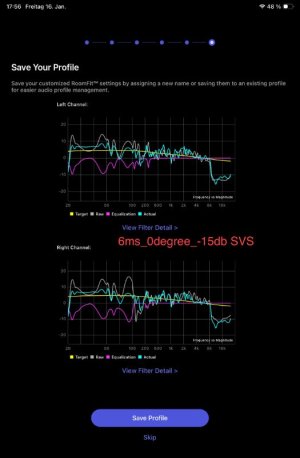
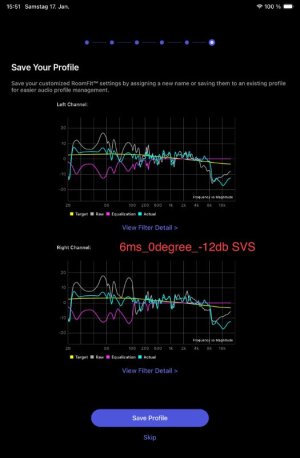
But I gave RoomFit another try with your proposed values (+5db sub level => only set in the WiiM app; still +20db in the SVS app).
0 degree:
View attachment 32576View attachment 32577View attachment 32578
180 degree:
View attachment 32579View attachment 32580View attachment 32581
Is this better?
This looks pretty good to me! I'd advise to keep the 0° polarity, 6ms loudspeaker delay, and the increased subwoofer level.
How do you like the sound with this combination of settings, and after RoomFit is applied?
A minor note that I'd personally keep WHA subwoofer level at 0dB and instead increase the sub gain in the SVS app from -20dB to -15dB. There's no difference in normal use, but staying at 0dB in WHA avoids clipping the subwoofer output in case you ever decide to listen with WiiM volume set close to 100%.

Regarding Spinorama: I saw a link to that side in another WiiM Forum thread but I honestly didn´t understand how to read the "rankings"
page.
That's understandable - it's definitely a lot of information to digest, and it is not really necessary to understand everything to still get some of the benefits. In case you're interested to dive deeper into this topic, I can highly recommend the book "
Sound Reproduction: The Acoustics and Psychoacoustics of Loudspeakers, Rooms and Headphones" by dr. Floyd Toole.
First, don't worry too much about the absolute ranking. Ranking on spinorama.org is based around the so called "tonality score" (also often called "preference score", "Olive score" or "Harman score").
The short version is that the tonality score is a number calculated directly from anechoic measurements, and this number has been found to correlate reasonably well with listener preference of specific loudspeakers, at least on average.
But it is important to understand that this score is not a precise measure, and that you need a significant jump in the score to get it to translate into corresponding preference in a listening test as well. This obviously makes ranking where decimal values are taken into account a bit misleading.
Another problem is that the score value of any speaker also depends on the quality of the measurement protocol - and unfortunately lower quality measurements tend to inflate the tonality score (some of this is explained
here). So it is best to only compare measurements of similar quality (spinorama.org allows you to filter on this).
Still, as a very rough heuristic we can say that loudspeakers with significantly higher "tonality scores" usually have better spinoramas, and are therefore more likely to be preferred by most people. We should just be careful not to overinterpret the exact score or ranking, and to understand their limitations.
Personally I see the score as a very rough (but still useful) guide when shortlisting speakers. However, I give much more weight to the details of anechoic measurements, as they are much more informative than any single number can be.
Looks like that the R3 paired with a sub is a match in heaven. But information on the
R3 page is beyond my current knowledge and I haven´t touched any EQ filter yet.
Maybe this is the next step. ;-)
Since KEF R3 is a very good speaker as is, so the benefits of adding corrective EQ to it are likely limited, and may not even be that noticeable in practice. There's definitely no 'need' to correct it - I just thought you may find it interesting to try.
IMO you have assembled a very good system, if you don't mind me saying so.