Strange behavior of RoomFit and settings

aeroshin

New Member
Joined
Jan 21, 2026
Messages
15
Hi everyone!
I think my RoomFit is behaving strangely and I could use some help.

My setup
  • WiiM Amp Pro
  • ELAC Debut B6.2 speakers
  • Calibration mic: Dayton iMM-6C (with calibration file)

RoomFit settings
  • Freq: 30.0 to 300 Hz
  • Max Gain: 4.0 dB
  • Min Gain: -12.0 dB
  • Max Q: 10.0
  • Non-Boost Mode: off (I believe this is correct since I don’t listen louder than about 40%)

What happened
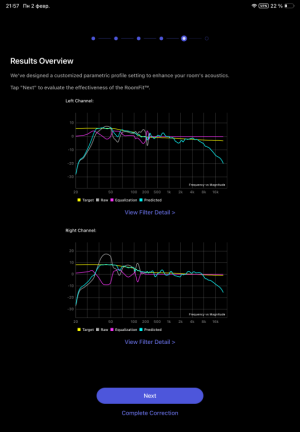
  1. After the measurement, the Predicted curve looked very good.
    1770063397221.png
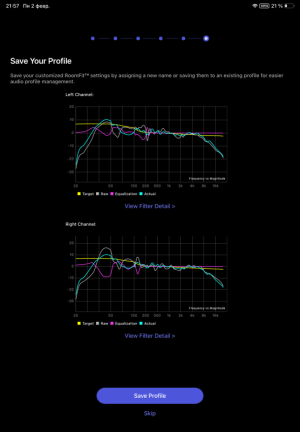
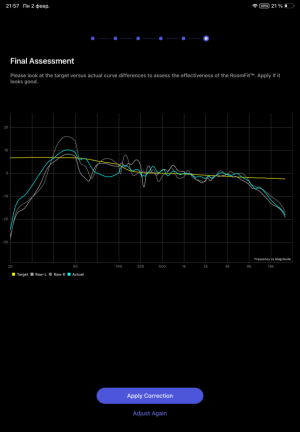
  2. I applied the results and did a re-measurement. Now the Actual response is uneven — in some places the Raw measurement even looks better than Actual.
    1770063438830.png
    1770063458970.png

Questions
  1. How can I fix this? Could I have set RoomFit incorrectly? Which settings should I change (Freq range, Max/Min gain, Q, Non-Boost mode, etc.) to get a smoother Actual response?
  2. On my measured curve there are deep dips (nulls) that I suspect are due to room modes / standing waves. Boosting at the null frequency won’t help. I was thinking you might be able to compensate by reducing the level of surrounding frequencies (so the curve looks flatter overall). Is there a way to do that in RoomFit, or another recommended approach to handle room nulls with these tools?
Any advice on diagnostics, settings to try, or workflow would be appreciated. If you need more data I can attach it.
Thanks in advance!
 
@dominikz ,
Could you share your opinion on whether FIR filters can fix the situation?
In this case I believe they could, yes. FIR filters allow us to manipulate the phase and the magnitude of the frequency response independently, whereas with IIR filters there's a dependency of one on the other. FIR could therefore be used to align the phase of either channel in just a limited part of the spectrum to avoid the cancellation in the summed response, but keep the rest of the response unaffected. So you could theoretically get similarly smooth individual channel and summed channel responses.

However, note that FIR filters can increase total system latency, and can even result in audible artifacts like pre-ringing (which in extreme cases sounds similar to a reversed-time reverb). FIR also requires more processing capacity than IIR, and in case of limited capacity FIR filters lose resolution at low frequencies. And of course any other audible artifacts that apply to IIR can happen with FIR as well (e.g. high-Q boosts can create potentially audible resonances/ringing).

So it is worth being aware that, while FIR gives us more flexibility in theory, there's also more that can go wrong when using FIR vs IIR.

This means that to fix the kind of issue described in this threat, it wouldn't be sufficient to just replace the current IIR with FIR filters and keep everything else the same. The whole RoomFit response analysis algorithm would need to be changed to take individual channel phase responses into account, and try to align them without introducing new artifacts which might be detrimental to sound quality. And depending on how much processing capacity is available in WiiM devices, we might lose low frequency resolution with FIR compared to IIR, which in some cases might not be a good trade-off at all.

My experience is that in many cases simple IIR filters work perfectly, so I see them as a go-to tool for room correction. But there are cases where the extra flexibility offered by FIR filters may be required to fix very specific issues.

That all being said, if you can connect a PC to your system you can try to design and test some FIR filters already. You could measure the response of each channel with REW, try designing some FIR filters with rePhase and then load the resulting FIR filter (as impulse response) into Equalizer APO to test it out.
 
In this case I believe they could, yes. FIR filters allow us to manipulate the phase and the magnitude of the frequency response independently, whereas with IIR filters there's a dependency of one on the other. FIR could therefore be used to align the phase of either channel in just a limited part of the spectrum to avoid the cancellation in the summed response, but keep the rest of the response unaffected. So you could theoretically get similarly smooth individual channel and summed channel responses.

However, note that FIR filters can increase total system latency, and can even result in audible artifacts like pre-ringing (which in extreme cases sounds similar to a reversed-time reverb). FIR also requires more processing capacity than IIR, and in case of limited capacity FIR filters lose resolution at low frequencies. And of course any other audible artifacts that apply to IIR can happen with FIR as well (e.g. high-Q boosts can create potentially audible resonances/ringing).

So it is worth being aware that, while FIR gives us more flexibility in theory, there's also more that can go wrong when using FIR vs IIR.

This means that to fix the kind of issue described in this threat, it wouldn't be sufficient to just replace the current IIR with FIR filters and keep everything else the same. The whole RoomFit response analysis algorithm would need to be changed to take individual channel phase responses into account, and try to align them without introducing new artifacts which might be detrimental to sound quality. And depending on how much processing capacity is available in WiiM devices, we might lose low frequency resolution with FIR compared to IIR, which in some cases might not be a good trade-off at all.

My experience is that in many cases simple IIR filters work perfectly, so I see them as a go-to tool for room correction. But there are cases where the extra flexibility offered by FIR filters may be required to fix very specific issues.

That all being said, if you can connect a PC to your system you can try to design and test some FIR filters already. You could measure the response of each channel with REW, try designing some FIR filters with rePhase and then load the resulting FIR filter (as impulse response) into Equalizer APO to test it out.
We can imagine that, quite reliably, future machines like Wiim will increase their computing power... it's the way things are going...
Perhaps a calculation proposal combining both approaches could be integrated and proposed... and as could already be the case, with different correction options—curves, etc.—to be tested subjectively. This would allow us to choose from the results and then filter out those that don't interest us subjectively.
;-)
But let's see in first how Wiim is doing with the subwoofer stuff...
The ineptitude of internal microphone is already quite old... so the FIR approach... hihi...
;-)
(That's interesting...impressive what you can achieve with a flu that takes a while to heal... ;-)
)

If a future Wiim game ever comes out with two subwoofer outputs and more processing power IIR-FIR, and really much better-designed analog inputs, then I'll probably "seriously open my eyes" ;-)
 
Last edited:
We can imagine that, quite reliably, future machines like Wiim will increase their computing power... it's the way things are going...
Perhaps a calculation proposal combining both approaches could be integrated and proposed... and as could already be the case, with different correction options—curves, etc.—to be tested subjectively. This would allow us to choose from the results and then filter out those that don't interest us subjectively.
;-)
But let's see in first how Wiim is doing with the subwoofer stuff...
The ineptitude of internal microphone is already quite old... so the FIR approach... hihi...
;-)
IMHO the hardware processing capacity is probably the easiest problem to solve.

The main problem is how to reliably *automate* phase-alignment FIR filter creation for a wide range of environments, without creating audible issues along the way.

Given that in many cases IIR is sufficiently capable for room correction, I personally see a bit of risk in attempting to implement FIR on top. Remember that even the current IIR-based approach of RoomFit took a long time to arrive at the current level of implementation.
If FIR is ever added, I believe it should be an *optional* addition to the current algorithm.
(That's interesting...impressive what you can achieve with a flu that takes a while to heal... ;-)
)
I agree, the DSPi project looks really amazing - kudos to the author!
 
That all being said, if you can connect a PC to your system you can try to design and test some FIR filters already. You could measure the response of each channel with REW, try designing some FIR filters with rePhase and then load the resulting FIR filter (as impulse response) into Equalizer APO to test it out.
I want to try using CamiliaDSP to test FIR filters that I plan to create in REW using iMM-6C :)
 
IMHO the hardware processing capacity is probably the easiest problem to solve.

The main problem is how to reliably *automate* phase-alignment FIR filter creation for a wide range of environments, without creating audible issues along the way.

Given that in many cases IIR is sufficiently capable for room correction, I personally see a bit of risk in attempting to implement FIR on top. Remember that even the current IIR-based approach of RoomFit took a long time to arrive at the current level of implementation.
If FIR is ever added, I believe it should be an *optional* addition to the current algorithm.

I agree, the DSPi project looks really amazing - kudos to the author!
My point is certainly not clear... but I truly believe that the idea of producing different PEQ profiles, etc., simply to be subjectively tested following a measurement, is a really "consumer-friendly" approach... even if it takes a few extra seconds of calculation... and avoids having to restart the process from the beginning each time...
 
I agree, the DSPi project looks really amazing - kudos to the author!
The problem, as you've probably gathered, is observing the developments in audio from "wiim" over the years through this lens...
such as never having qualified Wiim representatives in charge of these points to discuss with here... but just "social media marketing managers etc."
:oops:
And when I see the energy -patience- competances you expend for help, here, "for free" ...That's in comparison to Wiim's share...quite indecent from them...
 
Last edited:
I want to try using CamiliaDSP to test FIR filters that I plan to create in REW using iMM-6C :)
Note that creating a phase correction in REW might be challenging. Have a look at rePhase as well, it might be simpler for what you want to do.
My point is certainly not clear... but I truly believe that the idea of producing different PEQ profiles, etc., simply to be subjectively tested following a measurement, is a really "consumer-friendly" approach... even if it takes a few extra seconds of calculation... and avoids having to restart the process from the beginning each time...
I definitely agree that it would be great if we wouldn't have to re-run the entire RoomFit process (including the raw response measurement) whenever we change some configuration parameter. That could definitely be improved.
 
Back
Top