Taming booming bass with AI recommendations

Vignus

Active member
Joined
Nov 16, 2024
Messages
156
Hi All,

here's my experience using AI (chatgpt) recommendations when equalizing with AI. I must say I have tried to do that with RoomFit (paired with a Dayton USB mic) countless times. I'm happy to say RoomFit has improved a lot in the last months and only recently came close to a good result, but never quite made it.

First my set-up:
Room: 5mx5m, speakers KEF LS50 meta placed 50 cm from the front wall, my amp is a Yamaha a-701, my player a Wiim Ultra, and I'm sitting about 2m from the speakers, no room treatment. As you can see, not an ideal set up, boomines being very prominent.

I decided to giva AI a try and see what suggestions it would came up with. After entering all my data (speaker make and model, amp, room size, speaker placement and listening spot, AI came up with a very simple suggestion as compared to RoomFit EQ adjustments, that I didn't think it was gonna work. Here's the suggested EQ:

AI EQ:
  • 🎯 Final EQ – KEF LS50 Meta + WiiM Ultra

    5×5 m room · 50–70 cm from wall · 2 m listening · moderate volume

    1️⃣ High-Pass Filter

    • Type: High-pass
    • Frequency: 65 Hz
    • Slope: 24 dB/oct
  • Keeps bass clean and prevents room overload.


    2️⃣ Main boom control (room mode)
    • Type: Bell
    • Frequency: 102 Hz
    • Gain: –4.5 dB (slightly lighter than loud-listening preset)
    • Q: 1.05
  • This is the key filter for your square room.


    3️⃣ Bass warmth shaping
    • Type: Bell
    • Frequency: 165 Hz
    • Gain: –2.0 dB
    • Q: 1.3
  • Maintains body while avoiding thickness.


    4️⃣ Low-mid clarity (very subtle)
    • Type: Bell
    • Frequency: 275 Hz
    • Gain: –1.0 dB
    • Q: 1.5
  • Improves vocal and guitar clarity without thinning.
Results:
Well, it works very very well: boominess totally gone and sound is still very good. I was very surprised by the end-result.
My conclusion: sometimes simple adjustments work better, so I wanted to share this with you guys
 
Hi All,

here's my experience using AI (chatgpt) recommendations when equalizing with AI. I must say I have tried to do that with RoomFit (paired with a Dayton USB mic) countless times. I'm happy to say RoomFit has improved a lot in the last months and only recently came close to a good result, but never quite made it.

First my set-up:
Room: 5mx5m, speakers KEF LS50 meta placed 50 cm from the front wall, my amp is a Yamaha a-701, my player a Wiim Ultra, and I'm sitting about 2m from the speakers, no room treatment. As you can see, not an ideal set up, boomines being very prominent.
Please try to place the front of the speakers less than 60 cm from the wall behind them. That will help a lot minimizing room modes, uneven bass and boominess in the lower regions.

I decided to giva AI a try and see what suggestions it would came up with. After entering all my data (speaker make and model, amp, room size, speaker placement and listening spot, AI came up with a very simple suggestion as compared to RoomFit EQ adjustments, that I didn't think it was gonna work. Here's the suggested EQ:

AI EQ:
  • 🎯 Final EQ – KEF LS50 Meta + WiiM Ultra

    5×5 m room · 50–70 cm from wall · 2 m listening · moderate volume

    1️⃣ High-Pass Filter
    • Type: High-pass
    • Frequency: 65 Hz
    • Slope: 24 dB/oct
  • Keeps bass clean and prevents room overload.
I can imagine that it sounds cleaner but also bass light because this filter robs the speakers from playing any low bass. At 65Hz it is already at -3dB and -24dB at 32Hz. That's a steep and early bass roll off. A high-pass on speakers that are not truly full range (most hifi speakers) is a good idea though, you relieve them and your amplifier of very low stuff you don't need and the speakers can not play anyway at any meaningful level. Try somewhere between 30 and 40Hz.
There is also a lot to say about adding one or two good subwoofers and crossing them over using the WiiM's adjustments but maybe that is for another time..


  • 2️⃣ Main boom control (room mode)
    • Type: Bell
    • Frequency: 102 Hz
    • Gain: –4.5 dB (slightly lighter than loud-listening preset)
    • Q: 1.05
  • This is the key filter for your square room.
Around 100Hz is were a bassdrum, and bass guitar live. -4,5dB with a Q of 1.05 is a fairly deep dip at those frequencies.


  • 3️⃣ Bass warmth shaping
    • Type: Bell
    • Frequency: 165 Hz
    • Gain: –2.0 dB
    • Q: 1.3
  • Maintains body while avoiding thickness.
Can tame the boxy character of the speakers in-room response.


  • 4️⃣ Low-mid clarity (very subtle)
    • Type: Bell
    • Frequency: 275 Hz
    • Gain: –1.0 dB
    • Q: 1.5
  • Improves vocal and guitar clarity without thinning.
It does what it says.
Results:
Well, it works very very well: boominess totally gone and sound is still very good. I was very surprised by the end-result.
My conclusion: sometimes simple adjustments work better, so I wanted to share this with you guys
If you like it that's all that matters really. I just wanted to give my take on it.
 
Last edited:
I think the same - difficult to imagine any bass in this setting:
  • Type: High-pass
  • Frequency: 65 Hz
  • Slope: 24 dB
@Hans:
Please try to place the front of the speakers less than 60 cm from the wall behind them. That will help a lot minimizing room modes, uneven bass and boominess in the lower regions.
Your suggestion might be good against room modes (although I can not confirm on this) but it will not serve anything regarding a realistic loudspeaker detached soundscape ! At least I made this experience in my room.
 
@Hans:

Your suggestion might be good against room modes (although I can not confirm on this) but it will not serve anything regarding a realistic loudspeaker detached soundscape ! At least I made this experience in my room.
The professionals (like Genelec) describe this recommendation in detail. Detachment has not much to do with it, that phenomenon is speaker specific.
 
Please try to place the front of the speakers less than 60 cm from the wall behind them. That will help a lot minimizing room modes, uneven bass and boominess in the lower regions.
Do you have the same speakers as I do?
 
The professionals (like Genelec) describe this recommendation in detail. Detachment has not much to do with it, that phenomenon is speaker specific.

Not sure. In my case. in my room with - ProAc Response D15s - it makes a huge difference!
 
Do you have the same speakers as I do?
Nope. But I had them years ago. This placement is a general recommendation that the engineers at Genelec describe in detail but also other manufacturers recommend. Try it and you might be surprised.
 
The simple way is to do a roomfit measurement. screen cap the results and show it to chat gpt, then it will know what room problems roomfit have identified. it should then identify what frequencies you call "boom" and go from there.
 
Nope. But I had them years ago. This placement is a general recommendation that the engineers at Genelec describe in detail but also other manufacturers recommend. Try it and you might be surprised.
Many manufacturers say exactly the opposite! At least 60cm+ away from any wall… (not in respectto room modes)
 
Many manufacturers say exactly the opposite! At least 60cm+ away from any wall… (not in respectto room modes)
Unfortunately, "at least 60 cm" is not helpful at all as has been explained demonstrated here and elsewhere many times, unless its more than 1,2 m (which technically falls into the "at least 60 cm" category, of course).
 
My

They generally say that to avoid too much bass boost assuming no room correction.
Ok guys, after I read it a felt 1000 times I tried it! Not sure why I forwarded the loudspeakers years ago around 78cm (front) into the room! At that time I did it because of much better perceived soundstage. However I tried now to move them back to now around 45cm and I have to admit, soundstage did not get much worse (maybe slightly) - but bass became tighter and with less „bass extinctions“. Endet up with now 53cm. Just wanted to say thank you for this! 👍🏻🤗
 
Last edited:
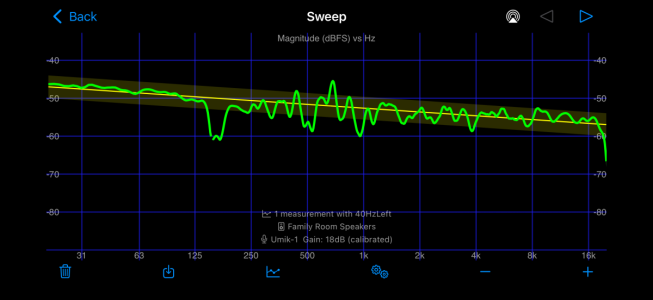
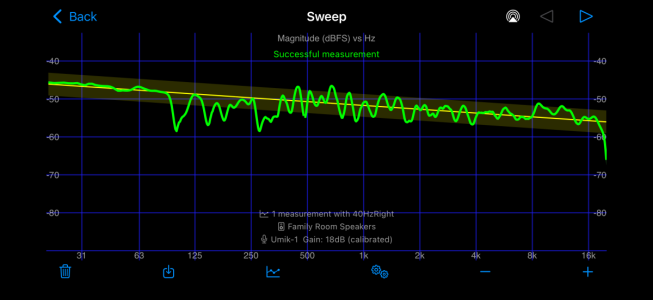
Placing the speakers very close to the wall does not automatically result in boomy or uneven bass once you have room correction involved. My left speaker driver is only 20-21” from the back wall (the back of the speaker enclosure is but several inches from the back wall—I have sealed the rear ports!) and my right speaker is only about 4-5” farther from the sliding door behind it (the sliding doors are recessed compared to the wall), so my speakers are quite close to the back wall, and my crossover to my subwoofer is very low, only 40Hz, as my speakers extend down to low/mid 30s in-room (the sub extends flat down to 12Hz in-room). Thanks to proper room correction tuning, I am able to achieve table-flat bass response below 90Hz that literally extends off the charts (when the charts stop at 20Hz). The left sweep is measured from left ear position, and right sweep from right ear position:
IMG_0486.png
IMG_0487.png

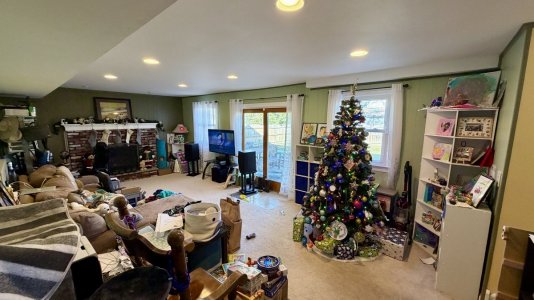
This in a very severely asymmetrical room placement scenario (there’s no avoiding it, the space is heavily shared with the rest of the family—please excuse the messiness, I have 5- and 7-year-old boys plus two cats):
IMG_0488.jpeg

-Ed
 
Back
Top