WiiM Amp subwoofer output polarity

slartibartfast

Major Contributor
Joined
Apr 18, 2024
Messages
5,960
I have my subwoofer adjacent to one of my speakers and set the subwoofer phase to 180 degrees for maximum output around the crossover. I have always assumed thos was necessary because the WiiM Amp somehow reversed the polarity to the main speakers.
Today I discovered speaker polarity pop tests and actually measured the speaker output with a UMIK-1 while playing the pop test waveform. The waveform from the main speakers was in phase with the test waveform.
Is it possible that the subwoofer output signal is phase reversed? If I had an oscilloscope handy I would measure it 🙂.
 
I don't think it's related, but running RoomFit consecutively can sometimes cause the speakers and subwoofer to become out of sync (by about 4ms). However, since I connect the Pro to the Amp Ultra's Sub-out, I assumed this was the cause. In most cases, putting the Pro to sleep or pressing the play button twice restores synchronization.
 
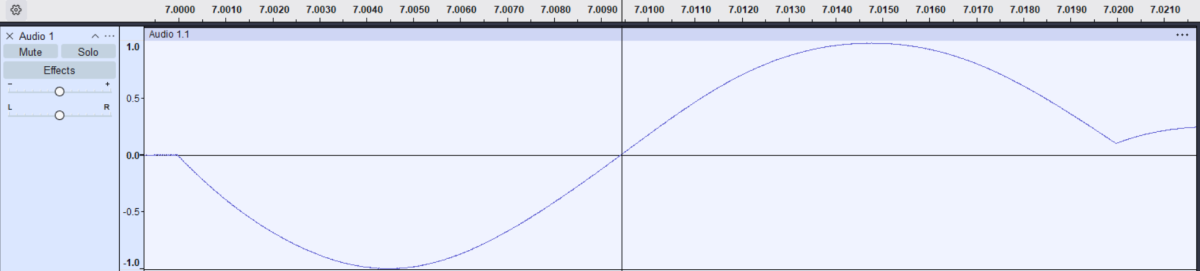
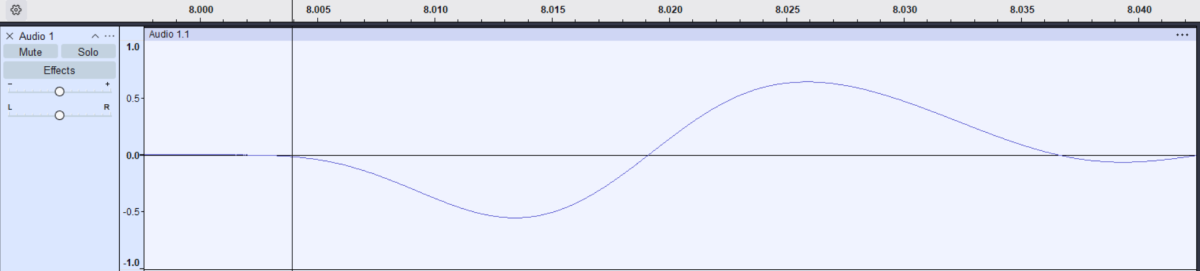
I investigated a little more and captured the subwoofer output of the amp with a Focusrite audio interface. I generated a test waveform consisting of a single cycle at 50Hz every 500ms and measured the subwoofer output first with the full range signal sent to the output and second with a crossover frequency of 50Hz. The sub output is set to 180 degrees.

First the full range signal. It can be seen that the signal is indeed inverted by 180 degrees but although the period is 20ms the zero crossing at the half period is nearer 9.5ms. Very strange.
1771850915476.png

Second with the crossover at 50 Hz. The waveform is delayed by 4ms and the frequency seems to have changed to 30Hz. Maybe a single cycle isn't a proper test.
1771851777974.png
 
I generated another test waveform with repeated 4 second bursts of 50Hz with a 1 second gap between each burst. Results show that it takes a couple of cycles for the subwoofer output to stabilise and after that there is a 0.5ms delay when the subwoofer filter is bypassed the full signal is applied to the sub. When the sub crossover is set to 250Hz the delay for a 50Hz signal increases to 2ms. With the crossover set to 50Hz the delay increases to 10ms. Of course I don't know the phase of the main speaker signal as it isn't easy to measure.
If nothing else this has shown me that the phase setting should probably be left at 0 degrees and the subwoofer sync should be performed using the output latency setting.
@dominikz have you ever investigated this?
 
I generated another test waveform with repeated 4 second bursts of 50Hz with a 1 second gap between each burst. Results show that it takes a couple of cycles for the subwoofer output to stabilise and after that there is a 0.5ms delay when the subwoofer filter is bypassed the full signal is applied to the sub. When the sub crossover is set to 250Hz the delay for a 50Hz signal increases to 2ms. With the crossover set to 50Hz the delay increases to 10ms. Of course I don't know the phase of the main speaker signal as it isn't easy to measure.
If nothing else this has shown me that the phase setting should probably be left at 0 degrees and the subwoofer sync should be performed using the output latency setting.
@dominikz have you ever investigated this?
I'm not 100% sure I understood correctly the tests you did, but a crossover will indeed introduce phase wraps to both the sub and the speaker response, so I'm not surprised that different crossover points require different delay values to optimize the crossover response.

Remember that phase response and delay are directly linked. So changing the phase changes the time-domain response as well, and likewise changing the delay affects the measured phase response.

If nothing else this has shown me that the phase setting should probably be left at 0 degrees and the subwoofer sync should be performed using the output latency setting.
Personally I'd still first choose the polarity value which allows me to use the least amount of delay for perfect sync.
 
Personally I'd still first choose the polarity value which allows me to use the least amount of delay for perfect sync.
In my case I can see that the speakers and sub are in phase in the sense that a positive signal on both moves the speaker cone outwards. That was why I figured that it was better to use delay instead of inverting the phase. The delay is only 5ms. I get almost exactly the same frequency response whether I use a 5ms delay or invert the subwoofer phase but inverting the phase would add a frequency dependant delay which should have a different effect even if I can't hear a difference. Does that make sense?
 
The delay is only 5ms. I get almost exactly the same frequency response whether I use a 5ms delay or invert the subwoofer phase but inverting the phase would add a frequency dependant delay which should have a different effect even if I can't hear a difference. Does that make sense?
Well humans are much more sensitive to magnitude response errors, much less so to phase/timing errors.
Given that delay is low either way, I suppose either variant should probably be OK in your case.
 
Back
Top