Glad to help!
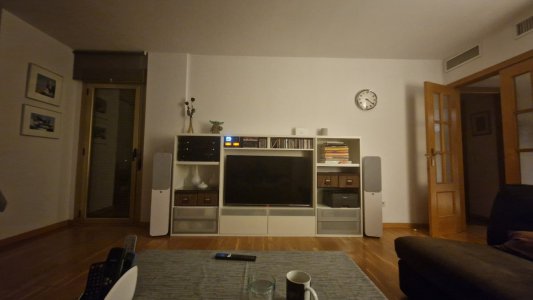
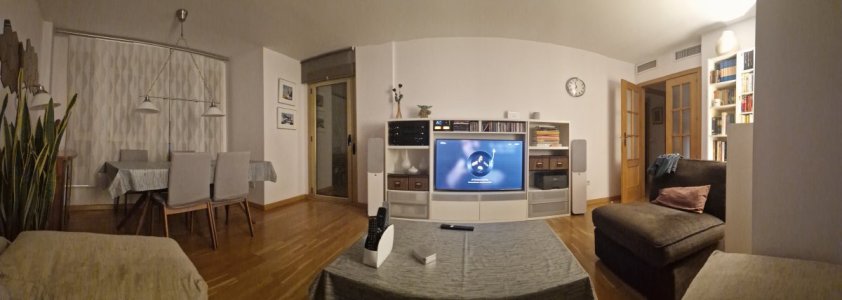
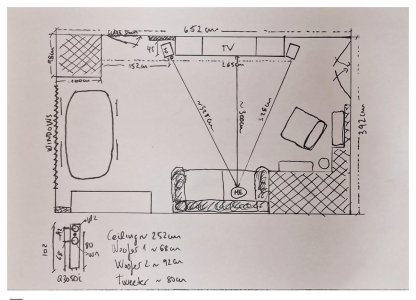
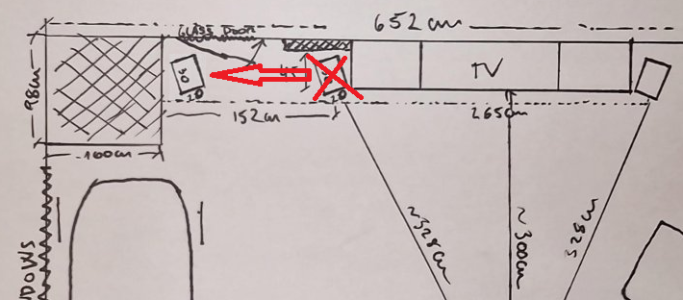
As you may have seen in the picture there's a glass door leading to a terrace/balcony in the position you suggested.
Sure, I know this can't be a permanent location for the speaker, I only suggested it as an experiment to see how the measured response changes. That should hopefully confirm the theory that the distance to the side wall is problematic.
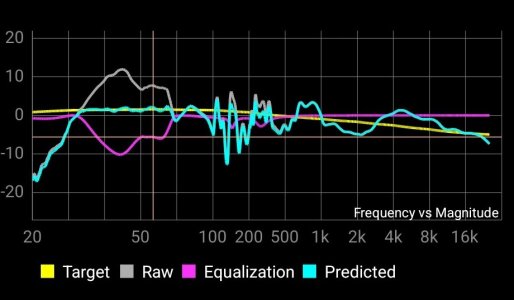
I used you calculator and it gave me a null at 56hz from side wall, I guess that is what you got too?
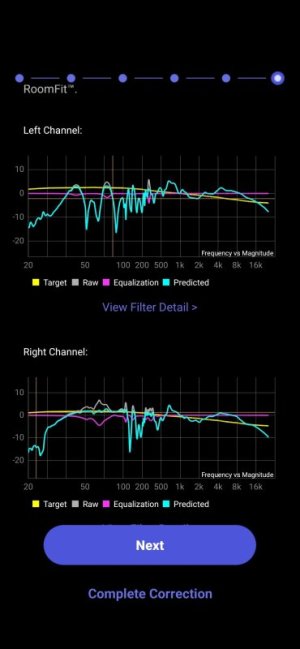
Yes. The prediction seems to match reasonably well with the RoomFit response.
I also did
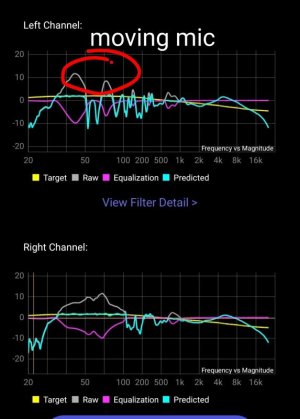
a simplified simulation (link) which also gave a reasonably good approximation of the RoomFit response you got for the left channel:
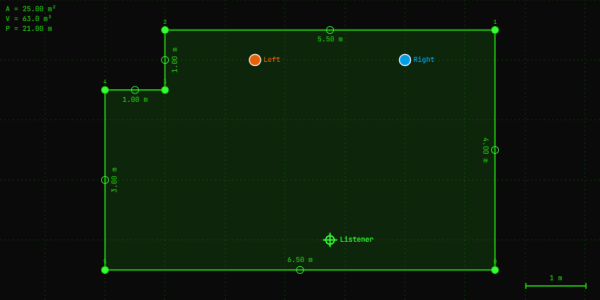
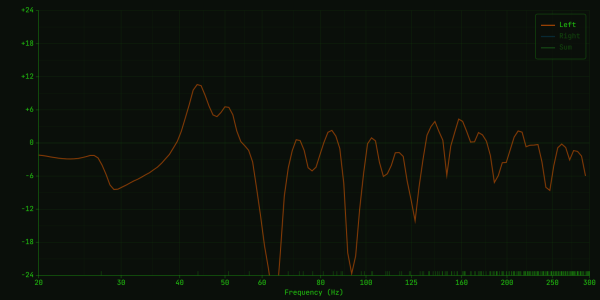
IMHO that is again pretty strong indication that the position of the left speaker vs the left wall is problematic.
Yesterday I tried putting a small sofa just there in that position and thick cushion against the wall up to 1m height or so but I think it didn't improve the low frequencies response. Will give another try again.
Would an absorption panel on that side wall be an alternative to moving speaker?
Unfortunately it will be hard to find absorbers that work well at such low frequencies.
Even relatively thick (~10cm) rockwool absorbers have pretty low absorption coefficients below 100Hz (
see e.g. this article), and thinner ones won't work that low at all. My guess is you'd probably need absorbers that are actually thicker than the speaker and mounted with significant air gap for this to work... so probably not practical.
Note that wavelength of sound at 50Hz is almost 7m, and that objects significantly smaller than the wavelength are basically 'invisible' to the sound wave. So moving furniture or furnishings around likely won't make a significant effect, sorry to say.
Very low frequencies are notoriously difficult to treat with physical acoustic room treatment.

Luckily, there are other ways to tackle them...
Difficult for me a subwoofer, specially since I have tower speakers , not many locations to put it...and not guaranteed it will fix then issue or create other integration headaches.
Honestly, one of the most compelling arguments to add subwoofer(s) is the fact that we can place them independently of the speakers, because that allows us to better optimize the bass response at the listening position.
It is again one of the things that is counterintuitive in audio - full range speakers are actually much more difficult to position in a room, because placement that works well for higher frequencies and stereo imaging is often not good for best quality bass. Having a separate subwoofer allows one to optimize for all of this because we can place speakers and sub(s) independently. More on
speaker and sub placement in this post.
But it is true you need to have floor space where you can put the sub. Though this doesn't need to be near the speakers, since very low frequency sources are difficult to localize (again due to very long wavelengths) - I usually recommend corner placement as a starting point for subs. Explanations
in this post.
It is also true that integrating a sub would require more effort and comes with a learning curve. I definitely feel it is worth it, but I understand that it can be intimidating. Perhaps
this post might be useful to get some idea of the basic steps involved.
That all being said, just using the Stereo RoomFit variant with your existing speakers and no sub might be perfectly good as well. In this case you might only perceive some issues if the bass in a recording is hard-panned to the left channel, which is IME rarely the case. As I mentioned before, many recordings have bass downmixed to mono (i.e. center-panned so reproduced to both speaker), which means that in practice you may not perceive (m)any issue(s) at all.
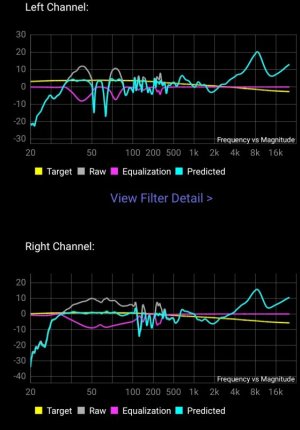
The other nulls around 65 70hz ,100... and the ripple above up to 400...not sure what causes them. It is really nasty response, the uneveness i wouldn't mind if the SPL variations weren't so high.
Let me start by saying that 'perfectly clean' looking responses in residential rooms are largely unrealistic, and IMHO not even required for very good sound quality. These are primarily living spaces so they should be comfortable, relaxing and aesthetic. After all, people tend to enjoy music more if they are comfortable.

We mainly want to focus on avoiding severe peaks ("bass boom") and deep and wide nulls ("bass suck-out").
As such, some compromises have to be made. IME if you can avoid the few dips in the 50-80Hz range that would likely be good enough. The notch at 130Hz, while deep, is so narrow that I doubt it would be audible at all, and the irregularities in the 150-500Hz range are already in the part of the range where they might not be as offending as they look.
At low frequencies what you measure in-room is basically what you hear. But we start to "hear through the room" as frequency goes up, so what we measure in-room at high frequencies doesn't anymore 100% reflect what we hear.
In case you want to know more about this phenomena, I can highly recommend the amazing book "
Sound Reproduction: The Acoustics and Psychoacoustics of Loudspeakers, Rooms and Headphones" by dr. Floyd. E. Toole.
The pink noise tests opened my ears on how different left and right channel sounds at the listening position are.
It is perhaps worth saying that pink noise is really the most revealing signal for tonality issues. It is like a microscope for tonality!

As such, what sounds really bad with pink noise (and looks ragged when measured) can actually be much less problematic with real music and movies in stereo.
There's good research showing that people best detect tonality issues in mono with pink noise, and that they get progressively worse at detecting issues as we increase the number of channels, and especially if we use content that is less "busy" (like e.g. 'audiophile' acoustic recordings). We (luckily!) haven't evolved our hearing for the purpose of reliably detecting deficiencies in audio equipment.
That doesn't mean human hearing is bad - quite the contrary, it is really good at extracting useful information and disregarding the distortions!
Of course it is still a good idea to strive for a better response even if we couldn't hear issues originally, but it is also wise to learn to accept issues which may be impractical to fix.
Still, at this early stage I absolutely encourage you to experiment! It can be a fun journey, where one can learn a lot about physics, acoustics and limits of human perception!
Tweeter in sandwich in between 2 woofers is very common tower speaker configuration. There are no cancelations but reinforced signal of both woofers, they work perfectly in phase. It is a 2-via (woofers same mid and lows, tweeter highs) system, not 3 not 2.5.
Regards
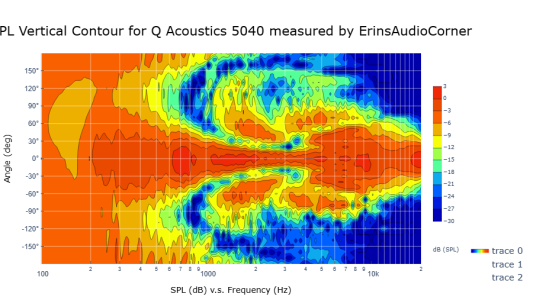
The woofer configuration of your speaker is definitely NOT the cause of the bass response cancellations you are seeing.
But it is worth mentioning that this kind of MTM configuration (2-way with a woofer on either side of tweeter) does cause cancellations/lobing off-axis vertically at higher frequencies. E.g. see this example of the pretty messy vertical directivity of Q Acoustics 5040 (
link to source):
Have you moved the two glass-covered pictures on that left wall? EDIT: I'm guessing it's that whole wall they're hanging on
..
The pictures won't have an effect at such low frequencies. Remember, wavelength at 50Hz is almost 7m...






 . When you said your speakers have two woofers with a tweeter in between, I wondered about the interplay between the woofers and how they team up to hit certain low freqs... I'm just speculating but what if you tried swapping the right and left speakers to verify that the puzzling problem remains in the same 'acoustically-influenced' location?
