
It seems like a soundbar would be preferable for many people compared to a separate L/R/C setup. The soundbar has an integrated sound and a cleaner look. With just a L/R/C offering it seems like Wiim would be limiting its market significantly. But, they may choose not to compete with the likes of Sonos, Sony, Samsung and LG in that market.The good news is now that WiiM has these products in their lineup with the obvious marketing as potential Center and Surround sources, it is quite likely that WiiM will push development of both supporting functionality (SurroundFit) and greater general support for Multichannel Audio (across at least the higher-end models).
This will WiiM to better play in the Home Theatre market, and possibly keep in the same conversation with Eversolo and HiFi Rose and HeOS for Multichannel Support (even if that currently is only ATMOS as supplied byApple Music, Amazon Music and Tidal).

You are using an out of date browser. It may not display this or other websites correctly.
You should upgrade or use an alternative browser.
You should upgrade or use an alternative browser.
WiiM Sound and Sound Lite - my impressions and measurements
- Thread starter dominikz
- Start date
DariuszP
Active Member
@dominikz - really great review - many thanks! It seems that your findings pretty well match my feelings - my WiiM Sound unit looked great, its functionality (as always with WiiM) was perfect, but it sounded "just ok" - a bit boomy and, at the same time, quite thin and most importantly stereo (from one speaker) was very disappointing. As my expectations were much higher (probably: with no good reason taking into account the physical limitations of this speaker) I decided to return it and look for some other options that could better serve my intended use case (see below).
@satheesht - could you be so nice and write a bit more about your feelings on JBL Authentics 300? I am looking for something that I could put on my (quite large) patio as a replacement for current pair of JBL Charge 5 BT speakers* (used for both music and outdoor movie playback) and this one is on my very short list (mostly: because of its battery and also likely higher volumes / bass output useful for movies). How do you rate the stereo stage from a single speaker (ideally I would just buy one, for both: simplicity and the budget).
* I actually quite like the sound of those tiny speakers with quite deep and fast bass and sparkling highs (the stereo pair of those was probably more engaging than a single WiiM Sound unit?), but it is really cumbersome to set them up every time, connect in pair, connect bluetooth, etc...
@satheesht - could you be so nice and write a bit more about your feelings on JBL Authentics 300? I am looking for something that I could put on my (quite large) patio as a replacement for current pair of JBL Charge 5 BT speakers* (used for both music and outdoor movie playback) and this one is on my very short list (mostly: because of its battery and also likely higher volumes / bass output useful for movies). How do you rate the stereo stage from a single speaker (ideally I would just buy one, for both: simplicity and the budget).
* I actually quite like the sound of those tiny speakers with quite deep and fast bass and sparkling highs (the stereo pair of those was probably more engaging than a single WiiM Sound unit?), but it is really cumbersome to set them up every time, connect in pair, connect bluetooth, etc...
Last edited:
The obvious comparison is the Sonos Era 100, (which also has 2 tweeters) and from this and other reviews the Era 100 seems like it may be the better speaker, at a lower price. I know I like the sound of the Era 100 very much. I feed it from an old Mini when I want to use the Wiim app. That works well and that allows me to use my existing Sonus setup with the Wiim app. As someone pointed out, Sonos has a lot of experience building speakers. Hopefully Wiim will catch up both in quality of sound and breath of offerings.

This will be another of my huge posts - sorry about that in advance!
NOTE: I've received the WiiM Sound (WS) and Sound Lite (WSL) free of charge from WiiM for testing purposes. The opinions shared are my own, however, and have not been moderated by WiiM in any way.
WiiM Sound - how does it sound?
This is the first speaker I received. When I got it, initially I just streamed some music without much analysis.
While I was pleasantly surprised by the bass extension of such a small speaker, I immediately noticed something was wrong with the overall tonality. Main issue for me is the brightness of the stock tuning, but midrange tonality also seemed a bit off to me as well. It didn't seem like something a simple treble control (high-shelf filter) could solve. There can also be some boominess in the bass, but that can be easily fixed with RoomFit.
To check my perception I did a few rounds of direct, level-matched comparisons with my Revel M16 speakers and with that confirmed the brightness and uneven tonality issue is definitely there. Creating a treble tone control with PEQ (link to instruction) can help to an extent, but not entirely because the issue is not linear (as we will see later).
I also added the WiiM Sound as a center channel with multichannel Dolby Digital content, with LR being assigned to Revel M16 and Sub to the SVS SB-1000 Classic (all driven from the WiiM Amp Ultra). For the Surround channels I temporarily assigned my Mini (so that I can set the Sound as Center), but then removed the Mini from the group. This gave me a 3.1 setup.
In this configuration the tonality difference between the Sound and my M16s was quite obvious, with the WiiM Sound being much brighter - and IMHO distractingly so. The fact that EQ doesn't work in this mode of operation makes this even more of a problem, IMO.
Another issue, but not specific to WiiM Sound, is that there's no automatic calibration of sound level and delay between channels in multichannel mode. I.e. you need to manually adjust the relative levels of WiiM devices until you are happy with the overall balance at your listening position. I'd personally much prefer a method that aligns the relative levels and delay in multichannel mode using the microphone connected to the phone (i.e. similar to RoomFit), while allowing manual fine-tuning. Perhaps something like this will come in the future (the announced "SurroundFit", perhaps?)
Lastly, the bass response from the speaker can very easily get distorted. This may not be as easily audible with music, but is very easily audible with pure tones. This is expected given the small woofer size, however - WiiM can't defy physics (at least not yet).
In summary, WiiM Sound is OK sounding (especially for background music listening), but honestly I expected much better from WiiM given how great their streamers and streaming amps are.
WiiM Sound Lite - how does it sound (lite)?
Out-of-the-box tonality seems the same as the original WS to me - I perceive it as too bright, with a midrange scoop. Basically you can assume everything from the previous section is valid here as well.
However, now having two WiiM smart speakers I could test a few additional use-cases.
What's up with the dual-tweeters?
- Pairing the WS with WSL in a stereo pair helps hide some of their tonality sins.
The added width and depth of stereo takes the focus away from tonality issues, which definitely improves the experience.
- Still, adding PEQ on top to tame the excessive treble can improve it a bit.
- However it is not without issues: in direct level-matched comparison (even with corrective EQ configured) the WS(L) pair is still brighter and not as smooth in the midrange as my Revel M16 pair.
- Stereo soundstage seemed a bit undefined/unstable to me - it has an almost "phasey" sound to it (like some kind of phase cancellation thing is happening). This is very apparent when comparing side-by-side with my Revel speakers.
- Grouping and channel allocation seems to persist after standby, which is nice.
- There seems to be an issue with the follower device not following volume of the main speaker every time, especially if using presets to adjust volume. I've opened a support ticket on this.
- I've also tried the WS+WSL as surround L/R in a Dolby 5.1 configuration with the WAU driving a pair or Revel M16 as front L/R and a SVS SB-1000 Classic subwoofer. This worked fine and was actually quite fun to try.
- But the current limitation where RoomFit/EQ are both inoperable with 5.1 content is a serious issue. Without bass correction (RoomFit) it easily gets too boomy, and without EQ the surrounds don't match the fronts on tonality. Until this functionality is added (SurroundFit?) I don't believe I'll actually use 5.1 much.
- Lastly, I tried "double stereo" playback by grouping WS [as L], WSL [as R] and WAU [as LR] in the same room, but opposite sides. This was far from being accurate (there's no sound stage to speak of), but it was fun to try.
Now isn't that an interesting question?
As we can see from the marketing pictures, the two tweeters are pointing approx. 45° to the sides:
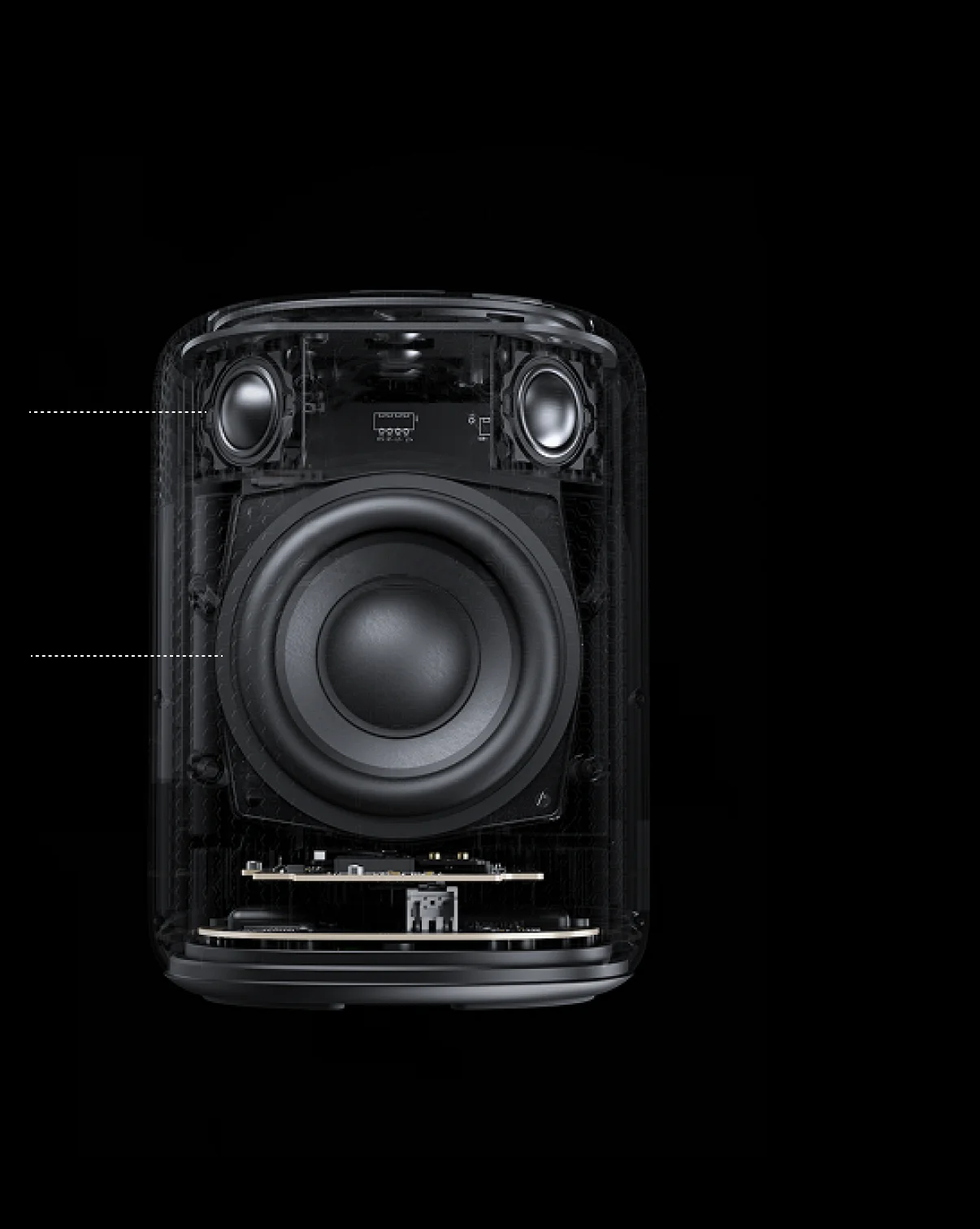
The intention was I guess to:
This sounds nice in theory, but in practice it IMHO brings several challenges:
- Make the sound dispersion wider
- Allow for 'true' stereo playback with a single speaker, i.e.:
- Above the crossover frequency (2.4kHz):
- The left tweeter plays the left channel only
- The right tweeter plays the right channel only
- Below the crossover frequency (2.4kHz):
- The single woofer plays a sum of both left and right channels
NOTE: So with both WS and WSL speakers the dual tweeter operate as follows:
- Two tweeters mounted on the same speaker will cause a complex pattern of acoustic interference in the dispersion. We'll see that in the following sections. My assumption is that this is what causes the "phasey" sound when pairing two speakers in a stereo group.
- We can't really perceive a stereo soundstage if both tweeters are so close together - unless perhaps if our room dimensions are really lucky, and speaker is placed optimally to reflect the sound from each tweeter's adjoining side-wall exactly to the listening position.
Now on to see some measurements...
- If we play a file where left and right channels contain a different signal, each tweeter will play the respective channel signal.
- This is what happens with regular stereo audio content on a single speaker, or when WS or WSL are configured with "LR" when added to a multi-device group:
View attachment 35251- If we play a file where left and right channels contain the same signal, both tweeters will play the same signal.
- This is what happens with mono audio content on a single speaker, or when WS/WSL are configured to each play a single channel when added to a multi-device group (e.g. "L", "R", "C", "SL" or "SR"):
View attachment 35253- If we play a file where only the left channel contains a signal, while the right one is empty then only the left tweeter will play, while the right tweeter will remain silent.
- This can currently only be achieved with test or manipulated audio files, by leaving one channel empty.
Methodology and equipment
The measurements were made through the WS/WSL Aux In input (EQ, RoomFit and Dynamic Bass were all disabled).
Measurement equipment:
High-frequency anechoic response was measured at 50cm distance and about 1,2m height, resulting in ~5,5ms reflection-free window.
- Cross-Spectrum Labs calibrated Dayton Audio EMM-6 measurement microphone
- RME BabyFace Silver Edition audio interface
- miniDSP UMIK-1 calibrated measurement microphone
- DIY loudspeaker measurement turntable stand
- Room EQ Wizard (REW) and VituixCAD software
This means that after temporal gating resolution and accuracy above 1kHz is high, but drops to about 1/3 octave at ~550Hz and lower below that.
The response was also measured at 1m distance, and produced the same result - which means that the drivers integrate well at 50cm and that responses at this distance are representative of device performance.
Low-frequency anechoic response was measured with three separate methods:
All three methods produced equivalent woofer responses, increasing the confidence in the results. There appears to be no bass reflex port in either WS or WSL.
- Single microphone nearfield woofer measurement - done for both WS and WSL
- Two microphone mode-compensation method (explained here) - done for WS only
- (Almost) free-field response measurement - done for WSL only
WiiM Sound (WS) - on-axis response (left and right tweeters play the same signal):
View attachment 35254
WiiM Sound (WS) - on-axis response (only the left tweeter plays, right tweeter is silent):
View attachment 35256
WiiM Sound Lite (WSL) - on-axis response (left and right tweeters play the same signal):
View attachment 35255
WiiM Sound Lite (WSL) - on-axis response (only the left tweeter plays, right tweeter is silent):
View attachment 35257
We can see that both WS and WSL give a very similar response, which is unsurprising given the identical architecture.
There is a peak in bass response around 70Hz, followed by a dip around 130Hz. The response above that is kept within +/- 2dB until about 12kHz, which seems pretty OK at first glance. Above 12kHz the response is chewed-up, likely due to some kind of acoustical interference caused by the physical design of the device.
But the really interesting part is the horizontal dispersion/directivity - here only shown for the WS, but the same applies to WSL.
WiiM Sound (WS) - horizontal directivity (left and right tweeters play the same signal):
View attachment 35259
WiiM Sound (WS) - horizontal directivity (only the left tweeter plays, right tweeter is silent):
View attachment 35260
While directivity is indeed pretty wide with both tweeters playing, it is riddled with cancellations when we move off-axis - unfortunately a natural product of this kind of acoustic design.
Here's how that looks if we compare responses between 0°-30°:
View attachment 35261
With only one tweeter playing, there is no cancellation, but there is directivity discontinuity around the crossover, at least in part due to physical misalignment of the tweeter and woofer. However the responses from 0°-30° are much better aligned to each other, because now there's no interference with the other tweeter:
View attachment 35262
So where does the brightness come from?
By now I hope we could see that the brightness issue is caused by the dual-tweeter design, and the resulting directivity mismatch between the single woofer and the tweeters. Basically to get a flat on-axis response (which is actually 45° off-axis to either woofer), both tweeter level need to be pretty high, which generates a lot of off-axis high frequency energy. Combine that with the cancellations caused by dual-tweeters, and I'd say that explains a lot of the issues I'm hearing.
Conclusion
As I mentioned at the beginning, these are not bad speakers - it is just that I expected more. If you pair them and apply some EQ, they can sound pretty good. I wouldn't replace my main speakers with them, however!
That's it for now! Hope some will find it useful!


For most people these are single ‘accent’ nook speakers. Do not listen to them on-axis and they work pretty well.

The design of the Sound is primarily as a wireless single speaker that replaces a Bluetooth device. IMHO, the biggest drawback is the lack of a built in battery - I fixed that by using a big battery brick with a built in 120VAC outlet.- it's biggest asset is audio over IP at high bit rates.
Also, IMHO, when used as a stereo pair it's not designed to be listened head on, but rather off axis, as it fills the room with a diffuse sound. In single speaker stand along playing stereo signals, the suck out at around 5Khz will not be so noticeable as you'd expect the signal to be different from left to right... and 5Khz is pretty high also.
The frequency aberrations you saw due to driver phase cancellation is a byproduct of the measurement technique.
In your use case... when playing them in stereo, did you listen to them "off axis"? Did the soundstage change as moved about the room?
Your measurements are welcomed, thanks for doing them, but devices such as these require a rethinking of the measuring... Configured as a stereo pair, ideally, you'd shift the microphone along a line parallel from the one that is defined by the speakers. Start by going from outside the Left.. then directly in front of the Left speaker, then move along to the center, then out in front of the Right speaker and finally outside of the Right speaker. See Figure 1 in the attached picture.
Also, you'd need to shift the speakers... how does the sound change as the speakers are pointing ahead or angled inwards?
As a stand along speaker... well... it's a different affair.
I keep thinking of dipoles and omnidirectional speakers... look at how they get measured. Speakers with multiple drivers or wave launching points (like a planar) involve the room and interactions between drivers to a point where typical single channel monopole measuring techniques are no wholly adequate.
Also, you could build a little "vertical ear" that gets placed in front of the speaker jutting out between the tweeters.... I think just one inch deep by two inches tall ought to be sufficient. Or maybe just some felt with backing adhesive, shaped into a tall strip... again, between the tweeters... See Figure 2 in the attached picture.
That would be an interesting measurement.
In the stereo pair, you might also drive them fully Left (for the left speaker) and fully Right (for the right speaker) so that only one tweeter is running and then angle it. Also, you could experiment... what if you drove the outside tweeter louder than the inner tweeters? That would, I think, increase the "spaciousness" of the soundstage... Conversely, it might "sharpen" the soundstage...
Just more ideas.
BTW, I have a Sound in my back room. As a stand alone device it fills the small room nicely with sound, which is what I believe is its intended purpose. I plan on buying a Lite when I get back from vacation...
Also, IMHO, when used as a stereo pair it's not designed to be listened head on, but rather off axis, as it fills the room with a diffuse sound. In single speaker stand along playing stereo signals, the suck out at around 5Khz will not be so noticeable as you'd expect the signal to be different from left to right... and 5Khz is pretty high also.
The frequency aberrations you saw due to driver phase cancellation is a byproduct of the measurement technique.
In your use case... when playing them in stereo, did you listen to them "off axis"? Did the soundstage change as moved about the room?
Your measurements are welcomed, thanks for doing them, but devices such as these require a rethinking of the measuring... Configured as a stereo pair, ideally, you'd shift the microphone along a line parallel from the one that is defined by the speakers. Start by going from outside the Left.. then directly in front of the Left speaker, then move along to the center, then out in front of the Right speaker and finally outside of the Right speaker. See Figure 1 in the attached picture.
Also, you'd need to shift the speakers... how does the sound change as the speakers are pointing ahead or angled inwards?
As a stand along speaker... well... it's a different affair.
I keep thinking of dipoles and omnidirectional speakers... look at how they get measured. Speakers with multiple drivers or wave launching points (like a planar) involve the room and interactions between drivers to a point where typical single channel monopole measuring techniques are no wholly adequate.
Also, you could build a little "vertical ear" that gets placed in front of the speaker jutting out between the tweeters.... I think just one inch deep by two inches tall ought to be sufficient. Or maybe just some felt with backing adhesive, shaped into a tall strip... again, between the tweeters... See Figure 2 in the attached picture.
That would be an interesting measurement.
In the stereo pair, you might also drive them fully Left (for the left speaker) and fully Right (for the right speaker) so that only one tweeter is running and then angle it. Also, you could experiment... what if you drove the outside tweeter louder than the inner tweeters? That would, I think, increase the "spaciousness" of the soundstage... Conversely, it might "sharpen" the soundstage...
Just more ideas.
BTW, I have a Sound in my back room. As a stand alone device it fills the small room nicely with sound, which is what I believe is its intended purpose. I plan on buying a Lite when I get back from vacation...
Attachments

Last edited:

dominikz
Senior Contributor
- Joined
- Dec 31, 2024
- Messages
- 1,034
Sorry to say that they are not a product of the measurement technique. The measurements also cover several ways the speaker can be used - not all of them cause the cancellations. I can only suggest to re-read the opening post and post #9, and have closer look at the data, methodology and the explanations provided.The frequency aberrations you saw due to driver phase cancellation is a byproduct of the measurement technique.
Also, the results I posted are just a small subset of literally hundreds of individual measurements I did for these speakers over the last few months, including full polar anechoic response measurements. I tried to pick the most informative and interesting ones.
There's unfortunately no way to configure what you suggested at all in current software.In the stereo pair, you might also drive them fully Left (for the left speaker) and fully Right (for the right speaker) so that only one tweeter is running and then angle it. Also, you could experiment... what if you drove the outside tweeter louder than the inner tweeters? That would, I think, increase the "spaciousness" of the soundstage... Conversely, it might "sharpen" the soundstage...
When you assign the Sound or Sound Lite to play a single channel ("L" or "R") in a group, both of its tweeters play the same allocated channel with equal level. This is described in the initial post. And two nearby tweeters playing the same signal will create acoustic interference off-axis. It's physics, so there's no way around that fact.
And even if it was possible to disable one tweeter when Sound / Sound Lite was added to a group, that would only solve some of the issues (interference), but unfortunately not all of them - because the speaker would still be bright on tweeter axis, since it is tuned for flat response on display axis. This is also demonstrated and explained in my previous posts as well.
Again, these are not bad speakers, and I have no issue if people like them or disagree with my subjective impressions! But there's no evidence that there's anything wrong with the data.
I did read the entire post. Trust me. I might have missed something but I did read it twice.
Ok, so perhaps for stereo use... just cover one of the tweeters with felt? Aim the speakers straight ahead?
Now, the question will be, which tweeter to cover up? The inside or outside? An eye patch?
Aaargh Capn'tn. there she blows the pirate speaker!
And it's quite common to align speakers about their vertical axis... so maybe set them up pointing ahead instead of the listener?
A straight shootin' pirate speaker with an outie eye patch?
BTW, I'm not saying the data is "wrong"... just that it is possible that with a speaker such as this, which will generate a "stranger" waveform that a single tweeter facing forward.
BTWII, dual tweeters are not rare... some speakers use them to "lob" the high frequencies - control the vertical directivity of a center channel. I happen to own one of these..
 www.saturdayaudio.com
In the meantime, I gotta note that I bought them to take on a two month trip overseas... if only they could make them a little bit lighter! We have purchased about 100 Kg of luggage for two of us... which sounds like a lot until you start shopping for "souvenirs"....
Ok, so perhaps for stereo use... just cover one of the tweeters with felt? Aim the speakers straight ahead?
Now, the question will be, which tweeter to cover up? The inside or outside? An eye patch?
Aaargh Capn'tn. there she blows the pirate speaker!
And it's quite common to align speakers about their vertical axis... so maybe set them up pointing ahead instead of the listener?
A straight shootin' pirate speaker with an outie eye patch?
BTW, I'm not saying the data is "wrong"... just that it is possible that with a speaker such as this, which will generate a "stranger" waveform that a single tweeter facing forward.
BTWII, dual tweeters are not rare... some speakers use them to "lob" the high frequencies - control the vertical directivity of a center channel. I happen to own one of these..
PSB Stratus C6 | Saturday Audio Exchange
In the meantime, I gotta note that I bought them to take on a two month trip overseas... if only they could make them a little bit lighter! We have purchased about 100 Kg of luggage for two of us... which sounds like a lot until you start shopping for "souvenirs"....
Last edited:
dominikz
Senior Contributor
- Joined
- Dec 31, 2024
- Messages
- 1,034
Whatever floats your pirate ship!Ok, so perhaps for stereo use... just cover one of the tweeters with felt? Aim the speakers straight ahead?
Now, the question will be, which tweeter to cover up? The inside or outside? An eye patch?
Aaargh Capn'tn. there she blows the pirate speaker!
And it's quite common to align speakers about their vertical axis... so maybe set them up pointing ahead instead of the listener?
A straight shootin' pirate speaker with an outie eye patch?

claudia.bailey
Active Member
- Joined
- May 10, 2024
- Messages
- 80
I didn't find them bright at all. I found them to be a bit bass-heavy, which made them sound a little dull to begin with.
That's basically what What HiFI reported and some people here dismissed as just plain wrong. I wonder if the quality control is not very good and different Sound speakers do, in fact, sound significantly different?I didn't find them bright at all. I found them to be a bit bass-heavy, which made them sound a little dull to begin with.
Last edited:
satheesht
New Member
@DariuszP On stereo imaging, a single authentics 300 won't be able to match a pair of speakers. As a single unit, it does sound really good - my use is completely indoors and for music. It should be able to comfortably exceed the sound of a pair of charge BTs and should be a good upgrade especially with wifi streaming. But definitely not for stereo unless it's also paired.@satheesht - could you be so nice and write a bit more about your feelings on JBL Authentics 300? I am looking for something that I could put on my (quite large) patio as a replacement for current pair of JBL Charge 5 BT speakers* (used for both music and outdoor movie playback) and this one is on my very short list (mostly: because of its battery and also likely higher volumes / bass output useful for movies). How do you rate the stereo stage from a single speaker (ideally I would just buy one, for both: simplicity and the budget).
* I actually quite like the sound of those tiny speakers with quite deep and fast bass and sparkling highs (the stereo pair of those was probably more engaging than a single WiiM Sound unit?), but it is really cumbersome to set them up every time, connect in pair, connect bluetooth, etc...
dominikz
Senior Contributor
- Joined
- Dec 31, 2024
- Messages
- 1,034
I didn't find them bright at all. I found them to be a bit bass-heavy, which made them sound a little dull to begin with.
The two units I received (WiiM Sound and WiiM Sound Lite) were pretty well-matched to each other on tonality, so I can't say I personally saw any evidence of quality control issues. But these are still just two units so I can't be sure.That's exactly what What HiFI reported and some people here dismissed as just plain wrong. I wonder if the quality control is not very good and different Sound speakers do, in fact, sound significantly different?
In stock form IMHO both WS & WSL are at the same time bass-heavy and bright. See the 70Hz bump in the measurements, and note that default Dynamic Bass value is +8dB. As mentioned before, brightness comes from off-axis treble energy being radiated into the room.
Add to that that bass quantity and quality is environment- and placement-specific in general, and that it is difficult to consistently evaluate tonality without a direct, level-matched reference.
In that sense I'm not surprised at all to read different impression by different people. Nothing wrong with that.
The boomy/excessive bass is luckily easy to tame - it is sufficient to set Dynamic Bass to 0dB and run RoomFit to remove bass resonances. Do note that this won't solve issues with bass distortion and/or limiting at elevated listening levels (though it should help somewhat because subtractive EQ increases headroom).
The brightness is much more difficult to fix, because in this case it is not caused by just a simple treble boost - we can see from the measurements it is more complex than that. I've been trying to find a way to mitigate this with EQ for a few months now, but none of the corrections I designed so far were as effective as I'd like. So I've ended up using a simple high-shelf filter to decrease treble by a few dB - it is far from ideal, but I find it helps a bit.
DariuszP
Active Member
Many thanks! I guess I will just buy one and see it this is enough (in fact for the movies I usually use just a single Charge as it is close to impossible to pair them with my projector and create a stereo pair at the SAME time@DariuszP On stereo imaging, a single authentics 300 won't be able to match a pair of speakers. As a single unit, it does sound really good - my use is completely indoors and for music. It should be able to comfortably exceed the sound of a pair of charge BTs and should be a good upgrade especially with wifi streaming. But definitely not for stereo unless it's also paired.
- the problem is not JBL but some faulty bluetooth in Samsung portable projector. So for this use case it would be a real upgrade even with a single unit).claudia.bailey
Active Member
- Joined
- May 10, 2024
- Messages
- 80
All I did to change this was use the dynamic bass slider. I don't believe What HiFi were aware of this, as their cons list mentioned lightweight bass and subdued treble. However, I am well aware that what I hear and what someone else hears is totally different. The article kept comparing it to the HomePod, and I really don't think they are the same beastThat's basically what What HiFI reported and some people here dismissed as just plain wrong. I wonder if the quality control is not very good and different Sound speakers do, in fact, sound significantly different?
DariuszP
Active Member
An update: I finally bought two JBLs and I must say in tandem they sound exceptionally good - very spacious and (while far from being linear) offering very entertaining sound profile. And most importantly - with its built-in batteries I can freely use the system wherever in need. I cannot say how JBLs would compare to two WiiM Sounds sound—wise: for sure adding the second speaker could really be a game changer for WiiM as well?@DariuszP On stereo imaging, a single authentics 300 won't be able to match a pair of speakers. As a single unit, it does sound really good - my use is completely indoors and for music. It should be able to comfortably exceed the sound of a pair of charge BTs and should be a good upgrade especially with wifi streaming. But definitely not for stereo unless it's also paired.
However: using JBLs reminds me about a really key and often underestimated advantage of WiiM - exceptional quality of its apps and the ergonomics of the entire ecosystem. While JBLs app is still usable, compared to WiiM it is really primitive and simply unpleasant to use. Its ergonomics is quite questionable - using it for a while makes me (again
) appreciate all those tiny little details that WiiM has perfected and now we “take for granted”. WiiM Home app is just lightyears ahead of JBL One or Heos (that I also have here and there) and alike. Once more: @WiiM Team - thank you for your great job, this creates a competitive advantage probably equally strong as the actual quality (and aesthetics!) of the gear itself.- exceptional quality of its apps and the ergonomics of the entire ecosystem.
Exactly.. When the time came to get a replacement for the BT speaker, I saw nothing... until the WiiM Sound came out.
It does lack the battery ( I do have a three pound battery pack that runs five hours ).... but for convenience it's simply not an issue. So, as long as I have WiFi around me when we travel ( we do AirBnB ) we'll be set.
If you already have WiiM Home in your PC/smart phone/tablet/chromebook.... and know how to cast Tidal... it's painless. Absolutely painless.
The only thing I would ask WiiM is to offer a battery powered Sound with an USB-C power input.
Hi all!
About a week ago I received my sound lite too. I have to say I’m really impressed by the built quality and ergonomics of that device. That’s no surprise as all WiiM products are just great. But the quality of sound is not acceptable for me. It doesn’t mean that the product is bad, but working with pro audio I have quite high expectations. The bass is quite ok, even impressive in some ways, but the quality of highs is not that great. The 3-5kHz range sounds harsh and distorted, emphasizing sibilants in almost every tune I listen. Putting eq doesn’t solve much, as this comes not from tuning curves but, as I suspect, from the drivers and their waveguides. In marketing materials you can find some exploded views of the unit showing clearly waveguides on top of the tweeters. That’s a common thing for such a speaker as filling the room with directional trebles is not an easy thing. It comes here with a cost of slight distortion which I found disturbing enough to return my device. Maybe I expect too much for this device, but for now I’d rather stick to the WiiM mini and some active speaker.
About a week ago I received my sound lite too. I have to say I’m really impressed by the built quality and ergonomics of that device. That’s no surprise as all WiiM products are just great. But the quality of sound is not acceptable for me. It doesn’t mean that the product is bad, but working with pro audio I have quite high expectations. The bass is quite ok, even impressive in some ways, but the quality of highs is not that great. The 3-5kHz range sounds harsh and distorted, emphasizing sibilants in almost every tune I listen. Putting eq doesn’t solve much, as this comes not from tuning curves but, as I suspect, from the drivers and their waveguides. In marketing materials you can find some exploded views of the unit showing clearly waveguides on top of the tweeters. That’s a common thing for such a speaker as filling the room with directional trebles is not an easy thing. It comes here with a cost of slight distortion which I found disturbing enough to return my device. Maybe I expect too much for this device, but for now I’d rather stick to the WiiM mini and some active speaker.
claudia.bailey
Active Member
- Joined
- May 10, 2024
- Messages
- 80
I am really confused that I am not suffering from any form of Sibilants at all or distortion at higher volumes. To be honest, all I did when I got them was turn down the bass, as it was a lot, and just correct it with EQ. I don't use them in a room fit that often. For me, a higher volume is like 65-70 volume, which, to be honest, is not a volume that I usually listen to often.Hi all!
About a week ago I received my sound lite too. I have to say I’m really impressed by the built quality and ergonomics of that device. That’s no surprise as all WiiM products are just great. But the quality of sound is not acceptable for me. It doesn’t mean that the product is bad, but working with pro audio I have quite high expectations. The bass is quite ok, even impressive in some ways, but the quality of highs is not that great. The 3-5kHz range sounds harsh and distorted, emphasizing sibilants in almost every tune I listen. Putting eq doesn’t solve much, as this comes not from tuning curves but, as I suspect, from the drivers and their waveguides. In marketing materials you can find some exploded views of the unit showing clearly waveguides on top of the tweeters. That’s a common thing for such a speaker as filling the room with directional trebles is not an easy thing. It comes here with a cost of slight distortion which I found disturbing enough to return my device. Maybe I expect too much for this device, but for now I’d rather stick to the WiiM mini and some active speaker.
Similar threads

- Replies
- 13
- Views
- 2K

- Replies
- 8
- Views
- 642

- Replies
- 5
- Views
- 428
- Replies
- 30
- Views
- 2K