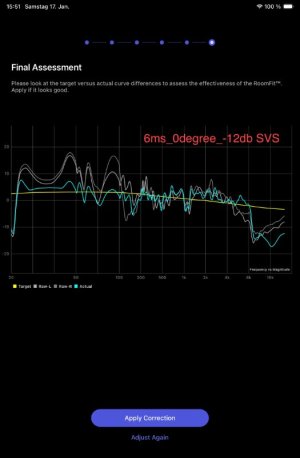
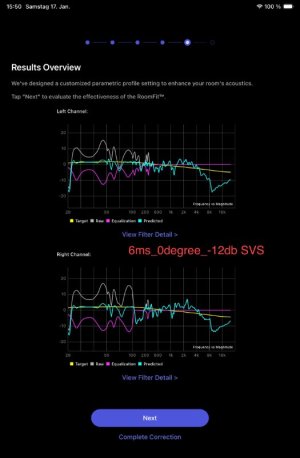
Sub integration | Sub & Speakers synch - automatic synch problem

Something else:
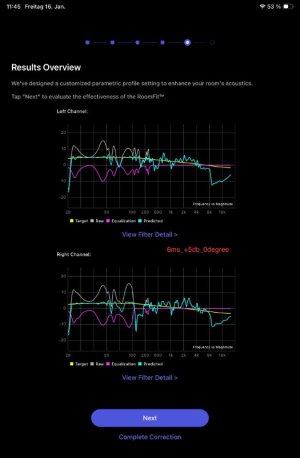
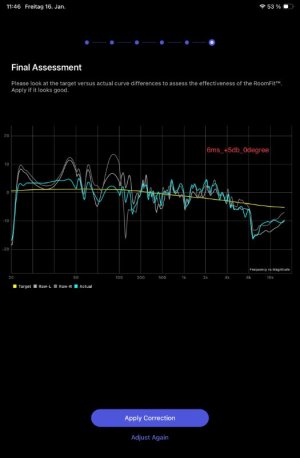
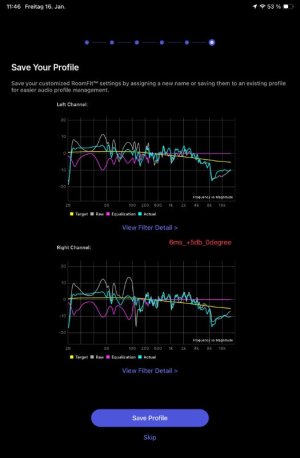
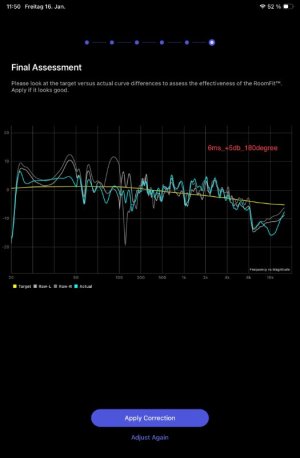
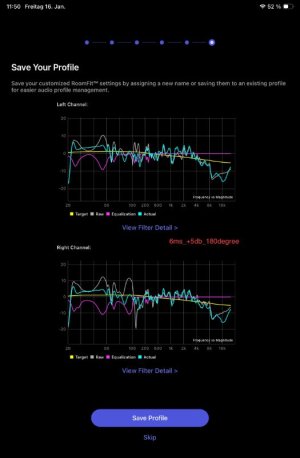
let´s assume someone has performed several RoomFit attempts and chooses a profile which differs from the current sub settings (e.g. sub settings are 9ms delay and 180 Phase but the chosen RoomFit profile is based on 6ms delay and 0 degree phase).

Will the Ultra ignore the current sub settings and uses the profile instead? Or is it required to change the sub settings to be in line with the values used in the profile?
You would need to manually adjust the sub settings. The ability to save a profile including sub settings has been asked for many times.
 
Honestly I`m puzzled which setting is the best.
Having your proposal, @dominikz, in mind, to choose the one with the highest value around 80Hz, I would lean for 11ms_0degree (post #7).
But I´m not totally sure.
Thanks for posting the comprehensive data on your environment and your tests!

Looking at your results, out of the ones you tested the 0° subwoofer polarity with 6ms loudspeaker delay seems to be the best baseline to my eyes, because it is the minimal delay where the notches/dips in the individual channel aren't too deep or wide:
img_0081-jpeg.32538

NOTE: As @slartibartfast suggested, you need to manually reconfigure polarity and delay in the Subwoofer menu, these values are not automatically restored when selecting a RoomFit profile.

The main acoustical problem now is the deep ~120Hz notch in the right channel, which is almost certainly caused by a reflection from the right speaker to the right side-wall (i.e. an SBIR null).
If you could move both your speakers ~50-60cm to the left that would probably fix this notch. Subwoofer should stay where it is.
If that is not possible in your living arrangement then I guess you'll just have to accept it. Luckily we're not that sensitive to narrow notches plus the left channel doesn't have the same issue, so this might not be very audible in the end.

Apart from moving the setup more to the left, I'd also advise to try to increase subwoofer level by about +5dB, and then re-run RoomFit.
That should make the bass response at the listening position smoother, and might improve some of the remaining dips/notches.

Lastly, if you have the older (non-Meta) KEF R3, you can try to add this loudspeaker response correction EQ profile, and enable it together with RoomFit (source):
Code:
# KEF R3 loudspeaker correction EQ (from spinorama.org):
Type    Freq    Q    Gain
PK    391.0    2.98    -0.85
PK    646.0    2.96    -1.08
PK    1261.0    0.49    1.26
PK    2545.0    2.79    0.34
PK    4966.0    2.04    -1.7
PK    10361.0    1.42    -0.75
PK    12662.0    0.72    1.29
I doubt this EQ would be a very meaningful audible improvement, but it is free so IMHO worth a test. :)

One thing that is a bit strange to me is that in most of your tests your left channel has a notch around the sub crossover, but not the right one. Let's see if the increased subwoofer level helps with that.
 
Thanks dominikz, much appreciated.

Unfortunately moving the speakers to the left won´t be possible due to sideboard and TV.
Hence I have to live with it ;-)

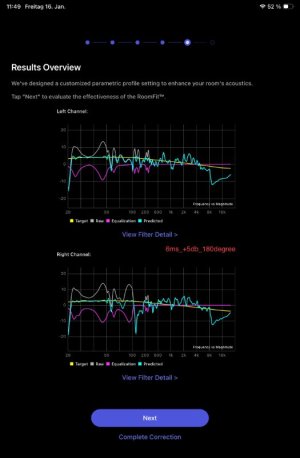
But I gave RoomFit another try with your proposed values (+5db sub level => only set in the WiiM app; still +20db in the SVS app).

0 degree:
IMG_0121.jpegIMG_0124.jpegIMG_0125.jpeg

180 degree:
IMG_0128.jpegIMG_0131.jpegIMG_0132.jpeg

Is this better?

Regarding Spinorama: I saw a link to that side in another WiiM Forum thread but I honestly didn´t understand how to read the "rankings" page.
Looks like that the R3 paired with a sub is a match in heaven. But information on the R3 page is beyond my current knowledge and I haven´t touched any EQ filter yet.
Maybe this is the next step. ;-)
 
Thanks dominikz, much appreciated.

Unfortunately moving the speakers to the left won´t be possible due to sideboard and TV.
Hence I have to live with it ;-)

But I gave RoomFit another try with your proposed values (+5db sub level => only set in the WiiM app; still +20db in the SVS app).

0 degree:
View attachment 32576View attachment 32577View attachment 32578

180 degree:
View attachment 32579View attachment 32580View attachment 32581

Is this better?
This looks pretty good to me! I'd advise to keep the 0° polarity, 6ms loudspeaker delay, and the increased subwoofer level.
How do you like the sound with this combination of settings, and after RoomFit is applied?

A minor note that I'd personally keep WHA subwoofer level at 0dB and instead increase the sub gain in the SVS app from -20dB to -15dB. There's no difference in normal use, but staying at 0dB in WHA avoids clipping the subwoofer output in case you ever decide to listen with WiiM volume set close to 100%. 🙂

Regarding Spinorama: I saw a link to that side in another WiiM Forum thread but I honestly didn´t understand how to read the "rankings" page.
That's understandable - it's definitely a lot of information to digest, and it is not really necessary to understand everything to still get some of the benefits. In case you're interested to dive deeper into this topic, I can highly recommend the book "Sound Reproduction: The Acoustics and Psychoacoustics of Loudspeakers, Rooms and Headphones" by dr. Floyd Toole.

First, don't worry too much about the absolute ranking. Ranking on spinorama.org is based around the so called "tonality score" (also often called "preference score", "Olive score" or "Harman score").
The short version is that the tonality score is a number calculated directly from anechoic measurements, and this number has been found to correlate reasonably well with listener preference of specific loudspeakers, at least on average.

But it is important to understand that this score is not a precise measure, and that you need a significant jump in the score to get it to translate into corresponding preference in a listening test as well. This obviously makes ranking where decimal values are taken into account a bit misleading.
Another problem is that the score value of any speaker also depends on the quality of the measurement protocol - and unfortunately lower quality measurements tend to inflate the tonality score (some of this is explained here). So it is best to only compare measurements of similar quality (spinorama.org allows you to filter on this).

Still, as a very rough heuristic we can say that loudspeakers with significantly higher "tonality scores" usually have better spinoramas, and are therefore more likely to be preferred by most people. We should just be careful not to overinterpret the exact score or ranking, and to understand their limitations.

Personally I see the score as a very rough (but still useful) guide when shortlisting speakers. However, I give much more weight to the details of anechoic measurements, as they are much more informative than any single number can be.

Looks like that the R3 paired with a sub is a match in heaven. But information on the R3 page is beyond my current knowledge and I haven´t touched any EQ filter yet.
Maybe this is the next step. ;-)
Since KEF R3 is a very good speaker as is, so the benefits of adding corrective EQ to it are likely limited, and may not even be that noticeable in practice. There's definitely no 'need' to correct it - I just thought you may find it interesting to try.
IMO you have assembled a very good system, if you don't mind me saying so. :)

 
Thanks again for your response, dominikz, your posts helped me a lot.
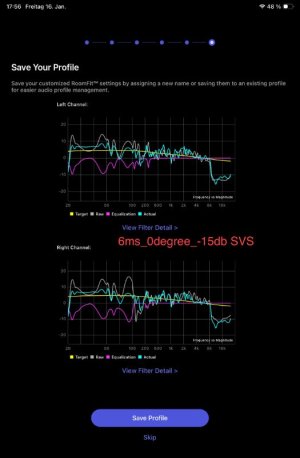
Here´s the measurement for 6ms / 0 degree and -15db level for the sub (set in the SVS app).

IMG_0136.jpeg

Maybe I will play a bit with the sub volume because if I disable "Sub out" in WiiM Home I don´t hear a difference. Only when I set the volume in the SVS app to -10db - which is by far not earth shaking in my room, only slightly emphasized - then the difference (Sub on / Sub out) will be audible. It´s not night and day but the missing sub is audible.
 
Thanks again for your response, dominikz, your posts helped me a lot.
No problem, I'm really glad you found them helpful!
Here´s the measurement for 6ms / 0 degree and -15db level for the sub (set in the SVS app).

IMG_0136.jpeg
That looks quite good to me, especially given the placement constraints. Good job!

Maybe I will play a bit with the sub volume because if I disable "Sub out" in WiiM Home I don´t hear a difference. Only when I set the volume in the SVS app to -10db - which is by far not earth shaking in my room, only slightly emphasized - then the difference (Sub on / Sub out) will be audible. It´s not night and day but the missing sub is audible.
There's a few things to note on this topic:
  • If the content you are listening to doesn't have much happening in the lowest octave, then it is not surprising it sounds similar with sub on or off. But if you try to play something with significant energy in the 20-40Hz region then the difference should be much more notable, since without a sub this part of the recording won't be audible at all.
  • The main motivation for adding a sub should be to be able to reproduce the lowest octave (i.e. to achieve full-range playback), and to smooth out the bass - which doesn't really need to mean a lot of bass. (Perhaps this post might be interesting)
  • The B&K target in RoomFit is intended to result in a pretty neutral response, without overpowering bass. If you prefer more bass I'd advise to use EQ to tune it to taste (see this post for a how to), instead of changing subwoofer level. Changing the subwoofer level can actually degrade the existing RoomFit correction (see here as well).
  • Another way to get more bass is to increase subwoofer level by another +5dB or so, then re-run RoomFit with the Harman target curve instead of B&K - that should give you significantly more bass even without EQ.
 
No problem, I'm really glad you found them helpful!

That looks quite good to me, especially given the placement constraints. Good job!


There's a few things to note on this topic:
  • If the content you are listening to doesn't have much happening in the lowest octave, then it is not surprising it sounds similar with sub on or off. But if you try to play something with significant energy in the 20-40Hz region then the difference should be much more notable, since without a sub this part of the recording won't be audible at all.
  • The main motivation for adding a sub should be to be able to reproduce the lowest octave (i.e. to achieve full-range playback), and to smooth out the bass - which doesn't really need to mean a lot of bass. (Perhaps this post might be interesting)
  • The B&K target in RoomFit is intended to result in a pretty neutral response, without overpowering bass. If you prefer more bass I'd advise to use EQ to tune it to taste (see this post for a how to), instead of changing subwoofer level. Changing the subwoofer level can actually degrade the existing RoomFit correction (see here as well).
  • Another way to get more bass is to increase subwoofer level by another +5dB or so, then re-run RoomFit with the Harman target curve instead of B&K - that should give you significantly more bass even without EQ.
I tried to find the right "level" with a couple of songs which I thought would "go down enough" such as:

Angel - Massive Attack

Wonder Where We Land - SBTRKT

Thanks for pointing to the SVS Micro thread, interesting read and gives further food for thought.
Guess it will be a trial and error process to find - at the end - the settings.

Just out of curiosity i did another RoomFit with -12db set in the SVS app:

IMG_0150.jpegIMG_0149.jpegIMG_0146.jpeg

From my "advanced beginner" view it doesn´t look too bad ;-)
Most likely I´ll stay in the -15 to - 12db range.
 
I tried to find the right "level" with a couple of songs which I thought would "go down enough" such as:

Angel - Massive Attack

Wonder Where We Land - SBTRKT

Thanks for pointing to the SVS Micro thread, interesting read and gives further food for thought.
Guess it will be a trial and error process to find - at the end - the settings.

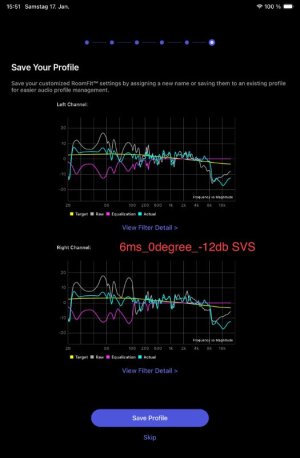
Just out of curiosity i did another RoomFit with -12db set in the SVS app:

View attachment 32641View attachment 32642View attachment 32643

From my "advanced beginner" view it doesn´t look too bad ;-)
Most likely I´ll stay in the -15 to - 12db range.
This one and the one before (sub at -15dB) look pretty similar to me - I suspect both should sound good! :)
But I fully support experimentation! :D

Regarding audibility of low bass - it's also worth noting that human hearing is less sensitive at very low frequencies. So depending on listening level it can absolutely make sense to boost bass to compensate (see "equal-loudness contours"). Or just crank the volume! :D
 
Back
Top