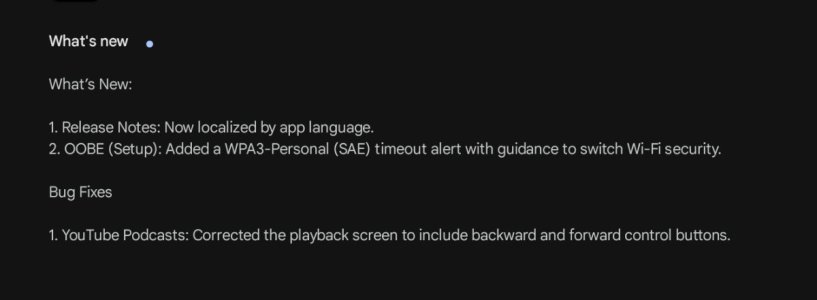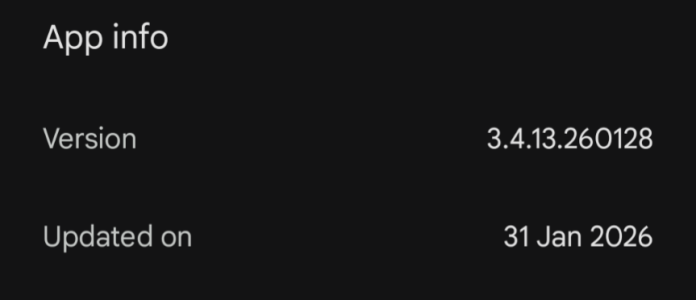
WiiM Home App v3.4.12 Update – Jan 26, 2026

Please review the app update release notes below. If you encounter any issues, feel free to reach out to us.

App Version:
3.4.12

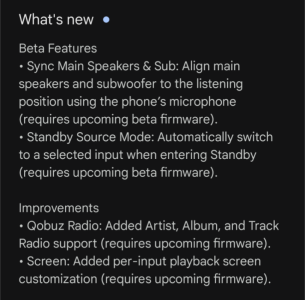
Beta Features

1. Sync Main Speakers & Sub: Align main speakers and subwoofer for the listening position using the phone’s microphone (requires an upcoming beta firmware update).
2. Standby Source Mode: Automatically switch to a selected input source when the device enters Standby (requires an upcoming beta firmware update).

Improvements

1. Qobuz Radio: Added support for Artist, Album, and Track Radio (requires an upcoming firmware update).
2. Room Correction: Added Variable, Psychoacoustic, and ERB smoothing options.
3. OOBE: Improved Wi-Fi setup stability.
4. Screen: Added per-input playback screen customization (requires an upcoming firmware update).

Bug Fixes

1. Plex: Fixed a bitrate downsampling issue.
2. NAS: Fixed local playlist playback failures and resolved Synology indexing issues on certain models.
3. [Android] Fixed a crash caused by oversized images.
 
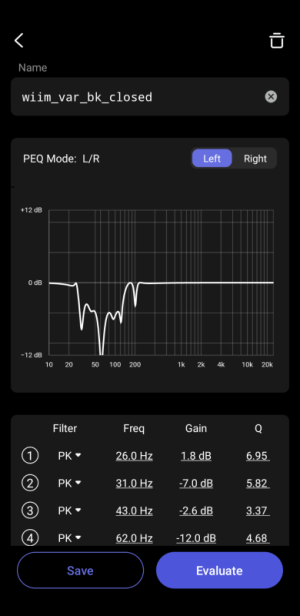
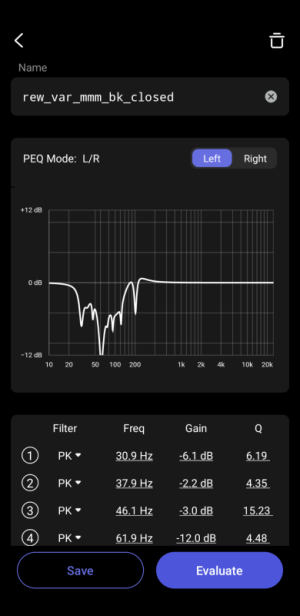
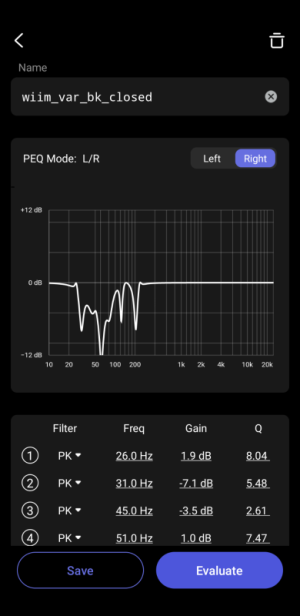
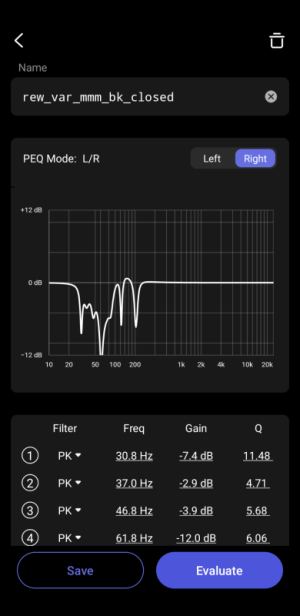
Thanks for sharing the RoomFit screenshots @Wiimer!

Yes, in principle.

Variable smoothing applies 1/48 octave below 100 Hz - which is much less smoothing (i.e. revealing more response detail) than 1/12 octave.

The constraint, however, is the fact that Max Q attribute is limited to only 10 in RoomFit. Q=10 corresponds to a bandwidth of about 1/7 octave (link to reference). Combining a few PEQ bands you can get higher precision than that, but probably not as much as you could if e.g. higher Q values were allowed (like you can e.g. allow in REW).

For comparison:
  • A single PEQ with Q=0.67 has about 2 octave bandwidth
  • A single PEQ with Q=1.4 has about 1 octave bandwidth
  • A single PEQ with Q=4.3 has about 1/3 octave bandwidth
  • A single PEQ with Q=8.7 has about 1/6 octave bandwidth
  • A single PEQ with Q=17 has about 1/12 octave bandwidth
  • A single PEQ with Q=69 has about 1/48 octave bandwidth
This is of course not to say that higher Q PEQ values are strictly needed for good results, I'm just giving examples trying to explain how it all works! :)
We can measure the case by case encountered... (explains my rambling above)
"I could offer us anything and it would be up to us to choose without technical considerations...but subjective ones in the long term."

Sometimes, subjective sorting (especially by bass and treble) will often be much more effective than observing our curves in detail... and besides... that's just the end goal. ;-)
 
Last edited:
Thanks for sharing the RoomFit screenshots @Wiimer!

Yes, in principle.

Variable smoothing applies 1/48 octave below 100 Hz - which is much less smoothing (i.e. revealing more response detail) than 1/12 octave.

The constraint, however, is the fact that Max Q attribute is limited to only 10 in RoomFit. Q=10 corresponds to a bandwidth of about 1/7 octave (link to reference). Combining a few PEQ bands you can get higher precision than that, but probably not as much as you could if e.g. higher Q values were allowed (like you can e.g. allow in REW).

For comparison:
  • A single PEQ with Q=0.67 has about 2 octave bandwidth
  • A single PEQ with Q=1.4 has about 1 octave bandwidth
  • A single PEQ with Q=4.3 has about 1/3 octave bandwidth
  • A single PEQ with Q=8.7 has about 1/6 octave bandwidth
  • A single PEQ with Q=17 has about 1/12 octave bandwidth
  • A single PEQ with Q=69 has about 1/48 octave bandwidth
This is of course not to say that higher Q PEQ values are strictly needed for good results, I'm just giving examples trying to explain how it all works! :)
Thanks for explaining it so clearly as always. Playing with new toys is so fun.😄
 
I haven't observed how Roomfit works, but one idea seems quite obvious and simple: for a given measurement, Roomfit provides several PEQ (Personal Efficiency) suggestions, whether for smoothing, curves, or a mix of both. Admittedly, this results in quite a few profiles, just a little extra calculation. Then there would be the possibility of quantified observation, but especially the possibility of subjective evaluation over time, followed by the deletion of profiles that are no longer useful. Is this already the case? For example, does it offer a BK (Block Correction) setting at 1/12 and a VAR (Variable Adjustment) setting to test in a single measurement?
At the moment this is not possible in RoomFit (i.e. you have to repeat the measurement for every RoomFit configuration change you make), but I completely agree that it would be great if we could modify parameters after the measurement is done and get a different correction without having to repeat the measurement.
We can measure the case by case encountered... (explains my rambling above)
"I could offer us anything and it would be up to us to choose without technical considerations...but subjective ones in the long term."

Sometimes, subjective sorting (especially by bass and treble) will often be much more effective than observing our curves in detail... and besides... that's just the end goal. ;-)
To be honest, my hope is that in time a single RoomFit run should be enough for most people, combined with simple bass/treble adjustment for fine tuning the tonality to taste (e.g. like suggested here, but made easier in time by WiiM).

This is of course assuming physical placement (and subwoofer integration, if any) has been optimized already.

But I'd say we're not there yet.
Perhaps suggesting a 1/24 smoothing for bass would be a good idea...:oops::oops::oops:
;-))
IMHO Variable and 1/12 are sufficient, I personally don't see that adding 1/24 on top of those would add much value, honestly.
And using 1/24 smoothing with e.g. fullrange correction would almost certainly degrade the sound in most cases. So adding 1/24 smoothing would actually bring some new risks.
 
Back
Top