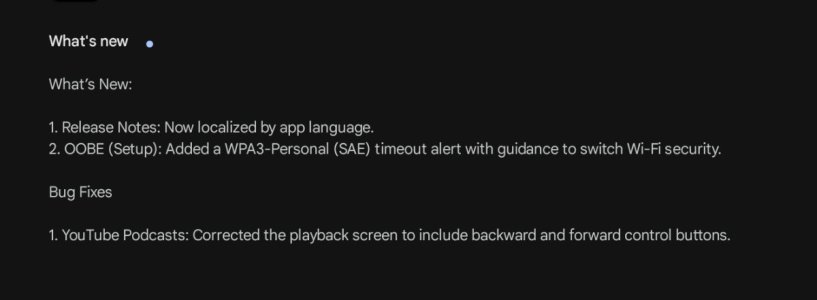
WiiM Home App v3.4.12 Update – Jan 26, 2026

Please review the app update release notes below. If you encounter any issues, feel free to reach out to us.

App Version:
3.4.12

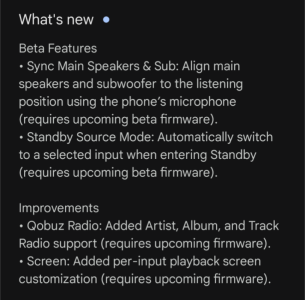
Beta Features

1. Sync Main Speakers & Sub: Align main speakers and subwoofer for the listening position using the phone’s microphone (requires an upcoming beta firmware update).
2. Standby Source Mode: Automatically switch to a selected input source when the device enters Standby (requires an upcoming beta firmware update).

Improvements

1. Qobuz Radio: Added support for Artist, Album, and Track Radio (requires an upcoming firmware update).
2. Room Correction: Added Variable, Psychoacoustic, and ERB smoothing options.
3. OOBE: Improved Wi-Fi setup stability.
4. Screen: Added per-input playback screen customization (requires an upcoming firmware update).

Bug Fixes

1. Plex: Fixed a bitrate downsampling issue.
2. NAS: Fixed local playlist playback failures and resolved Synology indexing issues on certain models.
3. [Android] Fixed a crash caused by oversized images.
 
Thanks for sharing the RoomFit screenshots @Wiimer!

Yes, in principle.

Variable smoothing applies 1/48 octave below 100 Hz - which is much less smoothing (i.e. revealing more response detail) than 1/12 octave.

The constraint, however, is the fact that Max Q attribute is limited to only 10 in RoomFit. Q=10 corresponds to a bandwidth of about 1/7 octave (link to reference). Combining a few PEQ bands you can get higher precision than that, but probably not as much as you could if e.g. higher Q values were allowed (like you can e.g. allow in REW).

For comparison:
  • A single PEQ with Q=0.67 has about 2 octave bandwidth
  • A single PEQ with Q=1.4 has about 1 octave bandwidth
  • A single PEQ with Q=4.3 has about 1/3 octave bandwidth
  • A single PEQ with Q=8.7 has about 1/6 octave bandwidth
  • A single PEQ with Q=17 has about 1/12 octave bandwidth
  • A single PEQ with Q=69 has about 1/48 octave bandwidth
This is of course not to say that higher Q PEQ values are strictly needed for good results, I'm just giving examples trying to explain how it all works! :)
We can measure the case by case encountered... (explains my rambling above)
"I could offer us anything and it would be up to us to choose without technical considerations...but subjective ones in the long term."

Sometimes, subjective sorting (especially by bass and treble) will often be much more effective than observing our curves in detail... and besides... that's just the end goal. ;-)
 
Last edited:
Thanks for sharing the RoomFit screenshots @Wiimer!

Yes, in principle.

Variable smoothing applies 1/48 octave below 100 Hz - which is much less smoothing (i.e. revealing more response detail) than 1/12 octave.

The constraint, however, is the fact that Max Q attribute is limited to only 10 in RoomFit. Q=10 corresponds to a bandwidth of about 1/7 octave (link to reference). Combining a few PEQ bands you can get higher precision than that, but probably not as much as you could if e.g. higher Q values were allowed (like you can e.g. allow in REW).

For comparison:
  • A single PEQ with Q=0.67 has about 2 octave bandwidth
  • A single PEQ with Q=1.4 has about 1 octave bandwidth
  • A single PEQ with Q=4.3 has about 1/3 octave bandwidth
  • A single PEQ with Q=8.7 has about 1/6 octave bandwidth
  • A single PEQ with Q=17 has about 1/12 octave bandwidth
  • A single PEQ with Q=69 has about 1/48 octave bandwidth
This is of course not to say that higher Q PEQ values are strictly needed for good results, I'm just giving examples trying to explain how it all works! :)
Thanks for explaining it so clearly as always. Playing with new toys is so fun.😄
 
I haven't observed how Roomfit works, but one idea seems quite obvious and simple: for a given measurement, Roomfit provides several PEQ (Personal Efficiency) suggestions, whether for smoothing, curves, or a mix of both. Admittedly, this results in quite a few profiles, just a little extra calculation. Then there would be the possibility of quantified observation, but especially the possibility of subjective evaluation over time, followed by the deletion of profiles that are no longer useful. Is this already the case? For example, does it offer a BK (Block Correction) setting at 1/12 and a VAR (Variable Adjustment) setting to test in a single measurement?
At the moment this is not possible in RoomFit (i.e. you have to repeat the measurement for every RoomFit configuration change you make), but I completely agree that it would be great if we could modify parameters after the measurement is done and get a different correction without having to repeat the measurement.
We can measure the case by case encountered... (explains my rambling above)
"I could offer us anything and it would be up to us to choose without technical considerations...but subjective ones in the long term."

Sometimes, subjective sorting (especially by bass and treble) will often be much more effective than observing our curves in detail... and besides... that's just the end goal. ;-)
To be honest, my hope is that in time a single RoomFit run should be enough for most people, combined with simple bass/treble adjustment for fine tuning the tonality to taste (e.g. like suggested here, but hopefully made easier at some point by WiiM).

This is of course assuming physical placement (and subwoofer integration, if any) has been optimized already.

But I'd say we're not there yet.
Perhaps suggesting a 1/24 smoothing for bass would be a good idea...:oops::oops::oops:
;-))
IMHO Variable and 1/12 are sufficient, I personally don't see that adding 1/24 on top of those would add much value, honestly.
And using 1/24 smoothing with e.g. fullrange correction would almost certainly degrade the sound in most cases. So adding 1/24 smoothing would actually bring some new risks.
 
Last edited:
At the moment this is not possible in RoomFit (i.e. you have to repeat the measurement for every RoomFit configuration change you make), but I completely agree that it would be great if we could modify parameters after the measurement is done and get a different correction without having to repeat the measurement.

To be honest, my hope is that in time a single RoomFit run should be enough for most people, combined with simple bass/treble adjustment for fine tuning the tonality to taste (e.g. like suggested here, but hopefully made easier at some point by WiiM).

This is of course assuming physical placement (and subwoofer integration, if any) has been optimized already.

But I'd say we're not there yet.

IMHO Variable and 1/12 are sufficient, I personally don't see that adding 1/24 on top of those would add much value, honestly.
And using 1/24 smoothing with e.g. fullrange correction would almost certainly degrade the sound in most cases. So adding 1/24 smoothing would actually bring some new risks.
I wasn't thinking full band... but just for cases in the low frequencies where 1/48 of the VAR is "too much" ;-)
 
This could explain some of the differences you saw, I guess.
BTW, I'd say that most people aren't aware that you can configure PEQ attribute limits in REW to make it a better fit to WiiM PEQ implementation constraints.
Luckily, seems like @WiiM Team are considering requesting that WiiM PEQ profile be added to REW (link) which would help a lot with this, IMHO!
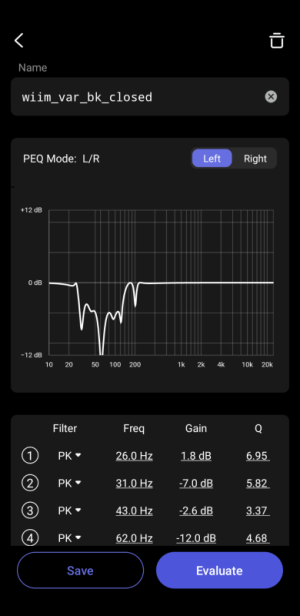
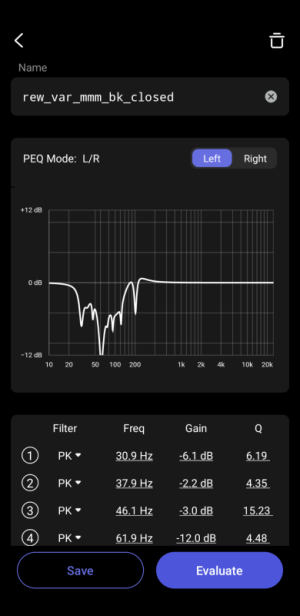
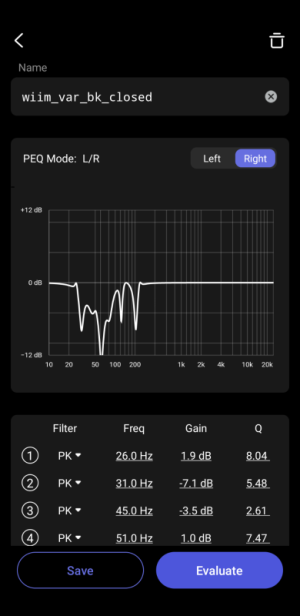
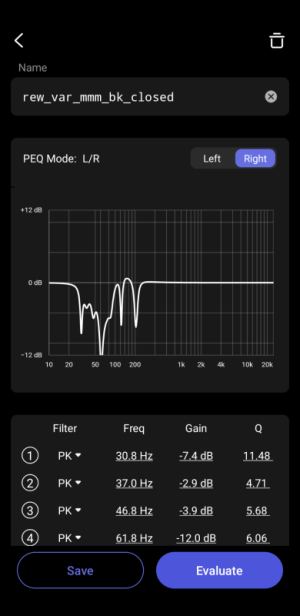
I repeated the measurements and this time REW gave me the expected flat response. I also made sure I moved the mic over an area centrally between the speakers. I made another WiiM variable measurement immediately afterwards. I didn't screenshot the results but these are the filter comparisons.
They look very similar to me 👍

Screenshot_20260130-121353.png
Screenshot_20260130-121421.png
Screenshot_20260130-121403.png
Screenshot_20260130-121430.png
 
Last edited:
I repeated the measurements and this time REW gave me the expected flat response. I also made sure I moved the mic over an area centrally between the speakers. I made another WiiM variable measurement immediately afterwards. I didn't screenshot the results but these are the filter comparisons.
They look very similar to me 👍

View attachment 33189
View attachment 33190
View attachment 33191
View attachment 33192
I'm always a little perplexed to see so many PEQ points on just this bandwidth (even if it actually represents several octaves). I'd be curious to hear your feedback if you, like some software, were able to determine a more modest number of points to consider before the calculations... a subjective result? (But I'm also a little surprised to see 20Hz to 300Hz and not more modestly 30/35Hz.)
;-)
 
I'm always a little perplexed to see so many PEQ points on just this bandwidth (even if it actually represents several octaves). I'd be curious to hear your feedback if you, like some software, were able to determine a more modest number of points to consider before the calculations... a subjective result? (But I'm also a little surprised to see 20Hz to 300Hz and not more modestly 30/35Hz.)
;-)
If you choose a wider flatness target in REW the number of filters reduces. Also choosing 1/6 octave smoothing would reduce the number of filters.
 
If you choose a wider flatness target in REW the number of filters reduces. Also choosing 1/6 octave smoothing would reduce the number of filters.
I was talking about Roomfit, not Rew... but I imagined that at 1/6 fewer points would be offered... ;-)
It would just sometimes be interesting to be able to manually determine a number of points before calculation, allowing some to be kept for easy global corrections manual above 1k, for example ;-)

(Corrections below 35/40Hz always raise questions, whether they are appropriate or not depending on the material...same thingd with headphone too etc)
 
I wasn't thinking full band... but just for cases in the low frequencies where 1/48 of the VAR is "too much" ;-)
Sure, I understood that is what you meant. But I just wanted to point out that in case 1/24 octave smoothing was added there would inevitably be at least some users who would attempt to use 1/24 smoothing with full range correction and then might be dissatisfied by results.

From my perspective the main benefit of variable smoothing isn't the specific smoothing factor value that is used - the benefit is that you get a response baseline for correction which has more details in the bass, and more smoothing in the highs. The exact smoothing factors are just implementation details which are IMO not that important.

To be entirely honest, if variable smoothing was the *only* smoothing option provided by RoomFit that would IMHO be entirely sufficient for any real-world scenario. It might even be better - sometimes more choice is not really better. :)

I repeated the measurements and this time REW have me the expected flat response. I also made sure I moved the mic over an area centrally between the speakers. I made another WiiM variable measurement immediately afterwards. I didn't screenshot the results but these are the filter comparisons.
They look very similar to me 👍

View attachment 33189
View attachment 33190
View attachment 33191
View attachment 33192
Looks pretty similar to me, yes. Thanks for sharing!
Of course REW correction filters are a bit more precise because REW can use filters with higher Q values, while RoomFit is limited to Q=10 and lower. This is as I'd expect the comparison to look like, so that's good news in my book!

I was talking about Roomfit, not Rew... but I imagined that at 1/6 fewer points would be offered... ;-)
It would just sometimes be interesting to be able to manually determine a number of points before calculation, allowing some to be kept for easy global corrections manual above 1k, for example ;-)
At the moment RoomFit always utilizes all 10 PEQ bands, at any selected bandwidth.
This is not always efficient, but also doesn't create any audible issues so I can personally live with this limitation. If I need additional corrections at higher frequencies I just add EQ on top.
But I'm also a little surprised to see 20Hz to 300Hz and not more modestly 30/35Hz.
Note that RoomFit automatically detects where the response drops at low frequencies.
So even if you use 20Hz as the lower bound of the correction range in RoomFit configuration, but your system rolls off at 35Hz, RoomFit will only apply corrections from 35Hz upward.
This was added as an enhancement a few releases back, to avoid trying to boost where the system has limited output anyway. Makes sense to me!
 
(((
Question... Wouldn't too many peaks with strong Q over, for example, in 3-4 octaves of bass (or the case on headphones above 1kHz etc.)have negative impacts or even cause regrettable artifacts, theoretically or subjectively?
;-)
)))
 
In
Sure, I understood that is what you meant. But I just wanted to point out that in case 1/24 octave smoothing was added there would inevitably be at least some users who would attempt to use 1/24 smoothing with full range correction and then might be dissatisfied by results.

From my perspective the main benefit of variable smoothing isn't the specific smoothing factor value that is used - the benefit is that you get a response baseline for correction which has more details in the bass, and more smoothing in the highs. The exact smoothing factors are just implementation details which are IMO not that important.

To be entirely honest, if variable smoothing was the *only* smoothing option provided by RoomFit that would IMHO be entirely sufficient for any real-world scenario. It might even be better - sometimes more choice is not really better. :)


Looks pretty similar to me, yes. Thanks for sharing!
Of course REW correction filters are a bit more precise because REW can use filters with higher Q values, while RoomFit is limited to Q=10 and lower. This is as I'd expect the comparison to look like, so that's good news in my book!


At the moment RoomFit always utilizes all 10 PEQ bands, at any selected bandwidth.
This is not always efficient, but also doesn't create any audible issues so I can personally live with this limitation. If I need additional corrections at higher frequencies I just add EQ on top.

Note that RoomFit automatically detects where the response drops at low frequencies.
So even if you use 20Hz as the lower bound of the correction range in RoomFit configuration, but your system rolls off at 35Hz, RoomFit will only apply corrections from 35Hz upward.
This was added as an enhancement a few releases back, to avoid trying to boost where the system has limited output anyway. Makes sense to me!
RoomFit is limited to a maximum Q of 10 even though PEQ accepts a maximum of 24. I suppose setting a maximum Q of 10 in REW would make the results even more similar. Initially I had left the max Q in REW at 50 but reduced it to 24 after a Q higher than 24 appeared on one channel. Changing the max Q on the channel which already had Q values less than 24 actually changed the resulting filters which I wasn't expecting. Small changes but why?
 
Back
Top