WiiM Home App v3.4.12 Update – Jan 26, 2026

Please review the app update release notes below. If you encounter any issues, feel free to reach out to us.

App Version:
3.4.12

Beta Features

1. Sync Main Speakers & Sub: Align main speakers and subwoofer for the listening position using the phone’s microphone (requires an upcoming beta firmware update).
2. Standby Source Mode: Automatically switch to a selected input source when the device enters Standby (requires an upcoming beta firmware update).

Improvements

1. Qobuz Radio: Added support for Artist, Album, and Track Radio (requires an upcoming firmware update).
2. Room Correction: Added Variable, Psychoacoustic, and ERB smoothing options.
3. OOBE: Improved Wi-Fi setup stability.
4. Screen: Added per-input playback screen customization (requires an upcoming firmware update).

Bug Fixes

1. Plex: Fixed a bitrate downsampling issue.
2. NAS: Fixed local playlist playback failures and resolved Synology indexing issues on certain models.
3. [Android] Fixed a crash caused by oversized images.
 
There's a powerful tool in REW that allows you to observe the overall behavior of acoustic modes of your room, to understand their orders of magnitude, etc. It's quite enlightening and educational—a helpful tool for proper placement, etc. It should be approached seriously before expecting miracles from a "roomfit" system.
;-)
If your room is rectangular.
 
Resolved

Hi @WiiM Team

The button to disable screen rotation in RoomFit on my Android phone has disappeared again.😑
 
Last edited:
Thanks for the test!
Perhaps worth pointing out that with this highly zoomed-in plot (only 17dB vertical scale) the differences look more significant then they really are. With the standard 50dB vertical scale and 20Hz to 20kHz horizontal scale the differences would visually decrease.

Apart from that, I agree with @EddNog difficult to comment without having much more details. I'll probably do a similar test in the next days and report my findings as well.
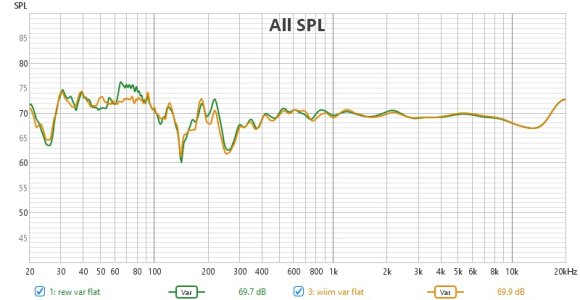
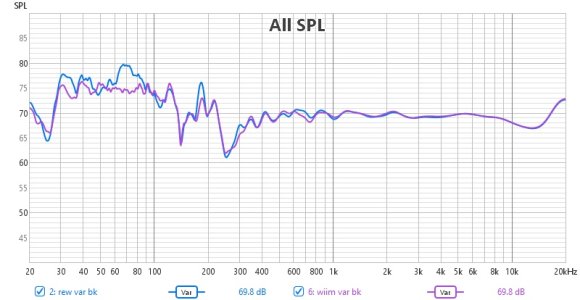
I did some more tests tonight and I seem to get better results from WiiM var mmm than REW.
Yellow = WiiM flat
Green = REW flat

varflat.jpg

Violet = WiiM B&K
Blue = REW B&K

varbk.jpg
 
I did some more tests tonight and I seem to get better results from WiiM var mmm than REW.
Yellow = WiiM flat
Green = REW flat

View attachment 33170

Violet = WiiM B&K
Blue = REW B&K

View attachment 33171
Interesting…in past attempts to use RoomFit, I got a similar bump around that 60-80Hz range with it (RoomFit) that didn’t occur with DIRAC, whereas you’re getting it with REW and not RoomFit. 🤔

-Ed
 
Interesting…in past attempts to use RoomFit, I got a similar bump around that 60-80Hz range with it (RoomFit) that didn’t occur with DIRAC, whereas you’re getting it with REW and not RoomFit. 🤔

-Ed
I don't understand why REW is doing that which annoys me 🤔
 
I did some more tests tonight and I seem to get better results from WiiM var mmm than REW.
Yellow = WiiM flat
Green = REW flat

View attachment 33170

Violet = WiiM B&K
Blue = REW B&K

View attachment 33171
Is this done with MMM?
Could it be there was some environment noise that contaminated the measurement (either during calibration, or while you were validating your results)?
I'm asking because in my experience REW and RoomFit corrections match the predicted curve pretty closely - but pink-noise (MMM) measurements are sensitive to external noise so that can throw them off a bit sometimes. Sweep is much more resistant to noise, so you can try to use that and compare.
Unfortunately I still didn't have any time for tests, maybe more luck during the weekend.
 
Is this done with MMM?
Could it be there was some environment noise that contaminated the measurement (either during calibration, or while you were validating your results)?
I'm asking because in my experience REW and RoomFit corrections match the predicted curve pretty closely - but pink-noise (MMM) measurements are sensitive to external noise so that can throw them off a bit sometimes. Sweep is much more resistant to noise, so you can try to use that and compare.
Unfortunately I still didn't have any time for tests, maybe more luck during the weekend.
You been active on measuring and testing but how does it sound after room correction?
 
You been active on measuring and testing but how does it sound after room correction?
System with room correction applied (when done correctly) always sounds better to me than without room correction. This is because I find room resonances very audible and distacting.

But apart from that, basically I've been using the same approach to room correction for probably around 5 years now:
  • B&K target (or -0.6dB/oct slope target),
  • no boosts,
  • individual channel correction,
  • correction range only below ~400Hz,
  • 1/12 or variable smoothing
This IMO works similarly well in both REW or RoomFit.

There are many small config variations one can make to get slightly different results, but IMHO once the differences get below a certain level I don't really obsess about it any more. I'm not actively looking for improvements to the corrections I use.
In the past I did extensive listening tests of various approaches to room correction (see one example here), which is why I don't feel the need to do it anymore.

The reason why I post all of my analyses and measurements here is to check WiiM implementation, to help other people, and because I enjoy doing the work and sharing the results. :) Nothing more.
 
Last edited:
Is this done with MMM?
Could it be there was some environment noise that contaminated the measurement (either during calibration, or while you were validating your results)?
I'm asking because in my experience REW and RoomFit corrections match the predicted curve pretty closely - but pink-noise (MMM) measurements are sensitive to external noise so that can throw them off a bit sometimes. Sweep is much more resistant to noise, so you can try to use that and compare.
Unfortunately I still didn't have any time for tests, maybe more luck during the weekend.
Yes it was mmm. I made the raw REW measurements the day before and generated both flat and B&K filters from them. I should repeat the REW raw measurements to see if the results change.
I only just realised I can use the Configurable PEQ feature in REW to limit the number of filters and the maximum gain. Previously I have been adjusting the flatness target to control the number of filters and manually splitting filters with gain higher than 12 into two and also manually rounding Q values. 🤣
 
Previously I have been adjusting the flatness target to control the number of filters and manually splitting filters with gain higher than 12 into two and also manually rounding Q values.
This could explain some of the differences you saw, I guess.
BTW, I'd say that most people aren't aware that you can configure PEQ attribute limits in REW to make it a better fit to WiiM PEQ implementation constraints.
Luckily, seems like @WiiM Team are considering requesting that WiiM PEQ profile be added to REW (link) which would help a lot with this, IMHO!
 
I tried it a bit. Does variable smoothing allow finer adjustment than 1/12 in the low frequencies?

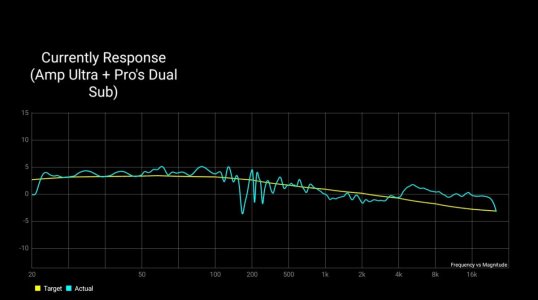
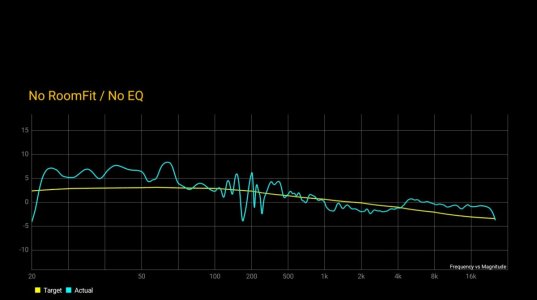
This is the current response of my main system. The main speakers are connected to the Amp Ultra, and two subs are connected to the Pro unit connected to the sub out. The subs are adjusted using the Pro's PEQ filter.
709bf593-5c21-44a7-b4d1-8fcb58ee3da2-1_all_3788.jpg


And this is the raw response with all RoomFit and PEQ turned off.
709bf593-5c21-44a7-b4d1-8fcb58ee3da2-1_all_3789.jpg


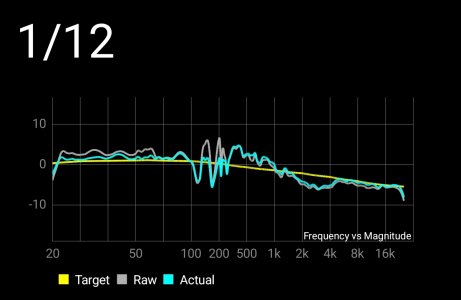
I tried correcting the 20Hz-300Hz range using Amp Ultra's RoomFit in this state.
(Since my tablet doesn't have the latest app yet, I measured the rest using my smartphone.)


1/12 smoothing
(Stereo MMM, 20-300Hz)
2119.jpg

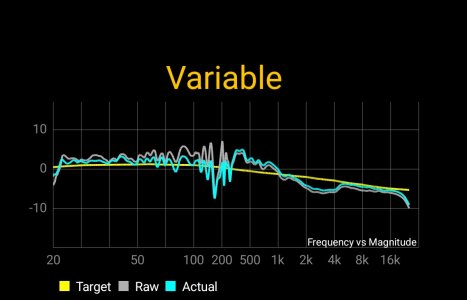
Variable smoothing
(Stereo MMM, 20-300Hz)
2121.jpg

I'm surprised that the measurement results differ significantly between 70Hz and 150Hz.

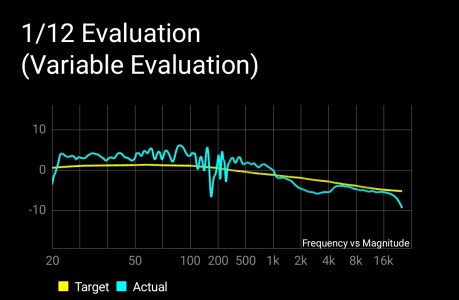
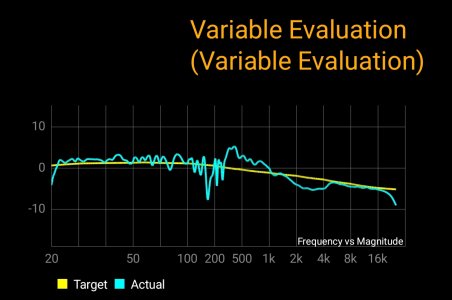
And these are the saved profile evaluation results. Both were evaluated using variable smoothing.

1/12
2125.jpg

Variable
2127.jpg

Variable smoothing provides a flatter response within the correction range, but without also correcting the 300Hz-1kHz range, the balance appears off.

For now, I plan to keep using the PEQ filter I created myself for the Sub. However, once the update arrives on my tablet, I intend to try variable smoothing on the main speakers only. 🙂
 
Thanks for sharing the RoomFit screenshots @Wiimer!
Does variable smoothing allow finer adjustment than 1/12 in the low frequencies?
Yes, in principle.

Variable smoothing applies 1/48 octave below 100 Hz - which is much less smoothing (i.e. revealing more response detail) than 1/12 octave.

The constraint, however, is the fact that Max Q attribute is limited to only 10 in RoomFit. Q=10 corresponds to a bandwidth of about 1/7 octave (link to reference). Combining a few PEQ bands you can get higher precision than that, but probably not as much as you could if e.g. higher Q values were allowed (like you can e.g. allow in REW).

For comparison:
  • A single PEQ with Q=0.67 has about 2 octave bandwidth
  • A single PEQ with Q=1.4 has about 1 octave bandwidth
  • A single PEQ with Q=4.3 has about 1/3 octave bandwidth
  • A single PEQ with Q=8.7 has about 1/6 octave bandwidth
  • A single PEQ with Q=17 has about 1/12 octave bandwidth
  • A single PEQ with Q=69 has about 1/48 octave bandwidth
This is of course not to say that higher Q PEQ values are strictly needed for good results, I'm just giving examples trying to explain how it all works! :)
 
I haven't observed how Roomfit works, but one idea seems quite obvious and simple: for a given measurement, Roomfit provides several PEQ (Personal Efficiency) suggestions, whether for smoothing, curves, or a mix of both. Admittedly, this results in quite a few profiles, just a little extra calculation. Then there would be the possibility of quantified observation, but especially the possibility of subjective evaluation over time, followed by the deletion of profiles that are no longer useful. Is this already the case? For example, does it offer a BK (Block Correction) setting at 1/12 and a VAR (Variable Adjustment) setting to test in a single measurement?
 
Back
Top