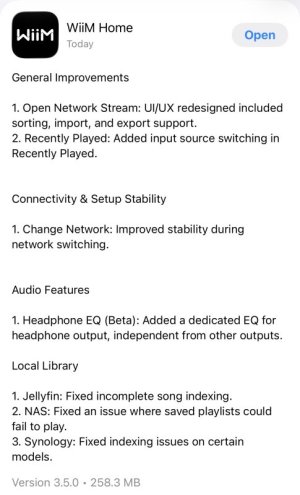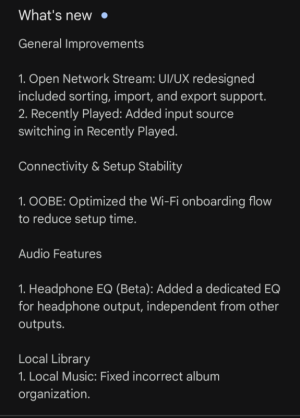
WiiM Home App v3.4.12 Update – Jan 26, 2026

Please review the app update release notes below. If you encounter any issues, feel free to reach out to us.

App Version:
3.4.12

Beta Features

1. Sync Main Speakers & Sub: Align main speakers and subwoofer for the listening position using the phone’s microphone (requires an upcoming beta firmware update).
2. Standby Source Mode: Automatically switch to a selected input source when the device enters Standby (requires an upcoming beta firmware update).

Improvements

1. Qobuz Radio: Added support for Artist, Album, and Track Radio (requires an upcoming firmware update).
2. Room Correction: Added Variable, Psychoacoustic, and ERB smoothing options.
3. OOBE: Improved Wi-Fi setup stability.
4. Screen: Added per-input playback screen customization (requires an upcoming firmware update).

Bug Fixes

1. Plex: Fixed a bitrate downsampling issue.
2. NAS: Fixed local playlist playback failures and resolved Synology indexing issues on certain models.
3. [Android] Fixed a crash caused by oversized images.
 
I did some more tests tonight and I seem to get better results from WiiM var mmm than REW.
Yellow = WiiM flat
Green = REW flat

View attachment 33170

Violet = WiiM B&K
Blue = REW B&K

View attachment 33171
Finally managed to make some measurements today.

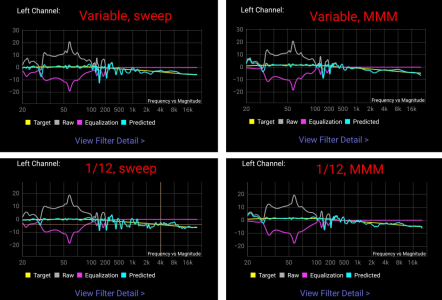
Let's compare Variable and 1/12 smoothing with both MMM and a single point sweep, all with correction range set to 20Hz to 300Hz (and all other setting equal):
1770322840885.png

As we can see above, all of these approaches result in similar "Equalization" curves and therefore the "Predicted" curves are similar as well. This is in line with expectation - at low frequencies all of these approaches are equally valid, so no big differences are expected.

One thing to note is the <30Hz response, where we can see a difference between sweep and MMM attempts. This is specific to my system - when using MMM RoomFit (incorrectly) assumes the response rolls of at 32Hz (because of the null there), and that the curve below it is environmental noise so doesn't correct it.

Now let's evaluate the RoomFit corrected responses with REW and MMM.

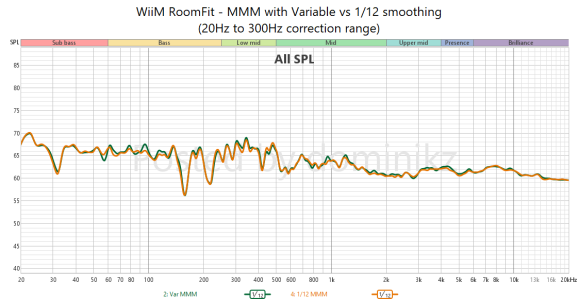
Here's how a RoomFit correction based on MMM 1/12 smoothing compares to the one made with Variable smoothing (single channel response shown):
1770322179482.png
No meaningful difference, at least not when the correction is limited to low frequencies only.

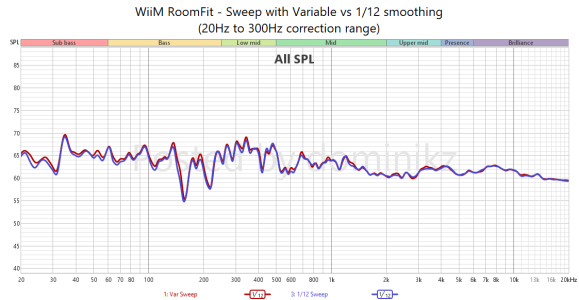
If using a just single point sweep instead of MMM again the results are pretty similar with either smoothing:
1770322265559.png
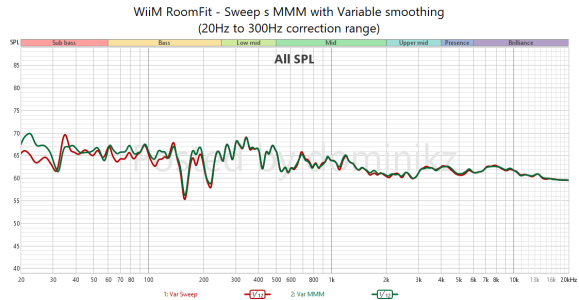
Lastly, let's compare MMM vs single point sweep when using variable smoothing for both:
1770322326368.png
Apart from the <30Hz difference (explained at the beginning of the post), the remaining differences are pretty small (but they are there). MMM is a bit smoother.

All in all, my conclusion is that variable smoothing works exactly as expected!

After all this people might ask why even bother if everything is so similar? My advice is to try and resist overthinking it. :D

Regarding measurement type:
  • If you don't have a lot of time and/or can't control environment noise use a single point sweep.
  • Otherwise MMM produces responses which are smoother and more similar to loudspeaker's anechoically Predicted In-Room (PIR) response. But do note that MMM is much more sensitive to noise and user-error than the single point sweep.
In both cases I'd personally always recommend using Variable smoothing - actually, I really don't see the need to use any other smoothing type for room correction purposes. Variable smoothing is precise in the bass (so it can fix sharp resonances), and smooth in the highs (which reduces the chance of overcorrection, especially when using a single sweep to measure).
 
Finally managed to make some measurements today.

Let's compare Variable and 1/12 smoothing with both MMM and a single point sweep, all with correction range set to 20Hz to 300Hz (and all other setting equal):
View attachment 33429

As we can see above, all of these approaches result in similar "Equalization" curves and therefore the "Predicted" curves are similar as well. This is in line with expectation - at low frequencies all of these approaches are equally valid, so no big differences are expected.

One thing to note is the <30Hz response, where we can see a difference between sweep and MMM attempts. This is specific to my system - when using MMM RoomFit (incorrectly) assumes the response rolls of at 32Hz (because of the null there), and that the curve below it is environmental noise so doesn't correct it.

Now let's evaluate the RoomFit corrected responses with REW and MMM.

Here's how a RoomFit correction based on MMM 1/12 smoothing compares to the one made with Variable smoothing (single channel response shown):
View attachment 33426
No meaningful difference, at least not when the correction is limited to low frequencies only.

If using a just single point sweep instead of MMM again the results are pretty similar with either smoothing:
View attachment 33427
Lastly, let's compare MMM vs single point sweep when using variable smoothing for both:
View attachment 33428
Apart from the <30Hz difference (explained at the beginning of the post), the remaining differences are pretty small (but they are there). MMM is a bit smoother.

All in all, my conclusion is that variable smoothing works exactly as expected!

After all this people might ask why even bother if everything is so similar? My advice is to try and resist overthinking it. :D

Regarding measurement type:
  • If you don't have a lot of time and/or can't control environment noise use a single point sweep.
  • Otherwise MMM produces responses which are smoother and more similar to loudspeaker's anechoically Predicted In-Room (PIR) response. But do note that MMM is much more sensitive to noise and user-error than the single point sweep.
In both cases I'd personally always recommend using Variable smoothing - actually, I really don't see the need to use any other smoothing type for room correction purposes. Variable smoothing is precise in the bass (so it can fix sharp resonances), and smooth in the highs (which reduces the chance of overcorrection, especially when using a single sweep to measure).
I find variable sound produce reverb that sound nice to my ear.
 
Back
Top