Wiim spatial correction measurement diagram explanation needed

Djdragon

Member
Joined
Dec 6, 2025
Messages
25
Wiim Amp Ultra with Teufel Ultima 40
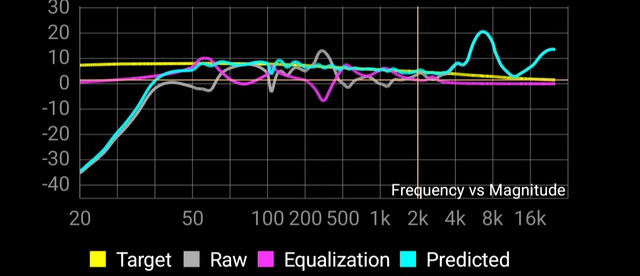
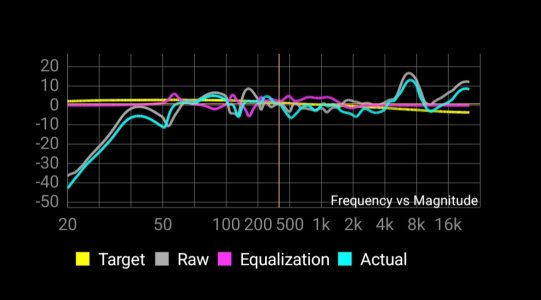
The entire room correction diagram – what does each color actually mean?! Let's start with the basics. Which direction (minus/plus) does it go in? When does it change a specific frequency range, and why is that bad or good?

Target – Raw – Equalization (I know what an equalizer is, but here?) – Actual (is that the tone Wimm changed?)

I took the measurement from a distance of 2 meters (approximately a little more than the center of the room).

Of course, I will also measure from other positions today. From 3.5 meters directly from the wall.
First, I need to understand the diagram myself.

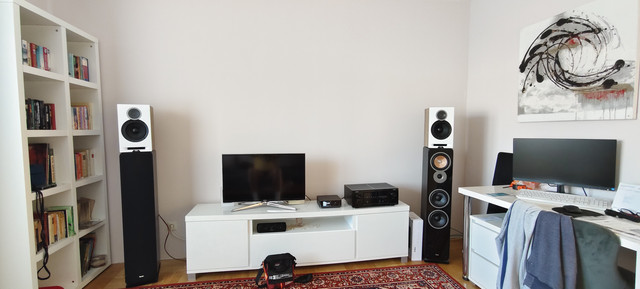
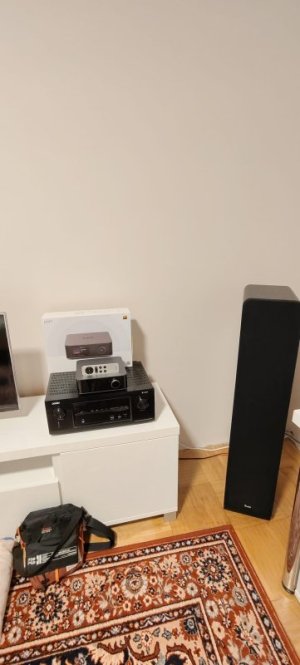
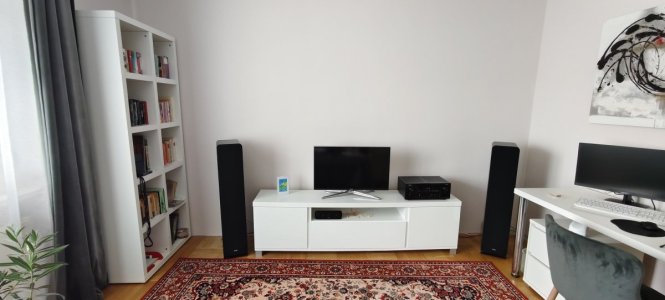
Wiim Amp Ultra with Teufel Ultima 40 in a 15m² room. I know the Teufel Ultima is too big for this room, so I ordered the Elac DBR62.
Erste messung mit Teufel Ultima 40.jpg
1e2c66fd-8ef0-46d0-9ffe-7e4fc131d414.jpg
IMG_20251210_113709.jpg
 
Wiim Amp Ultra with Teufel Ultima 40
The entire room correction diagram – what does each color actually mean?! Let's start with the basics. Which direction (minus/plus) does it go in? When does it change a specific frequency range, and why is that bad or good?

Target – Raw – Equalization (I know what an equalizer is, but here?) – Actual (is that the tone Wimm changed?)

I took the measurement from a distance of 2 meters (approximately a little more than the center of the room).

Of course, I will also measure from other positions today. From 3.5 meters directly from the wall.
First, I need to understand the diagram myself.

Wiim Amp Ultra with Teufel Ultima 40 in a 15m² room. I know the Teufel Ultima is too big for this room, so I ordered the Elac DBR62.
View attachment 30847
View attachment 30849
View attachment 30848
Target = desired response
Raw = measured response with no correction
Equalisation = correction applied by RoomFit
Actual = predicted response after RoomFit

Even though you think your speakers are too big and close to walls you still appear to have very little bass. Which microphone are you using?
 
Target = desired response
Raw = measured response with no correction
Equalisation = correction applied by RoomFit
Actual = predicted response after RoomFit

Even though you think your speakers are too big and close to walls you still appear to have very little bass. Which microphone are you using?
Agree, it looks like the Denon AVR has a crossover configured (to a subwoofer that isn't there) or some other kind of bass roll-off in place (Audyssey?) Could also be the microphone that did the measurement indeed.
 
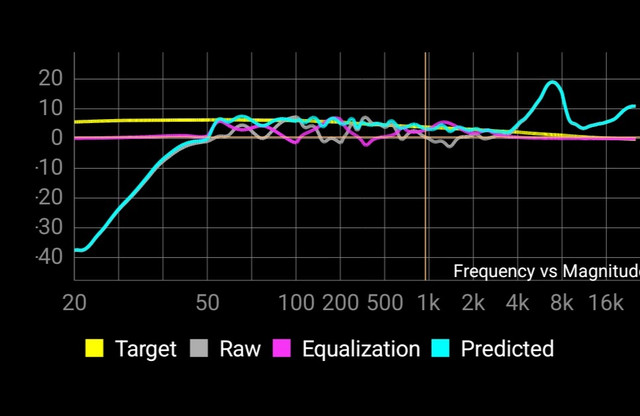
I am conducting the tests using a Vivo V40 mobile phone.I've now performed room correction cycles with Wiim and Elac DBR62 speakers from a distance of about 3 meters. The Elac speakers are on Teufel stands (not ideal, as they're positioned too high). I'll also conduct tests with lower stands, of course.

What does this tell me? With Room Fit, I perceive fuller mids and vocals, a wider soundstage, and broader dispersion, without even looking at the diagram (which I find very positive).

Here's another test with Teufel Ultima speakers. To my ears, the sound with the Teufel speakers isn't quite optimal. The soundstage isn't as wide, and the mids and highs aren't as good as with the Elac speakers.


With Elac Debut Reference DBR62


With Teufel 40 Ultima


Last edited:
I tested both speakers in a different room, not just a 14 m² room, but a 32 m² room. I tried both Teufel and Elac speakers.

I even used a different phone, a Samsung instead of a Vivo, and with both speakers and in both rooms, there was always a boost at 8 kHz, as you can see in the diagram!

How is that possible?
 
That's a whistling sound, I'd guess around 8 kHz, so in the very high frequency range. It doesn't bother me in music, at least not at all. How noticeable should it be?

But I probably haven't even displayed the correct, final correction yet? In the Wiim app, this 8 kHz boost is no longer visible in the saved, modified measurement results.

This diagram isn't needed for the presentation. When will this all be finished?


````````````` Devil Ultima


Elac Debut Reference DBR62

 
That's a whistling sound, I'd guess around 8 kHz, so in the very high frequency range. It doesn't bother me in music, at least not at all. How noticeable should it be?

But I probably haven't even displayed the correct, final correction yet? In the Wiim app, this 8 kHz boost is no longer visible in the saved, modified measurement results.

This diagram isn't needed for the presentation. When will this all be finished?


````````````` Devil Ultima


Elac Debut Reference DBR62

The 8kHz is not really there. Didn't you read the previous post? It is caused by the phone microphone as mentioned in numerous other posts in reply to your question.
 
I tested both speakers in a different room, not just a 14 m² room, but a 32 m² room. I tried both Teufel and Elac speakers.

I even used a different phone, a Samsung instead of a Vivo, and with both speakers and in both rooms, there was always a boost at 8 kHz, as you can see in the diagram!

How is that possible?
Get rid of any correction above 4k. As many times explained, often these corrections are not sensible…
 
How do I set that up? Which menu item is it for?
Have a look at this:


That's a whistling sound, I'd guess around 8 kHz, so in the very high frequency range. It doesn't bother me in music, at least not at all. How noticeable should it be?

But I probably haven't even displayed the correct, final correction yet? In the Wiim app, this 8 kHz boost is no longer visible in the saved, modified measurement results.

This diagram isn't needed for the presentation. When will this all be finished?


````````````` Devil Ultima


Elac Debut Reference DBR62

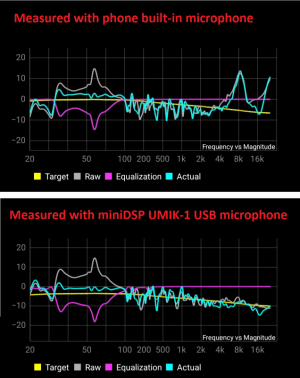
As other have explained, the 8kHz boost is not "real", it is produced by the built-in phone microphone. It is NOT caused by your speakers or your room.

This is common to many mobile phones, here's how the same speakers in the same room measure with my phone internal microphone compared to when I connect an external USB measurement microphone and measure the same thing:
1765619603099.png

This is one of the reasons why it is a good idea to get a calibrated measurement microphone like miniDSP UMIK-1 or Dayton iMM-6c.
 
Did you just measure that? Then it's the same for me.

But I have a question: How am I supposed to rely on Wiim's correction then? If it shows a boost at 8 kHz, like it does for me, shouldn't I apply the correction because it will ruin the entire sound? Do I have to listen to music without RoomFit?
 
Did you just measure that? Then it's the same for me.

But I have a question: How am I supposed to rely on Wiim's correction then? If it shows a boost at 8 kHz, like it does for me, shouldn't I apply the correction because it will ruin the entire sound? Do I have to listen to music without RoomFit?
Best solution is to use a decent USB microphone.
 
Did you just measure that?
Yes.

This 8kHz resonance is a known issue with built-in microphones in mobile phones.
Have a look at this post (link) for some deeper analysis and explanations of the implications.

But I have a question: How am I supposed to rely on Wiim's correction then?
The issue is not with WiiM's RoomFit, the issue is the built-in microphone in the phone you are using.

But the 8kHz resonance from your phone microphone is not really a big problem in practice, because you shouldn't apply any room correction at such high frequencies anyway.

Actually, you shouldn't allow RoomFit to correct above about 500Hz at all, because any room issues at such high frequencies can't effectively be fixed by room correction at all. You can have a look at this post (link) for a more detailed explanation of acoustical issues room correction like RoomFit can and can't fix.

The bigger problem with your phone microphone is that you can't know if its low-frequency response is reliable or not. Most phone built-in microphones have some bass roll-off, which means that they under-represent the actual bass response. This means that RoomFit may boost the bass a little to compensate.

Note that since bass quantity is a matter of personal preference, you may like this or you may not. And you can use PEQ on top of RoomFit to control the amount of bass anyway - so even this limitation is not that big of a problem in the end. You can use a single PEQ band as a bass control, as I wrote here:
EDIT: BTW, you can now use EQ to tune bass level to taste. A single band of low-shelf (LS) PEQ with frequency=150Hz, Q=0.7, and with gain to taste should do the trick.

RoomFit in any case fixes room resonances, and this is what is most important!

Still, as others have said, the most reliable solution is to get an external, calibrated USB measurement microphone like miniDSP UMIK-1 or Dayton iMM-6c. Here's a link to the related support page: Using an External Microphone for RoomFit™ Room Correction
 
Alright, everyone!

I just used my Denon AVR-X2400H with Audyssey to calibrate my Elac Debut Reference DBR62 and Teufel Ultima 40 speakers, and here are the results.

After the calibration, the Denon sounds significantly better with both speakers (Elac Debut Reference DBR62 and Teufel Ultima 40) than with Wiim and its useless RoomFit function!

Now I'm even considering returning my Wiim receiver, because the Wiim calibration is completely pointless! It simply doesn't improve the sound. Denon's measurement technology Audyssey is significantly better for me! So far! Who would have thought it?!

Here are the results.


... Teufel Ultima 40 with AVR-X2400H


Elac Debut Reference DBR62 with Denon AVR-2400H


Back
Top