
D
Deleted member 9022
Guest
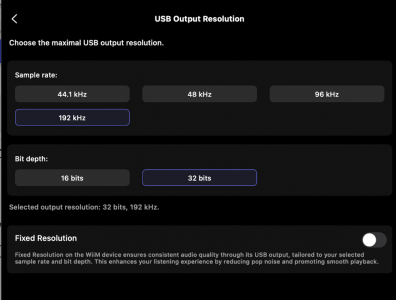
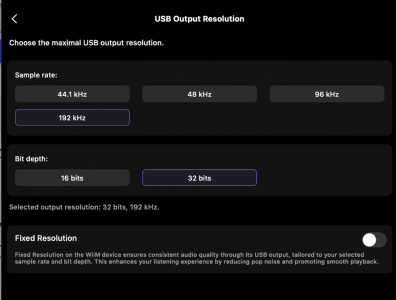
As part of your personal experience you mentioned that coaxial output wasn't even an option and you gave pseudo-technical explanations for why it couldn't be any different.
Expect others to express contradicting experience and plain facts.
Having said that, you absolutely should go with the option that sounds best to you in your environment, of course.
This is what I said, using USB has control to the receiver!No, that is not correct. The asynchronous package transfer on USB is unrelated to the audio clock in the PCM signal. The receiver must supply its own audio clock when using USB but this has nothing to do with the package transfer itself.
With USB it's always the receiver (DAC) that provides the clock and therefore defined how much jitter there is in the signal.
The SPDIF interface (Coax and Optical) includes the senders clock and this may be used by the receiver or the receiver can re-clock the signal and use its own clock. This depends on the DAC used. Typically a low cost DAC just uses the received clock, while a high-end DAC uses its own dedicated clock (that is hopefully better than the senders).
Most of this is however just theoretically, as all modern equipment has a internal clock that provides a jitter well below what is possible to hear.
What cable you use have no influence on the signal in any way, unless it is faulty or a very bad quality. I myself use a $2 optical cable with no issues at all (the external equipment do re-clocking, so any jitter due to optical smear can be ignored).
Last edited by a moderator: