

dominikz
Senior Contributor
- Joined
- Dec 31, 2024
- Messages
- 1,034
This will be another of my huge posts - sorry about that in advance! 
NOTE: I've received the WiiM Sound (WS) and Sound Lite (WSL) free of charge from WiiM for testing purposes. The opinions shared are my own, however, and have not been moderated by WiiM in any way.
WiiM Sound - how does it sound?
This is the first speaker I received. When I got it, initially I just streamed some music without much analysis.
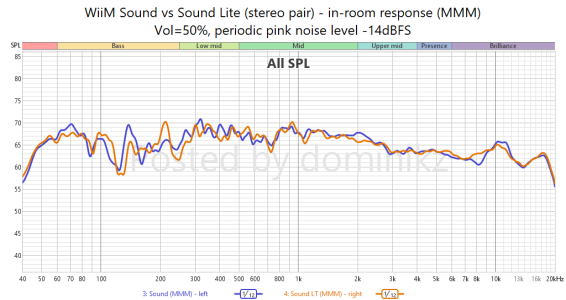
While I was pleasantly surprised by the bass extension of such a small speaker, I immediately noticed something was wrong with the overall tonality. Main issue for me is the brightness of the stock tuning, but midrange tonality also seemed a bit off to me as well. It didn't seem like something a simple treble control (high-shelf filter) could solve. There can also be some boominess in the bass, but that can be easily fixed with RoomFit.
To check my perception I did a few rounds of direct, level-matched comparisons with my Revel M16 speakers and with that confirmed the brightness and uneven tonality issue is definitely there. Creating a treble tone control with PEQ (link to instruction) can help to an extent, but not entirely because the issue is not linear (as we will see later).
I also added the WiiM Sound as a center channel with multichannel Dolby Digital content, with LR being assigned to Revel M16 and Sub to the SVS SB-1000 Classic (all driven from the WiiM Amp Ultra). For the Surround channels I temporarily assigned my Mini (so that I can set the Sound as Center), but then removed the Mini from the group. This gave me a 3.1 setup.
In this configuration the tonality difference between the Sound and my M16s was quite obvious, with the WiiM Sound being much brighter - and IMHO distractingly so. The fact that EQ doesn't work in this mode of operation makes this even more of a problem, IMO.
Another issue, but not specific to WiiM Sound, is that there's no automatic calibration of sound level and delay between channels in multichannel mode. I.e. you need to manually adjust the relative levels of WiiM devices until you are happy with the overall balance at your listening position. I'd personally much prefer a method that aligns the relative levels and delay in multichannel mode using the microphone connected to the phone (i.e. similar to RoomFit), while allowing manual fine-tuning. Perhaps something like this will come in the future (the announced "SurroundFit", perhaps?)
Lastly, the bass response from the speaker can very easily get distorted. This may not be as easily audible with music, but is very easily audible with pure tones. This is expected given the small woofer size, however - WiiM can't defy physics (at least not yet ).
).
In summary, WiiM Sound is OK sounding (especially for background music listening), but honestly I expected much better from WiiM given how great their streamers and streaming amps are.
WiiM Sound Lite - how does it sound (lite)?
Out-of-the-box tonality seems the same as the original WS to me - I perceive it as too bright, with a midrange scoop. Basically you can assume everything from the previous section is valid here as well.
However, now having two WiiM smart speakers I could test a few additional use-cases.
Now isn't that an interesting question?
As we can see from the marketing pictures, the two tweeters are pointing approx. 45° to the sides:
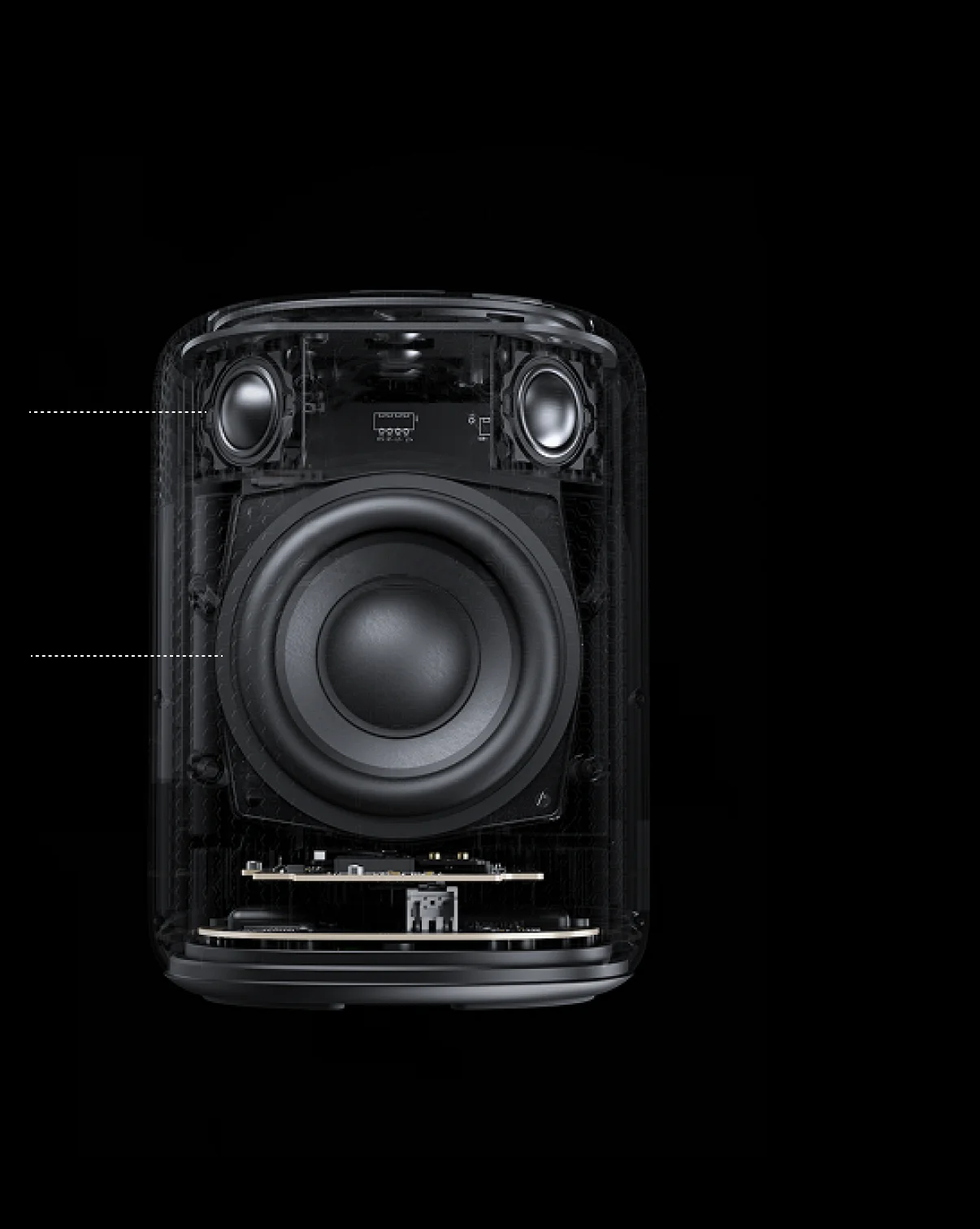
The intention was I guess to:
Methodology and equipment
The measurements were made through the WS/WSL Aux In input (EQ, RoomFit and Dynamic Bass were all disabled).
Measurement equipment:
This means that after temporal gating resolution and accuracy above 1kHz is high, but drops to about 1/3 octave at ~550Hz and lower below that.
The response was also measured at 1m distance, and produced the same result - which means that the drivers integrate well at 50cm and that responses at this distance are representative of device performance.
Low-frequency anechoic response was measured with three separate methods:
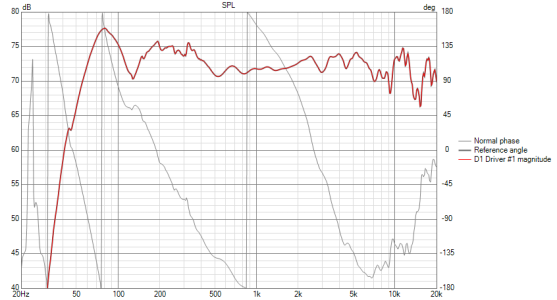
WiiM Sound (WS) - on-axis response (left and right tweeters play the same signal):
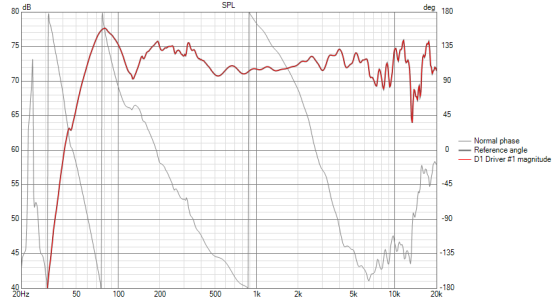
WiiM Sound (WS) - on-axis response (only the left tweeter plays, right tweeter is silent):
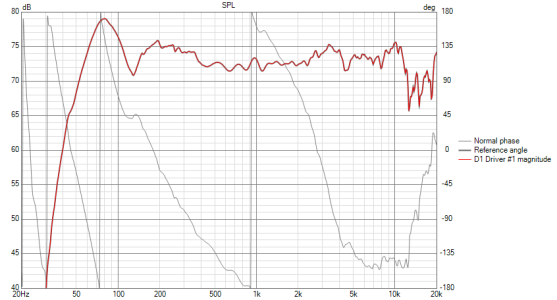
WiiM Sound Lite (WSL) - on-axis response (left and right tweeters play the same signal):
WiiM Sound Lite (WSL) - on-axis response (only the left tweeter plays, right tweeter is silent):
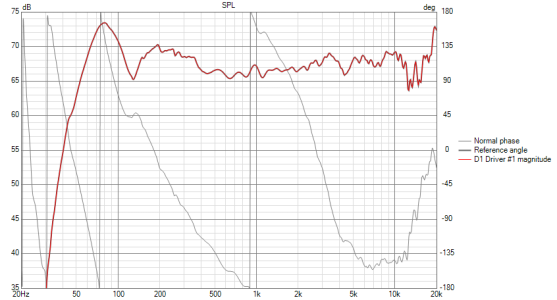
We can see that both WS and WSL give a very similar response, which is unsurprising given the identical architecture.
There is a peak in bass response around 70Hz, followed by a dip around 130Hz. The response above that is kept within +/- 2dB until about 12kHz, which seems pretty OK at first glance. Above 12kHz the response is chewed-up, likely due to some kind of acoustical interference caused by the physical design of the device.
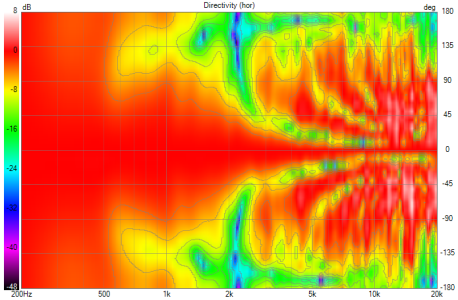
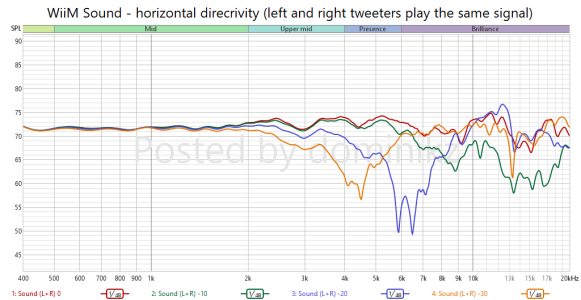
But the really interesting part is the horizontal dispersion/directivity - here only shown for the WS, but the same applies to WSL.
WiiM Sound (WS) - horizontal directivity (left and right tweeters play the same signal):
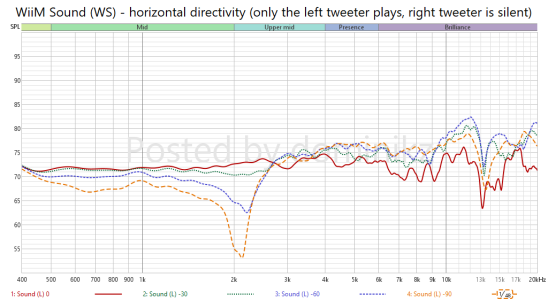
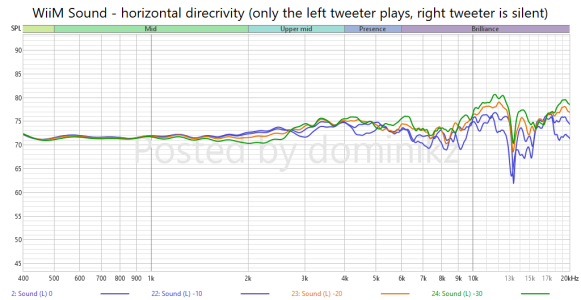
WiiM Sound (WS) - horizontal directivity (only the left tweeter plays, right tweeter is silent):
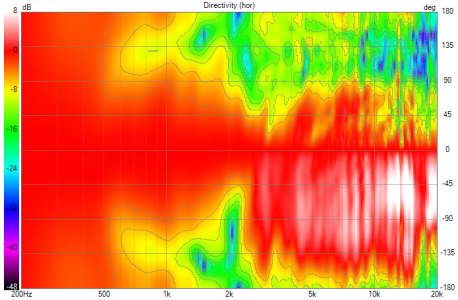
While directivity is indeed pretty wide with both tweeters playing, it is riddled with cancellations when we move off-axis - unfortunately a natural product of this kind of acoustic design.
Here's how that looks if we compare responses between 0°-30°:
With only one tweeter playing, there is no cancellation, but there is directivity discontinuity around the crossover, at least in part due to physical misalignment of the tweeter and woofer. However the responses from 0°-30° are much better aligned to each other, because now there's no interference with the other tweeter:
So where does the brightness come from?
By now I hope we could see that the brightness issue is caused by the dual-tweeter design, and the resulting directivity mismatch between the single woofer and the tweeters. Basically to get a flat on-axis response (which is actually 45° off-axis to either woofer), both tweeter level need to be pretty high, which generates a lot of off-axis high frequency energy. Combine that with the cancellations caused by dual-tweeters, and I'd say that explains a lot of the issues I'm hearing.
Conclusion
As I mentioned at the beginning, these are not bad speakers - it is just that I expected more. If you pair them and apply some EQ, they can sound pretty good. I wouldn't replace my main speakers with them, however!
That's it for now! Hope some will find it useful!
NOTE: I've received the WiiM Sound (WS) and Sound Lite (WSL) free of charge from WiiM for testing purposes. The opinions shared are my own, however, and have not been moderated by WiiM in any way.
WiiM Sound - how does it sound?
This is the first speaker I received. When I got it, initially I just streamed some music without much analysis.
While I was pleasantly surprised by the bass extension of such a small speaker, I immediately noticed something was wrong with the overall tonality. Main issue for me is the brightness of the stock tuning, but midrange tonality also seemed a bit off to me as well. It didn't seem like something a simple treble control (high-shelf filter) could solve. There can also be some boominess in the bass, but that can be easily fixed with RoomFit.
To check my perception I did a few rounds of direct, level-matched comparisons with my Revel M16 speakers and with that confirmed the brightness and uneven tonality issue is definitely there. Creating a treble tone control with PEQ (link to instruction) can help to an extent, but not entirely because the issue is not linear (as we will see later).
I also added the WiiM Sound as a center channel with multichannel Dolby Digital content, with LR being assigned to Revel M16 and Sub to the SVS SB-1000 Classic (all driven from the WiiM Amp Ultra). For the Surround channels I temporarily assigned my Mini (so that I can set the Sound as Center), but then removed the Mini from the group. This gave me a 3.1 setup.
In this configuration the tonality difference between the Sound and my M16s was quite obvious, with the WiiM Sound being much brighter - and IMHO distractingly so. The fact that EQ doesn't work in this mode of operation makes this even more of a problem, IMO.
Another issue, but not specific to WiiM Sound, is that there's no automatic calibration of sound level and delay between channels in multichannel mode. I.e. you need to manually adjust the relative levels of WiiM devices until you are happy with the overall balance at your listening position. I'd personally much prefer a method that aligns the relative levels and delay in multichannel mode using the microphone connected to the phone (i.e. similar to RoomFit), while allowing manual fine-tuning. Perhaps something like this will come in the future (the announced "SurroundFit", perhaps?)
Lastly, the bass response from the speaker can very easily get distorted. This may not be as easily audible with music, but is very easily audible with pure tones. This is expected given the small woofer size, however - WiiM can't defy physics (at least not yet
).In summary, WiiM Sound is OK sounding (especially for background music listening), but honestly I expected much better from WiiM given how great their streamers and streaming amps are.
WiiM Sound Lite - how does it sound (lite)?
Out-of-the-box tonality seems the same as the original WS to me - I perceive it as too bright, with a midrange scoop. Basically you can assume everything from the previous section is valid here as well.
However, now having two WiiM smart speakers I could test a few additional use-cases.
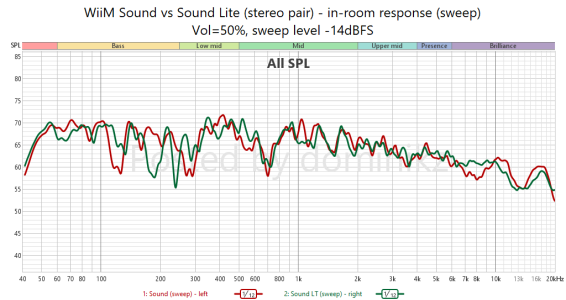
- Pairing the WS with WSL in a stereo pair helps hide some of their tonality sins. The added width and depth of stereo takes the focus away from tonality issues, which definitely improves the experience.
- Still, adding PEQ on top to tame the excessive treble can improve it a bit.
- However it is not without issues: in direct level-matched comparison (even with corrective EQ configured) the WS(L) pair is still brighter and not as smooth in the midrange as my Revel M16 pair.
- Stereo soundstage seemed a bit undefined/unstable to me - it has an almost "phasey" sound to it (like some kind of phase cancellation thing is happening). This is very apparent when comparing side-by-side with my Revel speakers.
- Grouping and channel allocation seems to persist after standby, which is nice.
- There seems to be an issue with the follower device not following volume of the main speaker every time, especially if using presets to adjust volume. I've opened a support ticket on this.
- I've also tried the WS+WSL as surround L/R in a Dolby 5.1 configuration with the WAU driving a pair or Revel M16 as front L/R and a SVS SB-1000 Classic subwoofer. This worked fine and was actually quite fun to try.
- But the current limitation where RoomFit/EQ are both inoperable with 5.1 content is a serious issue. Without bass correction (RoomFit) it easily gets too boomy, and without EQ the surrounds don't match the fronts on tonality. Until this functionality is added (SurroundFit?) I don't believe I'll actually use 5.1 much.
- Lastly, I tried "double stereo" playback by grouping WS [as L], WSL [as R] and WAU [as LR] in the same room, but opposite sides. This was far from being accurate (there's no sound stage to speak of), but it was fun to try.

Now isn't that an interesting question?
As we can see from the marketing pictures, the two tweeters are pointing approx. 45° to the sides:
The intention was I guess to:
- Make the sound dispersion wider
- Allow for 'true' stereo playback with a single speaker, i.e.:
- Above the crossover frequency (2.4kHz):
- The left tweeter plays the left channel only
- The right tweeter plays the right channel only
- Below the crossover frequency (2.4kHz):
- The single woofer plays a sum of both left and right channels
- Above the crossover frequency (2.4kHz):
- Two tweeters mounted on the same speaker will cause a complex pattern of acoustic interference in the dispersion. We'll see that in the following sections. My assumption is that this is what causes the "phasey" sound when pairing two speakers in a stereo group.
- We can't really perceive a stereo soundstage if both tweeters are so close together - unless perhaps if our room dimensions are really lucky, and speaker is placed optimally to reflect the sound from each tweeter's adjoining side-wall exactly to the listening position.
- If we play a file where left and right channels contain a different signal, each tweeter will play the respective channel signal.
- This is what happens with regular stereo audio content on a single speaker, or when WS or WSL are configured with "LR" when added to a multi-device group:

- This is what happens with regular stereo audio content on a single speaker, or when WS or WSL are configured with "LR" when added to a multi-device group:
- If we play a file where left and right channels contain the same signal, both tweeters will play the same signal.
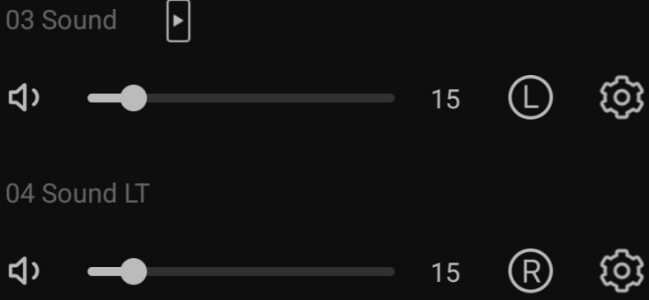
- This is what happens with mono audio content on a single speaker, or when WS/WSL are configured to each play a single channel when added to a multi-device group (e.g. "L", "R", "C", "SL" or "SR"):
- This is what happens with mono audio content on a single speaker, or when WS/WSL are configured to each play a single channel when added to a multi-device group (e.g. "L", "R", "C", "SL" or "SR"):
- If we play a file where only the left channel contains a signal, while the right one is empty then only the left tweeter will play, while the right tweeter will remain silent.
- This can currently only be achieved with test or manipulated audio files, by leaving one channel empty.
Methodology and equipment
The measurements were made through the WS/WSL Aux In input (EQ, RoomFit and Dynamic Bass were all disabled).
Measurement equipment:
- Cross-Spectrum Labs calibrated Dayton Audio EMM-6 measurement microphone
- RME BabyFace Silver Edition audio interface
- miniDSP UMIK-1 calibrated measurement microphone
- DIY loudspeaker measurement turntable stand
- Room EQ Wizard (REW) and VituixCAD software
This means that after temporal gating resolution and accuracy above 1kHz is high, but drops to about 1/3 octave at ~550Hz and lower below that.
The response was also measured at 1m distance, and produced the same result - which means that the drivers integrate well at 50cm and that responses at this distance are representative of device performance.
Low-frequency anechoic response was measured with three separate methods:
- Single microphone nearfield woofer measurement - done for both WS and WSL
- Two microphone mode-compensation method (explained here) - done for WS only
- (Almost) free-field response measurement - done for WSL only
WiiM Sound (WS) - on-axis response (left and right tweeters play the same signal):
WiiM Sound (WS) - on-axis response (only the left tweeter plays, right tweeter is silent):
WiiM Sound Lite (WSL) - on-axis response (left and right tweeters play the same signal):
WiiM Sound Lite (WSL) - on-axis response (only the left tweeter plays, right tweeter is silent):
We can see that both WS and WSL give a very similar response, which is unsurprising given the identical architecture.
There is a peak in bass response around 70Hz, followed by a dip around 130Hz. The response above that is kept within +/- 2dB until about 12kHz, which seems pretty OK at first glance. Above 12kHz the response is chewed-up, likely due to some kind of acoustical interference caused by the physical design of the device.
But the really interesting part is the horizontal dispersion/directivity - here only shown for the WS, but the same applies to WSL.
WiiM Sound (WS) - horizontal directivity (left and right tweeters play the same signal):
WiiM Sound (WS) - horizontal directivity (only the left tweeter plays, right tweeter is silent):
While directivity is indeed pretty wide with both tweeters playing, it is riddled with cancellations when we move off-axis - unfortunately a natural product of this kind of acoustic design.
Here's how that looks if we compare responses between 0°-30°:
With only one tweeter playing, there is no cancellation, but there is directivity discontinuity around the crossover, at least in part due to physical misalignment of the tweeter and woofer. However the responses from 0°-30° are much better aligned to each other, because now there's no interference with the other tweeter:
So where does the brightness come from?
By now I hope we could see that the brightness issue is caused by the dual-tweeter design, and the resulting directivity mismatch between the single woofer and the tweeters. Basically to get a flat on-axis response (which is actually 45° off-axis to either woofer), both tweeter level need to be pretty high, which generates a lot of off-axis high frequency energy. Combine that with the cancellations caused by dual-tweeters, and I'd say that explains a lot of the issues I'm hearing.
Conclusion
As I mentioned at the beginning, these are not bad speakers - it is just that I expected more. If you pair them and apply some EQ, they can sound pretty good. I wouldn't replace my main speakers with them, however!
That's it for now! Hope some will find it useful!
Last edited: