Wiim Ultra with SVS Micro 3000

The resonance at 40Hz is caused by the room and/or the placement, yes - this is not really an issue.
But there could also be a cancellation around the crossover, so the latest proposed steps are to see if there's any chance to get a better baseline for RoomFit with the sub level set at -20dB.

If neither option proposed in post #77 results in improvement, then the response you got post-RoomFit in post #47 is what I'd suggest to keep (i.e. the one with sub level set to -10dB).
There shouldn't be a cancellation at the crossover frequency sine the sub/speaker sync was run with the device in the listening position but that dip is quite large. It might be worth running an evaluation with the sub turned off to see what the speaker response is at the dip frequency.
 
There shouldn't be a cancellation at the crossover frequency sine the sub/speaker sync was run with the device in the listening position but that dip is quite large. It might be worth running an evaluation with the sub turned off to see what the speaker response is at the dip frequency.
It's still possible that the combination of phase and latency is not ideal.

As I said before, it's not so much about cancellation, but less then ideal summation. If sub and mains were really canceling out each other the increasing the sub level would probably not yield better results at a higher sub level.
 
It's still possible that the combination of phase and latency is not ideal.

As I said before, it's not so much about cancellation, but less then ideal summation. If sub and mains were really canceling out each other the increasing the sub level would probably not yield better results at a higher sub level.
Agreed, this is my suspicion as well.
 
It's still possible that the combination of phase and latency is not ideal.

As I said before, it's not so much about cancellation, but less then ideal summation. If sub and mains were really canceling out each other the increasing the sub level would probably not yield better results at a higher sub level.
It also seems odd that the 0/180 phase switch didn't make an audible difference. It should definitely make a visible difference to the measured response.
 
It also seems odd that the 0/180 phase switch didn't make an audible difference. It should definitely make a visible difference to the measured response.
Yeah. At least when listening with no room correction that 40 Hz resonance might fully mask any difference around 80 Hz.

@Lagavulin, don't get us wrong, your final results were really pretty fine and using EQ (not room correction) for the final touch of personal taste is a good idea, anyway. It's just a matter of if your system could sound even better with some more effort prior to running RoomFit.
 
No I really do appreciate your help and advice guys. You all know it's quite a steep learning curve for a subwoofer newbie. A combination of the WiiM tutorials and your guidance has I think moved me on quite a bit ... no I know I'm not there yet but I will persevere 👍

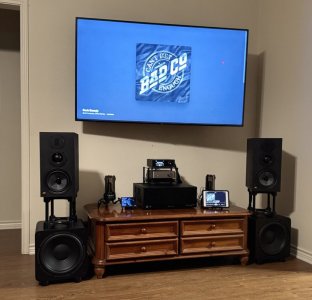
The room is 16x16ft but really the HiFi is in only about half of that space ... a bed and furniture are unfortunately taking up the other half inconveniently 😂

Before I had to go out I was listening to various tracks on the Ultra with RoomFit correction set at -10dB and the SVS volume set at -10dB .... I quite enjoyed the rendering. The bass wasn't overpowering but it was present and it wasn't thud thud thud as I described last evening ... it was well defined in that it had observable layers.
On a couple of tracks I could feel the pressuring of the room ... not in painful to the ears way ... but noticeable all the same.
No evidence to say this, but after a couple of days playing music through the SVS it sounds like the drivers maybe have loosened up a little?
I don't know whether a new subwoofer of any make goes through such a "burn in" period? I guess all new Drivers do to some degree ... it just seemed to me that the bass notes emanating from the subwoofer today sounded less raw and more relaxed (or is that natural).
Thanks 👍
 
just wanted to say thanks to the OP for posting his question and to harkpabst and dominikz for sharing their knowledge and experience, I am new to the WiiMisphere and learned a lot from reading these post to help me set up my dual SB1000Pro's, HiVi Swan 3.1a's with an Ultra + Vibelink
 
just wanted to say thanks to the OP for posting his question and to harkpabst and dominikz for sharing their knowledge and experience, I am new to the WiiMisphere and learned a lot from reading these post to help me set up my dual SB1000Pro's, HiVi Swan 3.1a's with an Ultra + Vibelink
Just a few quick questions ... what made you decide to go with twin subwoofers? Did you start with one and then add a second later or did you go straight to using two? How are they connected to the Ultra? A "y" splitter RCA cable? I think that the Ultra configures both in mono not in stereo ... is that right I'm probably wrong. Interested because I had thought of buying two Micro's but decided I needed to walk before I tried to run 👍
 
I had the first SB1000Pro when I built the Swan 3.1A speakers and had them powered by an old Pioneer AVR which didnt have enough power to work the Swans effectively so I started my quest for a new pre-amp/amp when I decided to get the Ultra + Vibelink the last Amazon Deal Days sale, the results were spectacular so in my quest to optimize what I had started to research multiple subs and decided to pick up a second SB1000Pro which is when I stumbled upon this informal yet advanced room-fit guide, I picked up a Dayton Audio iMM-6C microphone and started tuning and the results are quite amazing, thanks again

Larry
dual.jpg
 
I had the first SB1000Pro when I built the Swan 3.1A speakers and had them powered by an old Pioneer AVR which didnt have enough power to work the Swans effectively so I started my quest for a new pre-amp/amp when I decided to get the Ultra + Vibelink the last Amazon Deal Days sale, the results were spectacular so in my quest to optimize what I had started to research multiple subs and decided to pick up a second SB1000Pro which is when I stumbled upon this informal yet advanced room-fit guide, I picked up a Dayton Audio iMM-6C microphone and started tuning and the results are quite amazing, thanks again

Larry
View attachment 29456
Nice!
Having multiple subs gives you a chance to get similar bass quality accross multiple listening locations, especially if you run optimizations with MSO (Multi Sub Optimizer) software.

This link might be useful, as it gives a few practical examples showing the impact of a few different ways to setup multiple subs.

This presentation provides a deeper explanation of the research into use of multiple subs to control bass over a wider area.
 
https://www.acoustic.ua/recommendations/800

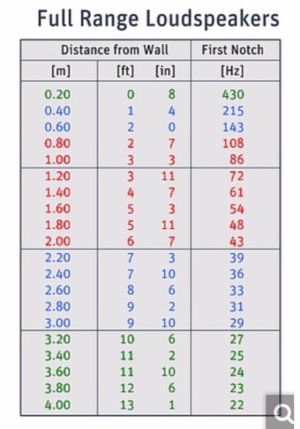
If I use a woofer setup with my "small" main speakers, I basically have a full-range speaker system, as illustrated in a table. I found this for a Long time via Neumann, in the Context of the link I posted, and it would change the speaker performance quite a bit. The downside is that the specifications resulting from the link are almost always just habits that you cultivate. They are a very good guideline, even for initial reflections.

A fact

By arranging several subwoofers in the form of a bass array, the resulting cylindrical bass radiation can eliminate the formation of transverse modes in the room.

An important and correct component, the use of subwoofers

When I look at the right side of the setup, it behaves significantly differently than the left side of the setup.

How can I compensate for this using a DSP without significantly changing the character of the main speakers?
 

Attachments

  • IMG_5368.jpeg
    IMG_5368.jpeg
    88.5 KB · Views: 5
Last edited:
If I use a woofer setup with my "small" main speakers, I basically have a full-range speaker system, as illustrated in a table. I found this for a Long time via Neumann, in the Context of the link I posted, and it would change the speaker performance quite a bit.
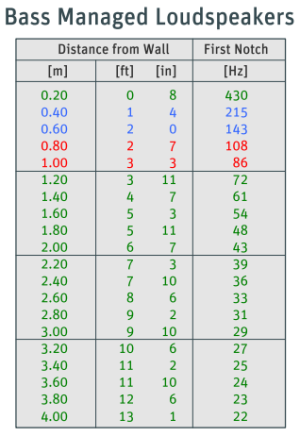
Actually, Neumann provides different recommendations for bass-managed loudspeaker (i.e. loudspeaker + sub) compared to recommedations for fullrange loudspeakers (which is the one you posted).

Here's how bass-managed placement recommendations by Neumann look (link to source, search for "Loudspeaker-Boundary Location" file):
1763289795441.png

When using subwoofers (and bass management) you should refer to this table when placing speakers, not the other one. Note that ~80Hz crossover is assumed here, and subwoofer(s) should always remain close to walls.

The placement recommendations for fullrange speakers vs loudspeakers+subs are different because in a bass-managed system you can place subwoofers at different places compared to loudspeakers, allowing you to use the crossover to avoid SBIR dips in cases where it simply wouldn't be possible with integrated fullrange loudspeakers.

I.e., using subs gives you significantly more flexibility in placement.

By the way, Genelec provides equivalent recommendations (see this article, section "Placement of the Monitors and the Subwoofer"). This is expected, since both Genelec and Neumann placement recommendations are based around SBIR null/notch/dip avoidance.

In this post I tried to provide a bit more detailed explanations.

Hope some of it will be helpful!
 
Last edited:
The first consideration is the room: what is its acoustic behaviour and which main speakers should be used for matching?

Neumann is designed for professional use, and the woofers are usually not located on the axis of the main loudspeaker, which is why the woofer table and the setup shown above are close to the wall on a more or less vertical axis.

If the RT60 is reduced from 200 Hz to 100 Hz to just 300 ms, the effect is astonishing. If you manage to stay in the range of 400 ms from 100 Hz to 50 Hz, the bass/upper bass performance is completely different.


I know that there is a table for woofers.
However, the distance calculations for LS systems in the link I provided are slightly different.
The aim here is to avoid TT room mode excitation AND define initial reflections in the room.

I have implemented the distances "calculated" in the link, as well as those propagated by Neumann, with various woofer & radiation principles, including the DSP 750 woofer from Neumann.

I currently have a Wiim ticket because I want to know whether multiple Wiim Subs can be controlled or connected from a single source. Vertical array
 
Last edited:
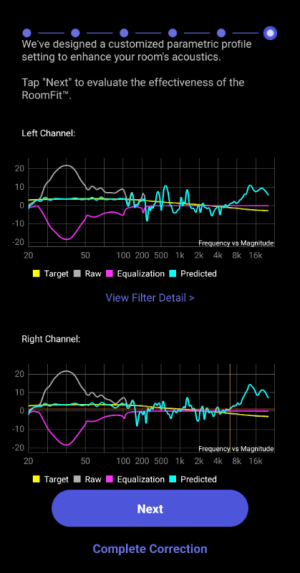
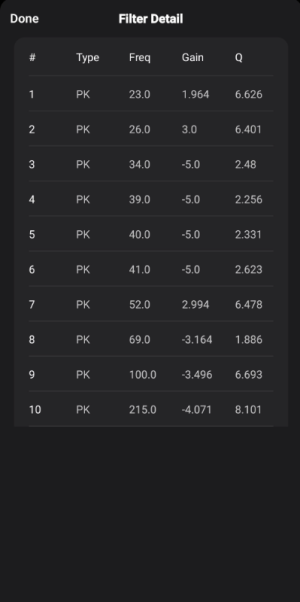
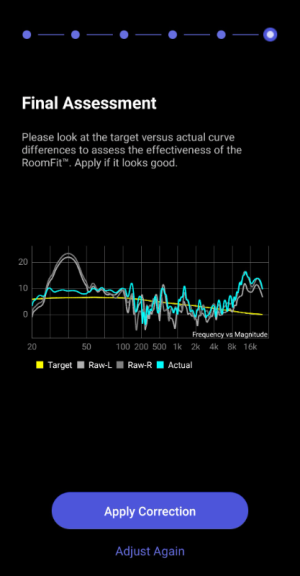
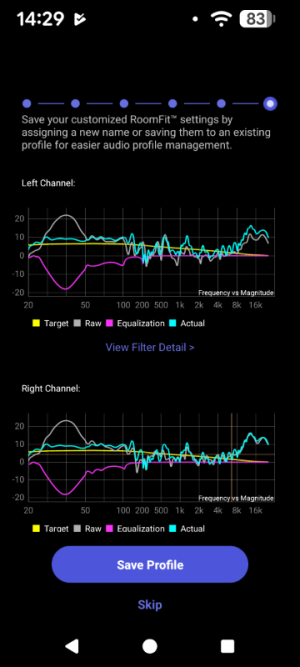
So .... I reran RoomFit but within a narrower min/max range of -5/+5dB gain. Results were very similar to before with a hump at 40Hz and all the PEQ bands being used to smooth out the response. Unfortunately I don't think I will be able to get rid of this as it is because of the room setup.
I could try moving the subwoofer to a different position but who knows what would happen ... it's currently sat behind the right hand main close to outerwall boundary's as SVS tend to recommend.
Do you think that the addition of a second SVS Micro 3000 placed behind the left hand main might go some way to reducing the room effect and allow the RoomFit PEQ bands to work over the full 20-300Hz range?
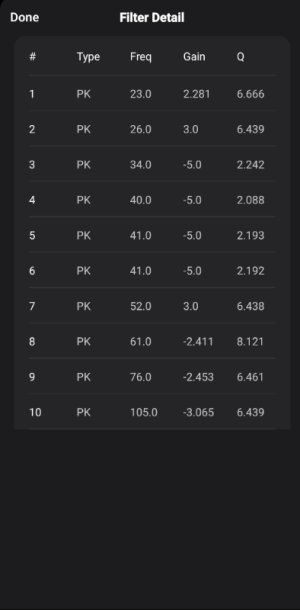
Screenshot_20251117-142322~2.pngScreenshot_20251117-142749~2.pngScreenshot_20251117-142809~2.pngScreenshot_20251117-142853~2.pngScreenshot_20251117-142921.png
 
So .... I reran RoomFit but within a narrower min/max range of -5/+5dB gain. Results were very similar to before with a hump at 40Hz and all the PEQ bands being used to smooth out the response.
If anything, you should rather increase the min/max range per PEQ Band to the lowest/highest possible value of -12 dB/+12 dB, not decrease it (as I said before).:)

The idea behind this is that less PEQ filters need to be combined to get a 20 dB reduction.

Also, let me try to rephrase my other recommendation one more time: Before we can agree on which is the best subwoofer level setting you have to make sure that the main speakers' and the subwoofer's output add up as much as possible right at the crossover frequency.

The phase difference between the speakers and sub need to be minimised. In other words: The peaks of the sound waves from mains and sub should reach your ear at exactly the same time (in particular at the crossover frequency). There shouldn't be any acoustic delay to either signal.

The ways to control that delay are:
  • The phase switch in the subwoofer settings. This will invert the polarity of the subwoofer output signal.
  • The latency setting between mains and sub. The WiiM device can attempt to measure it automatically (with the downside of the mic residing in the actual device) or you can just try to adjust it manually and compare the results by measuring.
Your results are already very good. If you like what you hear you can really stop right at this point. If you still want.to dig deeper into it the first step ist to optimise timing between main and subs. Only then you can determine the best level for the subwoofer prior to running RoomFit.

 
Last edited:
So .... I reran RoomFit but within a narrower min/max range of -5/+5dB gain. Results were very similar to before with a hump at 40Hz and all the PEQ bands being used to smooth out the response. Unfortunately I don't think I will be able to get rid of this as it is because of the room setup.
Changing the min/max gain to ±5dB can't solve the issue, so these results are expected. Actually, using ±5dB makes it worse, because more of the PEQ bands need to be assigned to the 40Hz resonance to bring it down. So I'd suggest to keep RoomFit min/max gain at ±12dB.

Have you tried the two options I proposed in post #77?
  1. In SVS app: Keep subwoofer phase/polarity at 0° and level at -20dB
    In Wiim Home App: Set subwoofer phase to , use automatic speaker and sub sync, and lastly re-run RoomFit. Take screenshots.

  2. In SVS app: Still keep subwoofer phase/polarity at 0° and level at -20dB
    In Wiim Home App: Change subwoofer phase to 180°, again re-run automatic speaker and sub sync, and lastly re-run RoomFit. Take screenshots again.

I could try moving the subwoofer to a different position but who knows what would happen ... it's currently sat behind the right hand main close to outerwall boundary's as SVS tend to recommend.
I wouldn't change the position of the sub for now.
Do you think that the addition of a second SVS Micro 3000 placed behind the left hand main might go some way to reducing the room effect and allow the RoomFit PEQ bands to work over the full 20-300Hz range?
Let me clarify that I don't believe there's that much need for correction above 100Hz in your system anyway.
Actually, after correction your response looks very good already.
The intention is just to see if you can improve subwoofer integration any further.
IMHO there's no need to consider a second sub, at least not because of this.
 
If anything, you should rather increase the min/max range per PEQ Band to the lowest/highest possible value of -12 dB/+12 dB, not decrease it (as I said before).:)

The idea behind this is that less PEQ filters need to be combined to get a 20 dB reduction.

Also, let me try to rephrase my other recommendation one more time: Before we can agree on which is the best subwoofer level setting you have to make sure that the main speakers' and the subwoofer's output add up as much as possible right at the crossover frequency.

The phase difference between the speakers and sub need to be minimised. In other words: The peaks of the sound waves from mains and sub should reach your ear at exactly the same time (in particular at the crossover frequency). There shouldn't be any acoustic delay to either signal.

The ways to control that delay are:
  • The phase switch in the subwoofer settings. This will invert the polarity of the subwoofer output signal.
  • The latency setting between mains and sub. The WiiM device can attempt to measure it automatically (with the downside of the mic residing in the actual device) or you can just try to adjust it manually and compare the results by measuring.

Your results are already very good. If you like what you hear you can really stop right at this point. If you still want.to dig deeper into it the first step ist to optimise timing between main and subs. Only then you can determine the best level for the subwoofer prior to running RoomFit.
Ok ... I misunderstood.
My original results were based on min/max -12/+12dB.
The 7ms difference between main and sub was measured by the Ultra positioned in my listening position. That's with the sub physically 2ft or 60cms behind the mains. I can't really move the subwoofer into the same plain as the mains ... there will always be a delay that is measured and corrected by the Ultra.
Overall the sound is pleasing especially when I add a touch of EQ to it ... maybe I will stop here but then again I have time on my side to trial other things and who knows I may return to where I am right now. The good thing is that the Ultra allows me to store each attempt with a different name that I can compare and contrast ... an incredible bit of kit for little money.
Thanks for the clarification.
 
Ok ... I misunderstood.
My original results were based on min/max -12/+12dB.
The 7ms difference between main and sub was measured by the Ultra positioned in my listening position. That's with the sub physically 2ft or 60cms behind the mains. I can't really move the subwoofer into the same plain as the mains ... there will always be a delay that is measured and corrected by the Ultra.
Overall the sound is pleasing especially when I add a touch of EQ to it ... maybe I will stop here but then again I have time on my side to trial other things and who knows I may return to where I am right now. The good thing is that the Ultra allows me to store each attempt with a different name that I can compare and contrast ... an incredible bit of kit for little money.
Thanks for the clarification.
I wouldn't have much faith in the delay calculated by the Ultra unless the Ultra is at your listening position. Much better to observe the response around the crossover with REW while adjusting the delay manually.
 
Changing the min/max gain to ±5dB can't solve the issue, so these results are expected. Actually, using ±5dB makes it worse, because more of the PEQ bands need to be assigned to the 40Hz resonance to bring it down. So I'd suggest to keep RoomFit min/max gain at ±12dB.

Have you tried the two options I proposed in post #77?


I wouldn't change the position of the sub for now.

Let me clarify that I don't believe there's that much need for correction above 100Hz in your system anyway.
Actually, after correction your response looks very good already.
The intention is just to see if you can improve subwoofer integration any further.
IMHO there's no need to consider a second sub, at least not because of this.
Okay ..
Your option 1 ... that is exactly how I ran my first attempts with the SVS sub
Your option 2 ... I do believe I tried this but couldn't hear any difference (maybe my hearing). It might have measured differently but I can remember
All attempts since have always been with the SVS and ultra set at 0 phase.
Just to be sure when I get a chance I will rerun option 2, collect screenshots and post here 👍
That hump at 40Hz is bothering me but seemingly not anyone else? I believe it's a room and sub positioning issue and that maybe a second sub placed mid room would smooth out the room effects.
 
I wouldn't have much faith in the delay calculated by the Ultra unless the Ultra is at your listening position. Much better to observe the response around the crossover with REW while adjusting the delay manually.
The Ultra as I've previously mentioned was moved to my listening position to measure the delay. I really don't want to get into external mics and REW ... for me that's a step too far but thanks for your suggestions.
 
Back
Top